The biggest change for Azerbaijan’s tourism businesses is not the overall 6% fall in arrivals but the sharp contraction in one source market. Arrivals from Gulf countries declined 32% to 218,300 in January–September. Those from the EU rose 6.1%, but totalled just 94,200. Percentages alone conceal the very different starting points.
The State Statistical Committee’s release for January–September 2026 reports 1.8318 million arrivals by foreigners and stateless persons. We use “arrivals” deliberately: border entries are not the same as unique tourists, leisure trips or paid hotel stays.
The missing volume is substantial
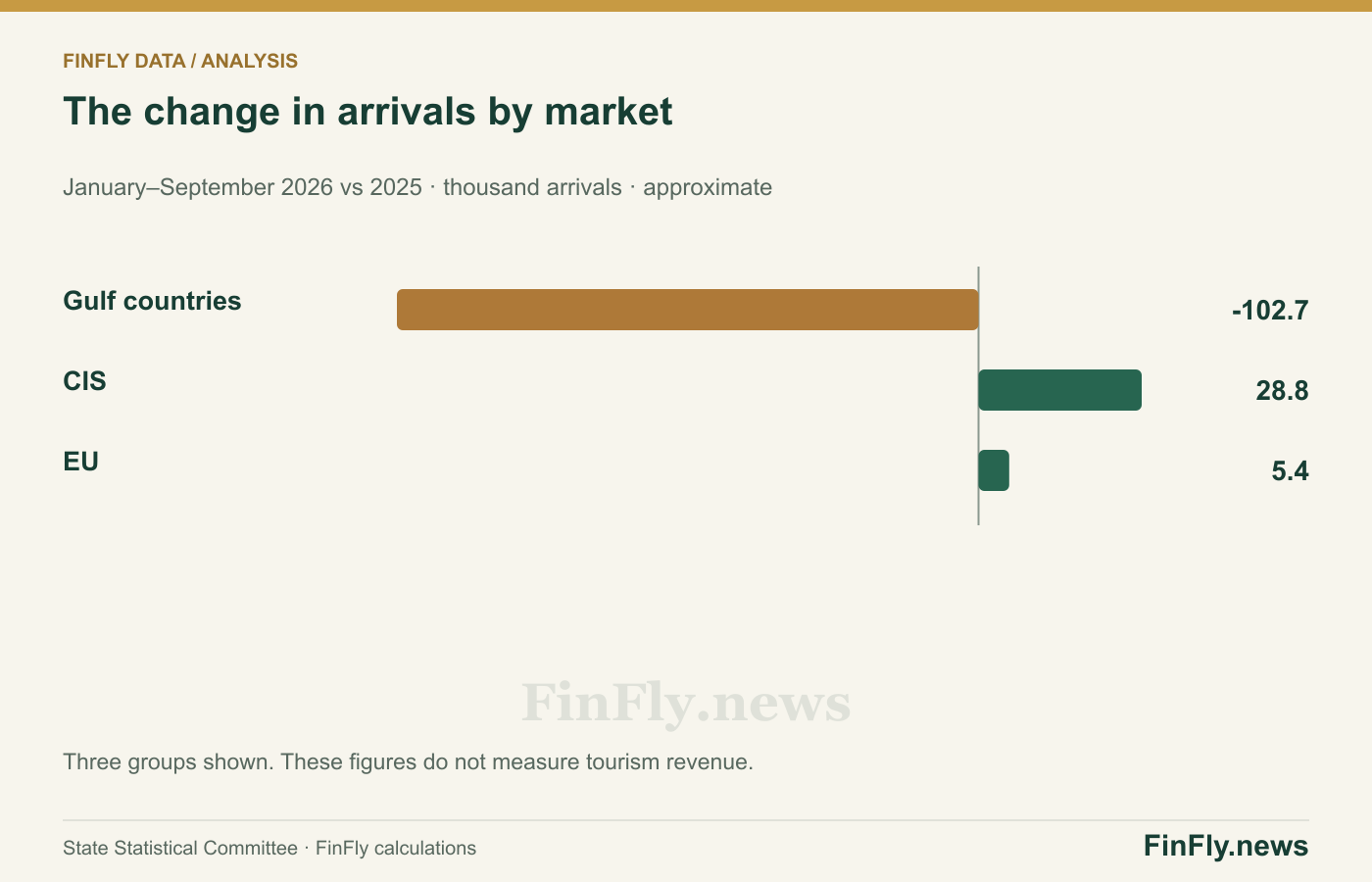
Working backwards from the published decline implies approximately 321,000 Gulf arrivals a year earlier. The reduction is therefore around 103,000. Total arrivals fell by roughly 117,000. The Gulf decline is equivalent in size to almost 88% of that overall net reduction. This is an arithmetic comparison, not an estimate of causation or the region’s contribution to lost tourism revenue.
The EU increase represents only about 5,400 additional arrivals. Even adding the roughly 28,800 increase from CIS countries would not offset the Gulf reduction. These are approximate calculations because the official release rounds both counts and growth rates.
Hotels will not feel the change equally
A hotel that relies heavily on one market may experience a sharper change than the national average suggests. Another property with a different customer base may see the opposite. Origin is only one dimension: trip purpose, season, length of stay and accommodation category also matter.
Multiplying 103,000 missing arrivals by an arbitrary average spending figure would create false precision. We would need nights and expenditure data before estimating a revenue effect. Some visitors stay with relatives, travel for business or enter more than once.
Russia and Türkiye together account for 46.5% of the total by citizenship. That underlines the influence of a limited number of markets on the aggregate. Citizenship, however, does not identify where a person actually lives, earns money or buys a travel package.
Diagnose the segment before cutting prices
A useful business response begins with the booking funnel: which markets generated fewer enquiries, where cancellations increased and how paid nights changed. If the problem is concentrated in one sales channel, discounting rooms for every guest may reduce revenue without restoring the missing demand.
Air transport accounted for 73.5% of arrivals. Flight schedules and accessibility are consequently important variables to monitor, but the figure does not establish that aviation caused the decline. The release cannot isolate fares, geopolitical developments, visa conditions or changing consumer preferences.
Our priority would be diversification measured in actual sales, not additional country names in a marketing plan. Interest from a new market matters when it becomes bookings, nights and revenue. The modest EU increase does not yet support a claim that the Gulf shortfall has been replaced.