
A route carrying Central Asian electricity across the Caspian through Azerbaijan could create a new regional market. Establishing that a cable can be built and showing that electricity sales can pay for it are different investment questions.
The Eurasian Development Bank’s Energy Without Borders report, published on October 29, treats the Trans-Caspian green corridor as a strategic option. Until the feasibility study is completed, it should not be described as a confirmed implementation route.
Technical preparation is not an investment decision
The corridor chapter describes the first feasibility-study phase involving Azerbaijan, Kazakhstan and Uzbekistan. Consultant CESI’s remit covers system studies, onshore and subsea routing, high-voltage direct-current infrastructure and the commercial framework.
The cited ambition to integrate up to 5 GW of renewables by 2030 is not an approved cable rating. Installed generating capacity, available transmission and electricity actually sold are different measures. Revenue depends on deliveries over time and their price, not a single capacity figure.
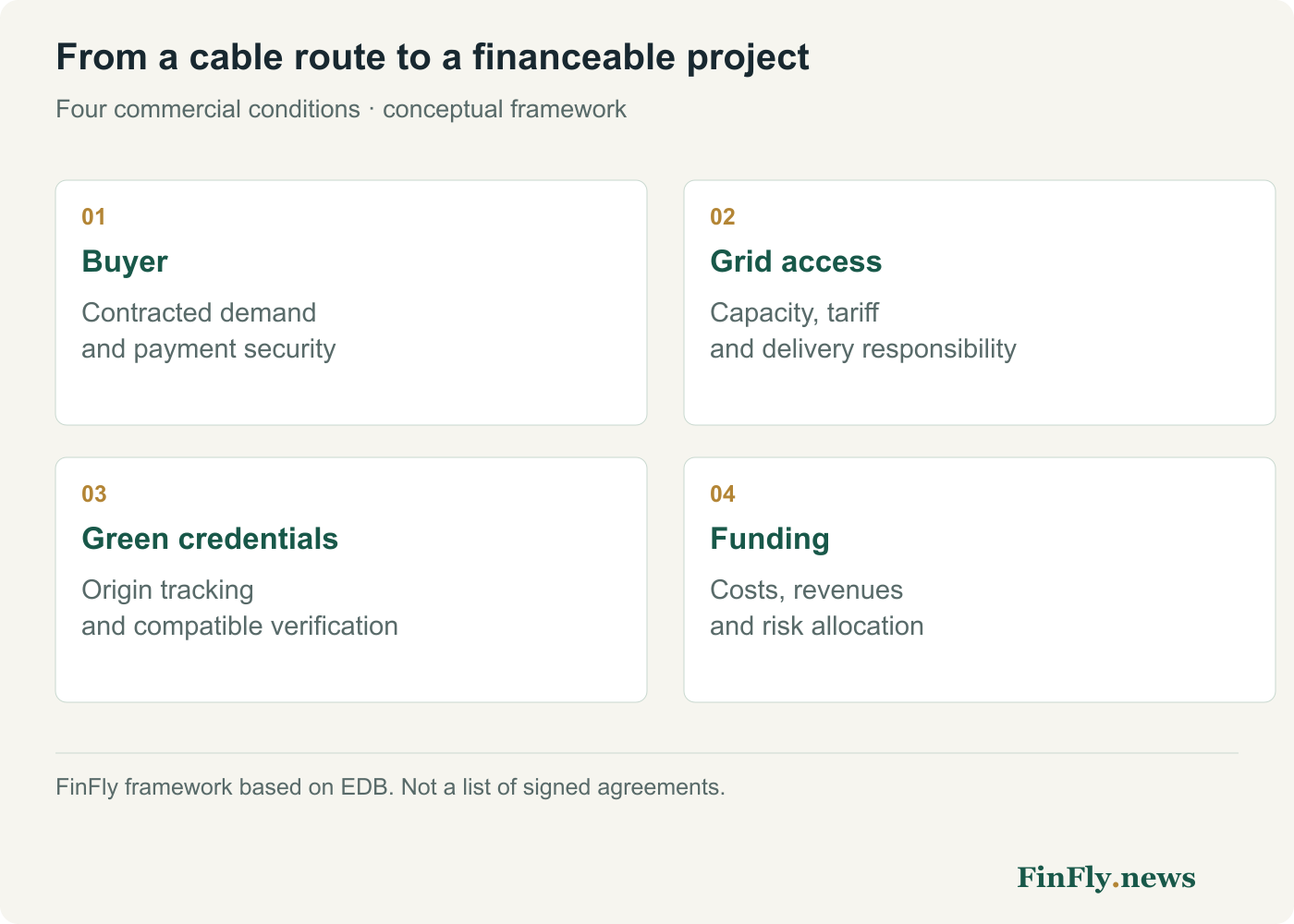
The buyer must fund the entire delivery chain
An export price must cover more than generation. Internal transmission, cross-border access, losses, balancing and financing all sit between the power plant and its customer. Until those costs and obligations are allocated, a low generation price does not establish that delivered electricity will be competitive.
A long-term purchase agreement can improve revenue predictability. It must nevertheless specify who carries delivery shortfalls, grid restrictions and price risks. An expression of interest is not the same as an obligation to buy volumes on terms that support debt service.
| Condition | What must be defined |
|---|---|
| Demand | Buyer, volume, term and payment guarantees |
| Transmission | Available capacity, tariff, losses and liability |
| Green credentials | Origin tracking and compatible certification |
| Financing | Capital costs, revenues and risk allocation |
FinFly framework based on issues identified by EDB, not a list of agreements already signed.
Azerbaijan’s interest extends beyond transit
Participation could generate demand for grid services, engineering and infrastructure. The country’s income would depend on asset ownership, tariff decisions, transmitted volumes and cost allocation. A regional economic estimate cannot be converted into guaranteed Azerbaijani receipts.
Export operation must also be compatible with domestic reliability. The same grid cannot promise unlimited capacity to every user simultaneously. Priority rules and available-transfer calculations are needed for both normal and emergency conditions.
The next milestone is a testable commercial model
EDB also highlights compatible guarantees of electricity origin. For the buyer, a green claim must be a verifiable attribute of delivery, not merely evidence that a wind farm exists somewhere in the connected system. Inconsistent accounting creates the risk of claiming the same environmental benefit more than once.
The project should be assessed through a sequence of documents: feasibility, network configuration, purchase terms, tariff design and funding. Each resolves a different uncertainty. For Azerbaijan, success means infrastructure with durable demand, transparent returns and reliable domestic supply, rather than simply another route on a map.