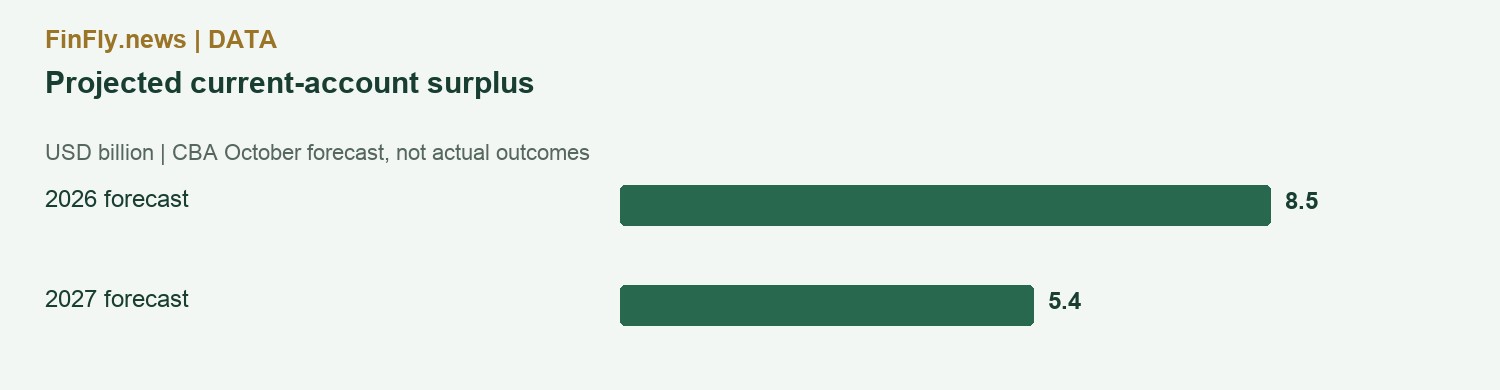
The projected 2027 current-account surplus is $3.1 billion below the 2026 estimate. The CBA nevertheless revised both annual forecasts upwards.
Projected annual change in the surplus
The updated CBA forecast projects a current-account surplus of $8.5 billion in 2026 and $5.4 billion in 2027. The difference is $3.1 billion, or about 36.5% of the current-year forecast. Both are projected annual outcomes, not completed full-year results.
The bank revised both estimates upwards. The upward revision for 2027 relative to the previous forecast coexists with an expected decline from the 2026 projection. The release does not give the earlier absolute values, so the size of the upward revisions cannot be calculated from it.
Trade balance and current-account coverage
The regulator cites customs data showing a $10.5 billion trade surplus for January-September. That should not be directly compared with the annual current-account forecast. Both the time period and the scope differ.
Trade statistics describe goods flows. The balance-of-payments current account also includes services and income, and its goods component follows balance-of-payments methodology. A large merchandise surplus therefore does not become an identical net external balance for the economy.
| Measure | 2026 forecast | 2027 forecast |
|---|---|---|
| Current-account surplus | $8.5bn | $5.4bn |
| Share of GDP | More than 10% | More than 6% |
| Difference between projections | -$3.1bn / -36.5% |
Positive external balance maintained
The $5.4 billion forecast implies a continued current-account surplus. The CBA expects it to exceed 6% of GDP in 2027, compared with more than 10% in 2026. That remains meaningful external support, but the projected cushion narrows.
The bank links its upgraded forecasts to prices of major exports and positive trends in non-oil-and-gas goods and service exports. For businesses, the central question is how durable those receipts are. Dependence on export prices increases the sensitivity of the current account to changes in global market conditions.