Voluntary motor insurance shows diverging flows
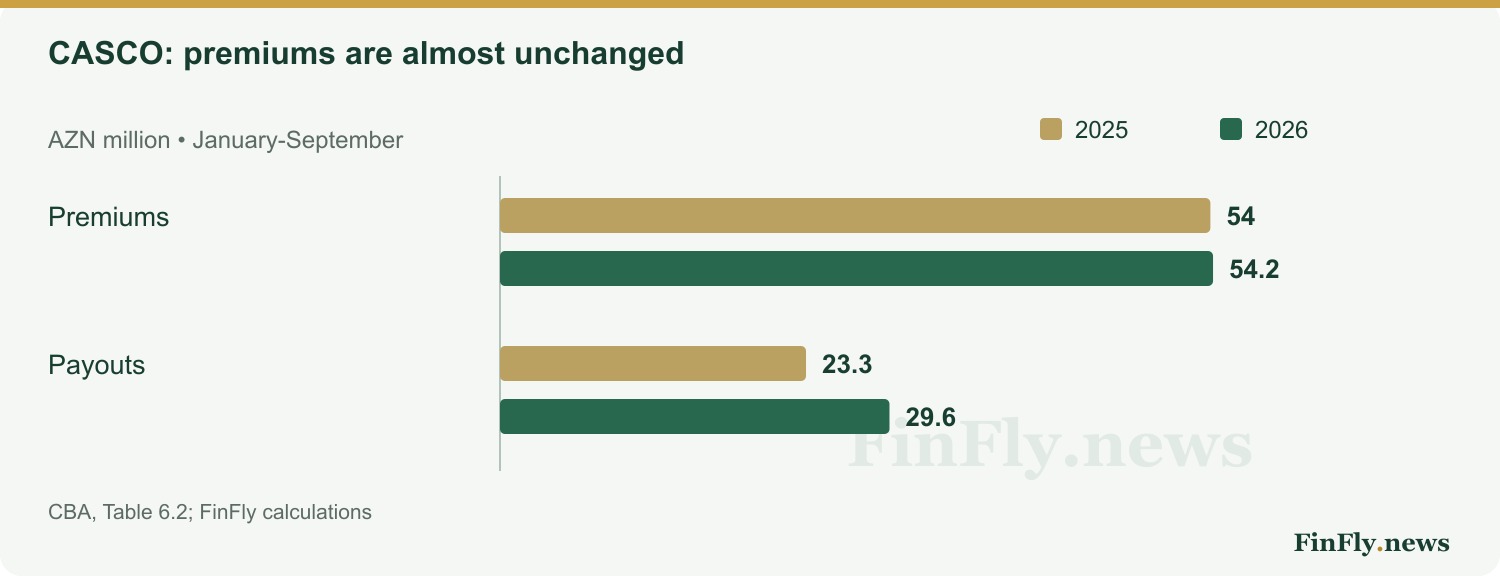
Azerbaijan’s voluntary motor insurance payouts reached AZN 29.61 million in January-September, up 27.3% year on year. Premiums were AZN 54.21 million, an increase of just 0.4%. The CBA’s September insurance-by-class table places this line under voluntary property insurance, not compulsory motor third-party liability.
A year earlier, payouts totalled AZN 23.27 million and premiums AZN 54.01 million. Payments increased by AZN 6.34 million, while premium income added only AZN 0.20 million. That materially changes the relationship between the two flows despite an almost unchanged premium base.
What the 54.6% ratio does not show
Paid claims divided by written premiums rose from 43.1% to 54.6%, an increase of 11.5 percentage points. This is a useful period comparison, not a full actuarial loss ratio. It excludes movements in reserves for incurred but unpaid claims and does not adjust written premiums to their earned portion.
It is not a combined ratio either, since operating expenses are missing. Nor can the difference between premiums and payouts be treated as insurers’ net profit.
Faster payouts could reflect claim frequency, average repair bills or settlement timing. More expensive spare parts are a possible factor, but the published table contains neither claim counts nor average payments. It cannot establish the specific cause of the increase.
| Measure | 2025 | 2026 |
|---|---|---|
| Premiums | 54.01 | 54.21 |
| Payouts | 23.27 | 29.61 |
| Payouts / premiums | 43.1% | 54.6% |
Pricing and coverage are the next variables to watch
For policyholders, the practical issue is whether insurers will change premiums, deductibles or repair conditions. Sector totals do not prove that a price increase has already been decided: responses depend on each company’s portfolio and pricing policy.
A fuller assessment requires policy counts, average premiums, claim frequency, claim severity and provisioning. The supported conclusion is narrower: CASCO payouts have risen sharply while premiums are nearly flat. If that divergence persists, insurers will need to offset costs through pricing, product terms or operational efficiency.
Cover: an AI-generated editorial illustration by FinFly.news.