
When government revenue exceeds spending, a new bond issue can look unnecessary. Azerbaijan recorded a budget surplus of almost AZN 4 billion in the first nine months of 2026, yet the Finance Ministry placed another AZN 53 million of bonds on 20 October. There is no automatic contradiction: the budget balance and debt management answer different questions.
The State Statistical Committee’s January–September summary reports revenue of AZN 29.3121 billion and expenditure of AZN 25.3482 billion. The difference is AZN 3.9639 billion. Revenue rose 0.6% and spending 2.8% in nominal terms from the corresponding period of 2025. These are nine-month execution figures, not the final annual result.
A surplus, cash and borrowing are different measures
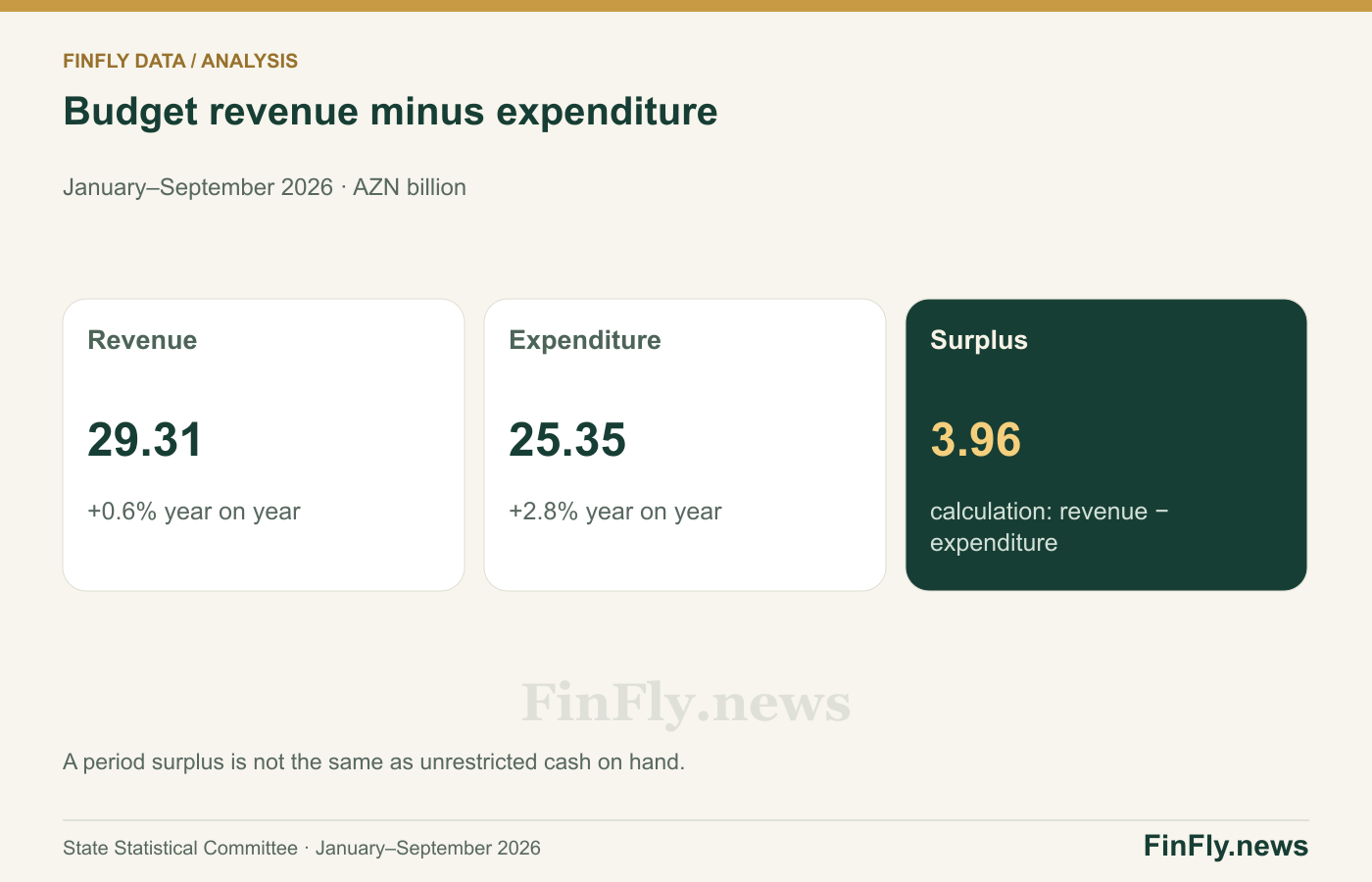
A surplus is the difference between recorded budget revenue and expenditure over a period. A cash balance is money held at a particular moment. Net borrowing is new borrowing less principal repaid. A positive first measure does not establish the size of the second or eliminate the need to examine the third.
| Measure | Question answered |
|---|---|
| Budget surplus | Did revenue exceed expenditure during the period? |
| Cash balance | How much cash is held at a given date? |
| Net borrowing | How much was borrowed after subtracting principal repayments? |
Consider an illustration: a government issues AZN 100 million of bonds and repays AZN 100 million of maturing debt. There is gross issuance, but those two transactions do not increase debt on a net basis. This explains the mechanism; it is not a description of October’s auction. The announcement does not link that issue to a particular repayment.
Why issue bonds when the budget is in surplus?
Receipts and payments do not arrive evenly through the year. The accumulated January–September balance does not identify obligations due in the remaining months or cash reserved for them. Debt maturities have their own calendar. Liquidity needs therefore cannot be inferred from one subtraction of revenue and spending.
Regular issuance can also support a domestic government-bond market by offering instruments at different maturities and establishing yield benchmarks. That is a possible function, not a verified explanation for this specific issue. Establishing its purpose would require the ministry’s financing plans and commentary.
The 20 October auction placed AZN 53 million against AZN 222.9 million of bids. This event occurred after the nine-month reporting period. It can prompt a useful question about financing, but cannot be folded into the September balance without the other October transactions.
The better question is how borrowing fits the plan
Businesses need predictable government payments and an understanding of domestic funding conditions. Taxpayers need to know net borrowing, future interest obligations and the purposes of spending. Those questions require financing accounts and repayment schedules, not just a short macroeconomic summary.
A surplus is a favourable feature of current execution, not proof that every new bond is redundant. We would judge borrowing by its cost, maturity and role in the overall financial plan. That is what distinguishes liquidity management from debt accumulation without a clear purpose.