
Azerbaijan’s agriculture is still growing, but the margin above last year has narrowed. Real output increased 1.1% in January–September, compared with 2.6% in the first eight months. Crop output is the main change: its cumulative growth slowed from 3.1% to 0.5%.
The State Statistical Committee’s nine-month release values agricultural output at AZN 11.9053 billion in current prices. The 1.1% growth rate, however, measures real output. Neither figure is a direct measure of farm income: gross production differs from earnings, and current-price values also reflect prices.
Crop output is barely ahead of last year
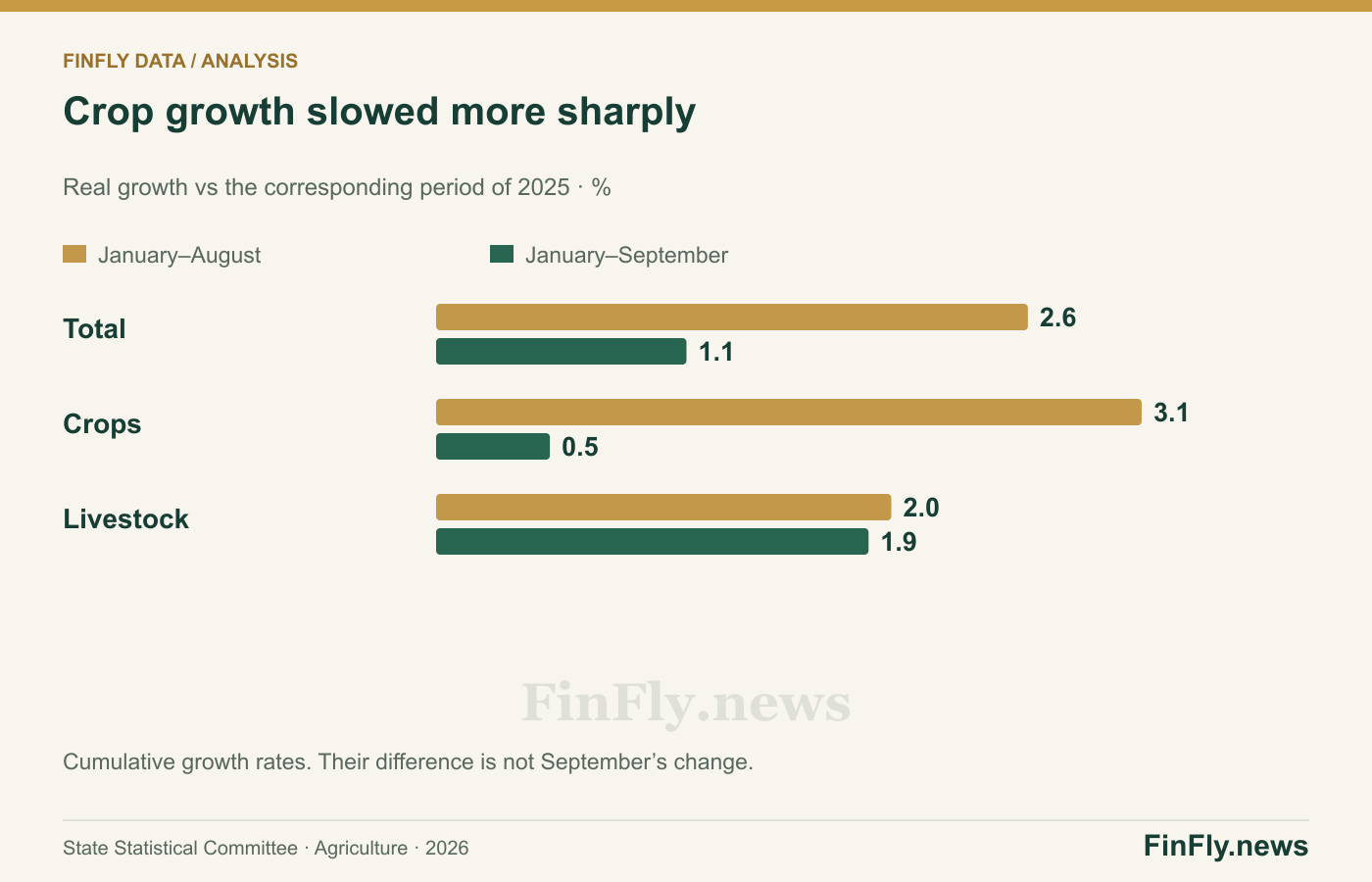
Livestock followed a steadier path, growing 2.0% in January–August and 1.9% in January–September. The crop slowdown is more pronounced. At current prices, crops account for 51% of agricultural output and livestock for 49%, so weaker crop performance can materially constrain the overall result.
Those current-price shares are not exact weights for decomposing real growth. That would require consistent price weights and the index methodology. We use the shares only to illustrate the relative scale of the two parts of agriculture.
Nor does the change from 2.6% to 1.1% mean output fell 1.5% in September. These are cumulative periods of different lengths, each compared with the corresponding period a year earlier. Isolating September requires comparable monthly volumes.
A processor needs specific inputs, not an aggregate index
Consider a business buying one particular crop. Overall agricultural growth offers no guarantee of supply: other crops or livestock can improve while its own input becomes harder to source. Marketable volume, quality, delivery timing and the contract price are the operational variables that matter.
The same distinction applies to farm earnings. A larger harvest with a weaker farm-gate price may not improve profits. A smaller harvest with a higher price may still fail to cover costs. Seeds, fuel, labour, storage and financing all need to be considered; the aggregate release does not disclose them.
The retail food-price link has several steps
Local harvests reach supermarket prices through imports, inventories, processing, transport and retail margins. Agricultural growth of 1.1% therefore cannot by itself explain food inflation. The relevant test is along individual product supply chains.
The release also does not identify a single cause of weaker crop growth. Weather, yields, planted areas and harvest timing are hypotheses to investigate in detailed data, not interchangeable explanations to assert.
The practical response is to move from “agriculture is growing” to managing specific supplies. For businesses, the slowdown is a reason to review input availability and purchasing schedules. For the wider economy, the next question is whether crop growth strengthens as the season ends — a question to monitor, not a forecast already established.