Kazakhstan’s crop outlook matters for the regional food market, but it is not a ready-made forecast for an Azerbaijani shop. The World Bank’s October report projects a 22% decline in Kazakhstan’s wheat production in the 2026/27 season. This is a change in physical output in one country, not an increase in world prices or the future mark-up on bread.
Azerbaijan does buy substantial quantities of wheat abroad. According to State Customs Committee data for January–August 2026, imports under code 1001 totalled 841,677.91 tonnes, valued at $185.17 million. The table combines all countries of origin. It therefore cannot establish Kazakhstan’s share or show that the whole volume is exposed to one supplier.
Independent FinFly analysis drawing on World Bank (2026), Making AI Work: Jobs, Firms, and Productivity, ECA Economic Update (October 2026). FinFly’s interpretations are not endorsed by the World Bank. DOI · CC BY 3.0 IGO.
What customs value tells us
Dividing the statistical value by tonnage gives approximately $220 per tonne, a FinFly calculation using the customs table. This is an average unit value for eight months of imports, not a market quotation on 9 October. Shipments can differ in quality, purchase timing and other conditions, so the figure is not the price available for any new contract.
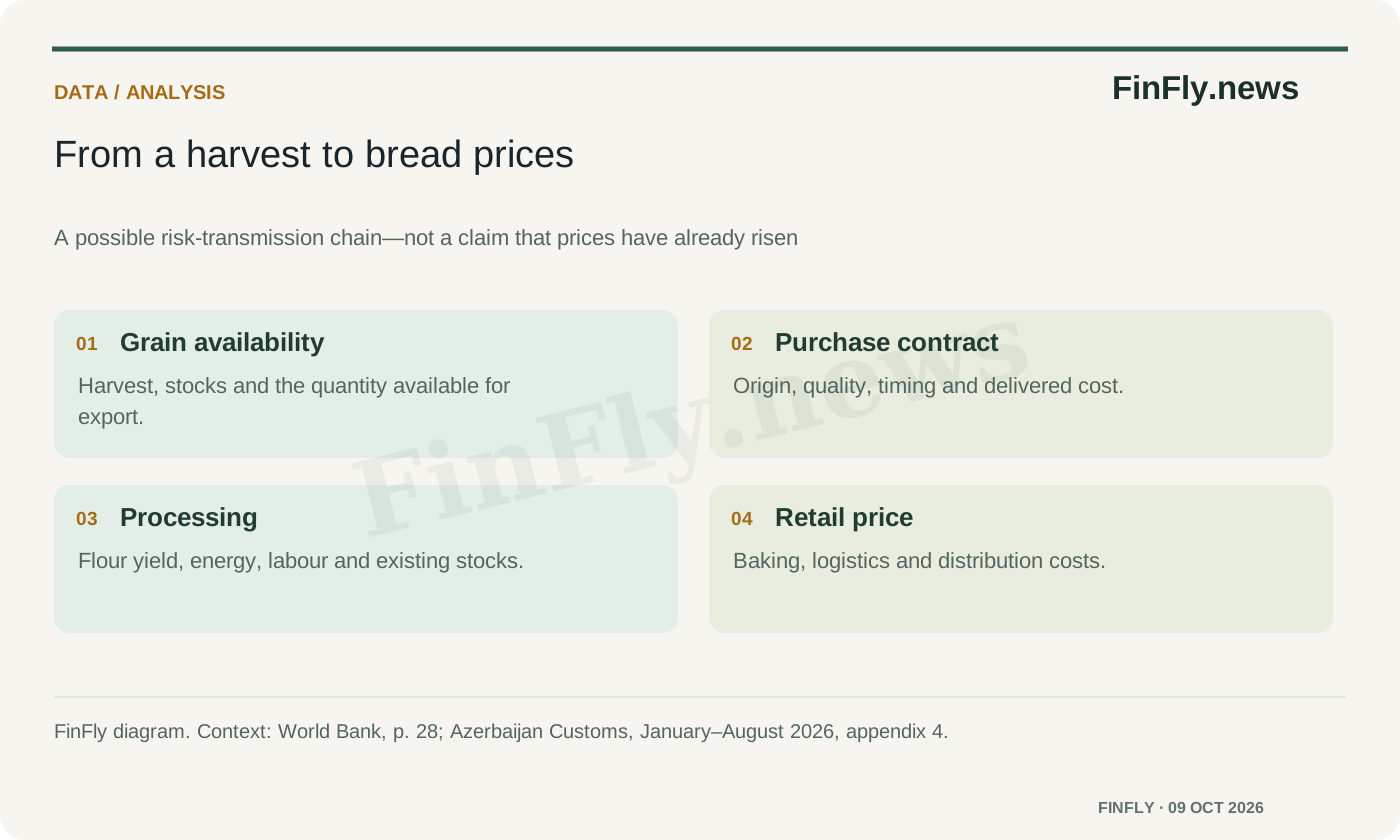
It also cannot be compared directly with the retail price of a kilogram of bread. Flour yield, processing, energy, transport, packaging, labour and retail costs stand between the two. Changes in raw-material prices travel through this chain with delays influenced by stocks and earlier contracts.
Harvests, exports and deliveries are different quantities
A smaller national crop need not produce an equal fall in exports. Stocks, domestic consumption, grain quality and trade decisions affect the amount available for foreign buyers. This section of the Bank’s report does not calculate the specific availability of Kazakh wheat for Azerbaijani importers.
Even if one origin becomes less available, other suppliers may be possible. Substitution is neither costless nor instantaneous: buyers must compare quality, logistics, timing and full delivered cost. Exposure is therefore better assessed at the procurement-portfolio level than through a single national harvest figure.
How an external change could reach consumers
The possible chain runs from tighter supply to new purchasing terms, then to mill input costs and ultimately to bread production and distribution costs. This describes a transmission mechanism, not a claim that every step has already occurred. Stocks and existing contracts may delay it; other cost changes may amplify or offset it.
Quantifying the effect would require current import shares by origin, comparable shipment prices, stocks and processing costs. The sources used here do not provide that complete set. This article consequently makes no numerical prediction of bread-price increases. Such a percentage would imply precision the evidence cannot support.
Which signals deserve attention?
Importers can monitor execution of existing contracts and the terms of new offers. Mills and bakeries need to track the delivered price of suitable grain, working-capital availability and the period for which production is supplied. For consumers, a series of observed retail prices is more informative than turning every foreign crop forecast into an immediate warning about bread.
The eight-month import total and the agricultural-season forecast also cover different periods. Comparing them demonstrates why external supply matters to a purchasing country; it does not measure an already realised effect of the new season on earlier deliveries.
The supported conclusion is to watch procurement conditions and supplier diversification. The unsupported conclusion is that bread will become 22% more expensive. Understanding the distance between those claims is central to analysing food-supply risk rather than substituting an alarming headline for it.