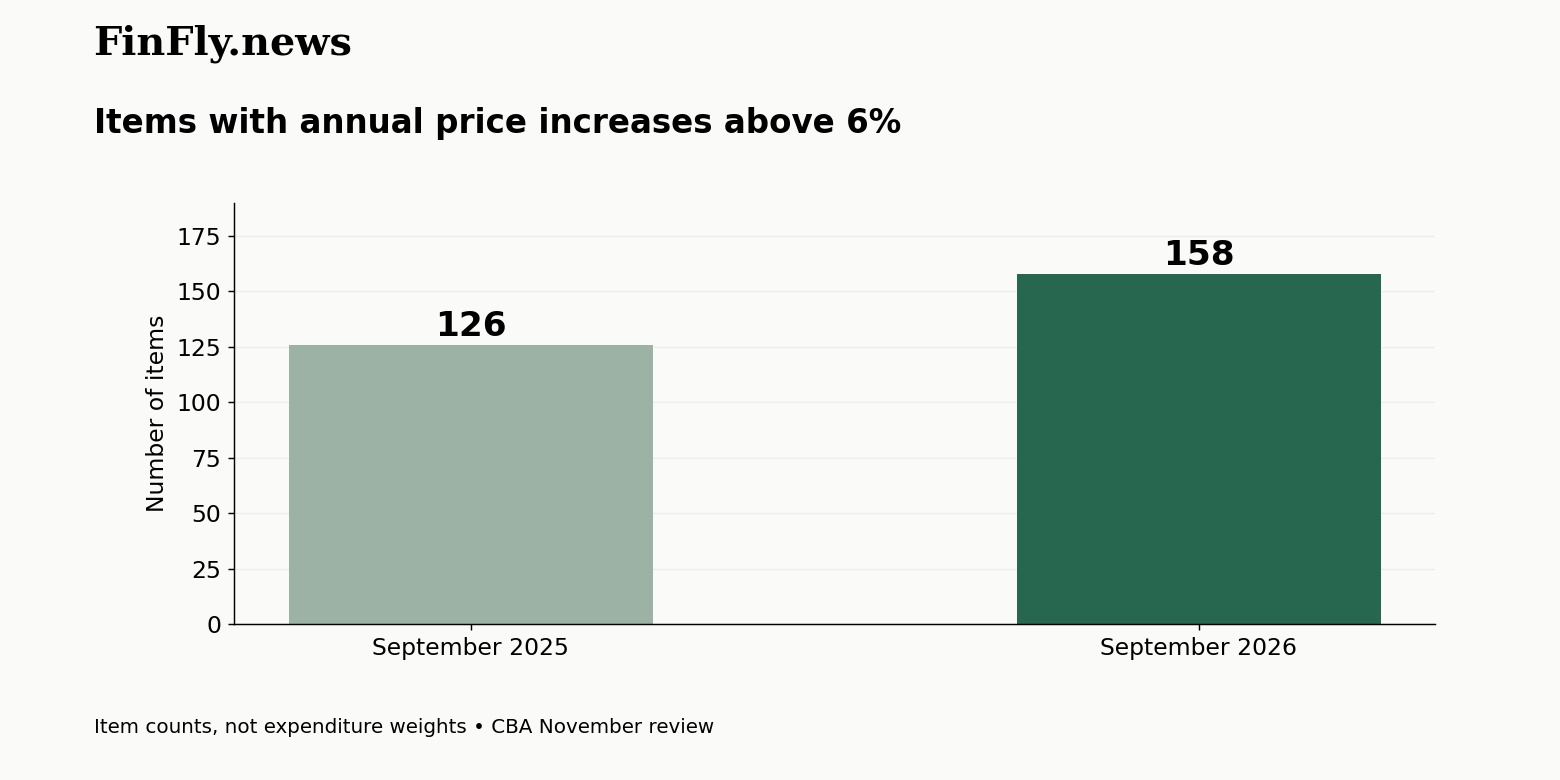
A headline price index describes an average basket; shoppers pay for individual items. The CBA's November review illustrates the gap: in September, 158 items had annual price increases above 6%, compared with 126 a year earlier.
The CBA's calculations using State Statistical Committee data cover 566 goods and services. The faster-rising group therefore expanded by 32 items, or roughly a quarter. That is a change in the number of items, not a 25% increase in the overall price level.
An average is not every household's bill
The consumer price index assigns expenditure weights to goods and services. Counting items in a category does not establish the share of a household's budget spent on them. A frequently purchased product can matter more to personal spending than several rarely used services.
| Measure | September 2025 | September 2026 |
|---|---|---|
| Items with annual price growth above 6% | 126 | 158 |
| Change in item count | - | +32 |
Meanwhile, prices fell for 16% of basket items in September 2026. These opposing movements explain how substantial increases in one group can coexist with a more moderate aggregate inflation reading.
Where spending pressure appears
Purchase frequency matters. Food and regular services are paid for repeatedly, making price changes immediately visible. A rarely purchased appliance may become cheaper without offsetting weekly expenses in a month when the household does not buy it.
Businesses face a similar measurement problem. A general index cannot describe the cost base of a bakery, a transport company or a retailer. Each relies on a different combination of materials, energy, rent and labor. The ability to pass higher costs to customers is constrained by demand and competition.
Reading the figures carefully
A larger group of fast-rising items warrants closer attention to inflation's composition. It does not establish that most families experienced spending inflation above 6%. That conclusion would require the weights and composition of their actual consumption.
For a practical budget comparison, track the cost of an unchanged shopping basket. If quantities or quality also change, the entire increase in the bill cannot be attributed to inflation. The review's important message is that price pressure is uneven: the aggregate index remains an economic benchmark, while a household budget needs a more detailed calculation.