
Bitcoin has no quarterly revenue that can miss analysts’ forecasts. Its network does not issue earnings guidance or borrow from the Federal Reserve. Yet disappointment with technology companies, more expensive financing or investors’ need for cash can trigger selling in crypto markets.
The reason is that Bitcoin's price is formed in the same financial environment in which investors buy stocks, bonds and other assets. The network's technological independence does not make its buyers’ money independent.
Shared investors transmit shocks between markets
Consider a fund holding both equities and Bitcoin. After a stock-market decline, its manager might reduce overall risk, increase cash reserves or meet collateral requirements on other positions. Selling cryptocurrency in that situation need not represent a reassessment of its long-term prospects. It may be part of a portfolio-wide decision.
This is a transmission mechanism, rather than an established explanation for every trade. Explaining a specific decline requires evidence on capital flows, leveraged positions and the timing of news. Two markets falling together does not by itself prove that one caused the other to fall.
Research nevertheless supports the connection. A working paper published by the Chicago Fed in August 2026 finds increasing Bitcoin exposure to the broad equity market. After controlling for the Dow Jones, the separate Nasdaq exposure in the authors’ model is statistically insignificant. Describing Bitcoin simply as following technology stocks can therefore be too narrow. These are the authors’ findings, not an official Federal Reserve position.
Expensive money changes demand for risk
Higher returns on lower-risk instruments raise the potential reward investors require from Bitcoin. More expensive borrowing also constrains the financing of speculative positions. Price pressure does not require a blockchain malfunction: greater caution among buyers or a need to release cash can be sufficient.
A rate increase is not a mechanical sell signal, however. Markets also trade expectations. If a restrictive decision is already priced in, a softer outlook may matter more. Analysis needs to consider how financial conditions change relative to expectations, rather than just the announced rate.
Leverage amplifies the initial move
After an external trigger, selling can acquire momentum within crypto itself. Insufficient collateral can lead an exchange to reduce or close leveraged positions, as described in Coinbase's spot-margin rules. Closing long positions can add pressure to a falling market.
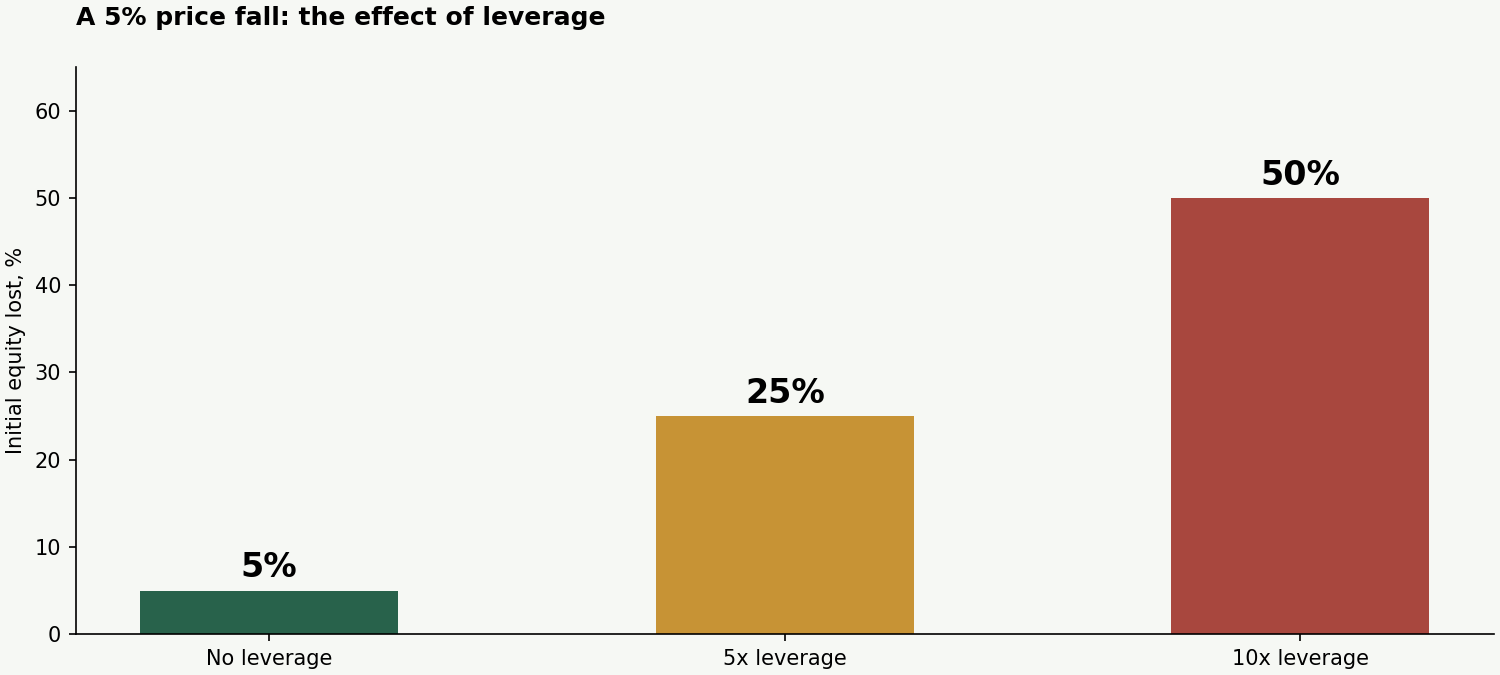
A hypothetical calculation illustrates the sensitivity. With $1,000 of equity, an unleveraged position is worth $1,000; at 5x leverage it is $5,000; at 10x it is $10,000. A 5% asset-price decline produces losses of $50, $250 and $500, respectively.
| Leverage | Position size | Loss on a 5% decline | Initial equity lost |
|---|---|---|---|
| None | $1,000 | $50 | 5% |
| 5x | $5,000 | $250 | 25% |
| 10x | $10,000 | $500 | 50% |
This illustrates position sensitivity, not liquidation thresholds. Actual closure depends on the venue's rules, collateral and other account positions. The relevant point is that the same price movement creates very different demands on participants’ capital.
ETFs broadened access without removing volatility
Exchange-traded products allow Bitcoin exposure to enter familiar investment portfolios. Cryptocurrency consequently participates in decisions about allocating capital across asset classes. This creates a channel through which events far outside crypto can affect it.
A sale of shares from one investor to another does not automatically mean the fund sells an equivalent amount of Bitcoin. Such a conclusion requires evidence on redemptions and changes in fund holdings, rather than trading turnover alone.
Trading schedules also differ. The iShares risk disclosures note that digital assets trade around the clock while shares trade during exchange hours. CME research also documents significant Bitcoin moves over weekends. Being able to sell at any time does not guarantee equal market depth at every hour.
Limited supply does not prevent a selloff
The limited-supply argument concerns Bitcoin's design and long-term investment thesis. It does not fix the price at which a buyer and seller meet today. If demand falls faster than the amount offered for sale, the price can decline while issuance rules remain unchanged.
Safe-haven behavior also needs to be tested over a defined period. IMF research published in 2022 documented stronger connections between crypto and equities in 2020-2021 than before the pandemic. That is a historical finding, not a permanent coefficient for today's market.
Other markets’ problems become shared problems
Bitcoin can suffer from problems elsewhere because markets share capital owners, financing sources and risk constraints. An external shock can start the selling, while leverage and insufficient buying interest can amplify it.
Crypto also retains its own reasons for falling: platform failures, regulatory decisions, custody problems and large sales by individual holders. Separating those from a broader reduction in risk appetite requires several types of evidence.
The key distinction is between network independence and price independence. The network can continue operating normally while its asset is repriced alongside the rest of an investor's portfolio. Understanding Bitcoin requires attention both to the blockchain and to the financial condition of the capital entering its market.