Toyota ranks 31st in the Corporate Startup Activity Index 2026, Volkswagen Group 43rd and Tesla 228th. The result may appear to challenge familiar perceptions of automotive innovation, but the index asks a different question: how corporations engage with external startups.
Innovative products and open models are distinct
A company may develop technology mainly through its own teams. Another may use investments, acquisitions and programmes for independent ventures. This index measures documented external engagement and associated startup outcomes, not the technological superiority of a vehicle.
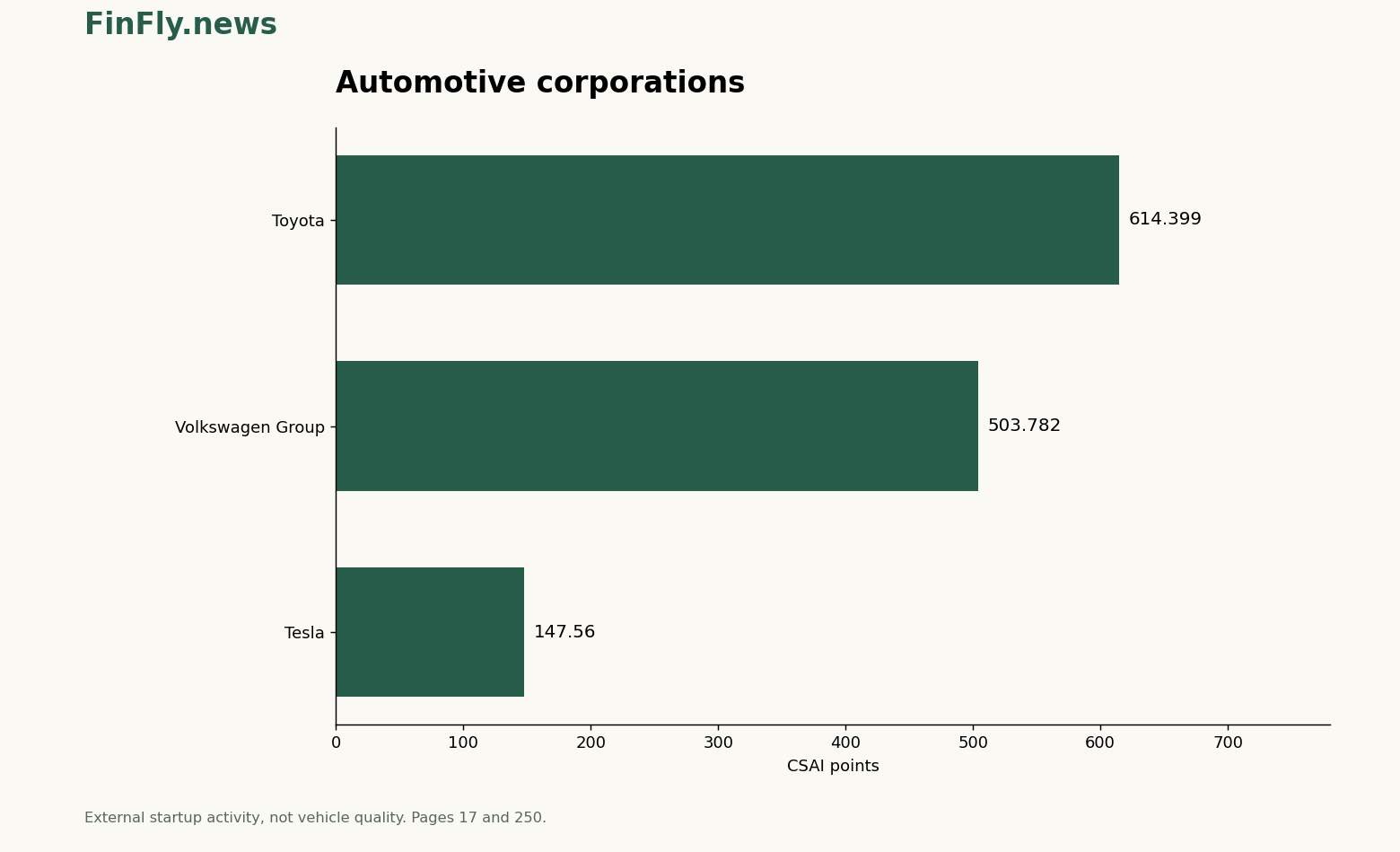
Toyota scores 614.399 points, Volkswagen Group 503.782 and Tesla 147.560. The first two scores are approximately 4.16 and 3.41 times Tesla’s. These are score ratios, not ratios of innovations, research spending or venture funding.
Looking beyond the finished vehicle
Potential entry points for independent teams include quality control, logistics, energy management and equipment maintenance. These are possible areas of industrial demand, not verified orders from the three corporations.
Industrial customers also require reliability and integration. A working demonstration is not the same as readiness for production deployment. Access to a test environment and clear procurement criteria can therefore matter as much as the initial introduction.
Avoid the wrong conclusion
The ranking does not establish that Tesla is less innovative. It establishes that Toyota and Volkswagen receive higher scores for the external activity measured by StartupBlink.
Founders should match operational needs to their product rather than rely on a corporation’s public technology image. An established manufacturer may offer a more suitable entry point for an external team.
| Corporation | Rank | CSAI score |
|---|---|---|
| Toyota | 31 | 614.399 |
| Volkswagen Group | 43 | 503.782 |
| Tesla | 228 | 147.560 |