
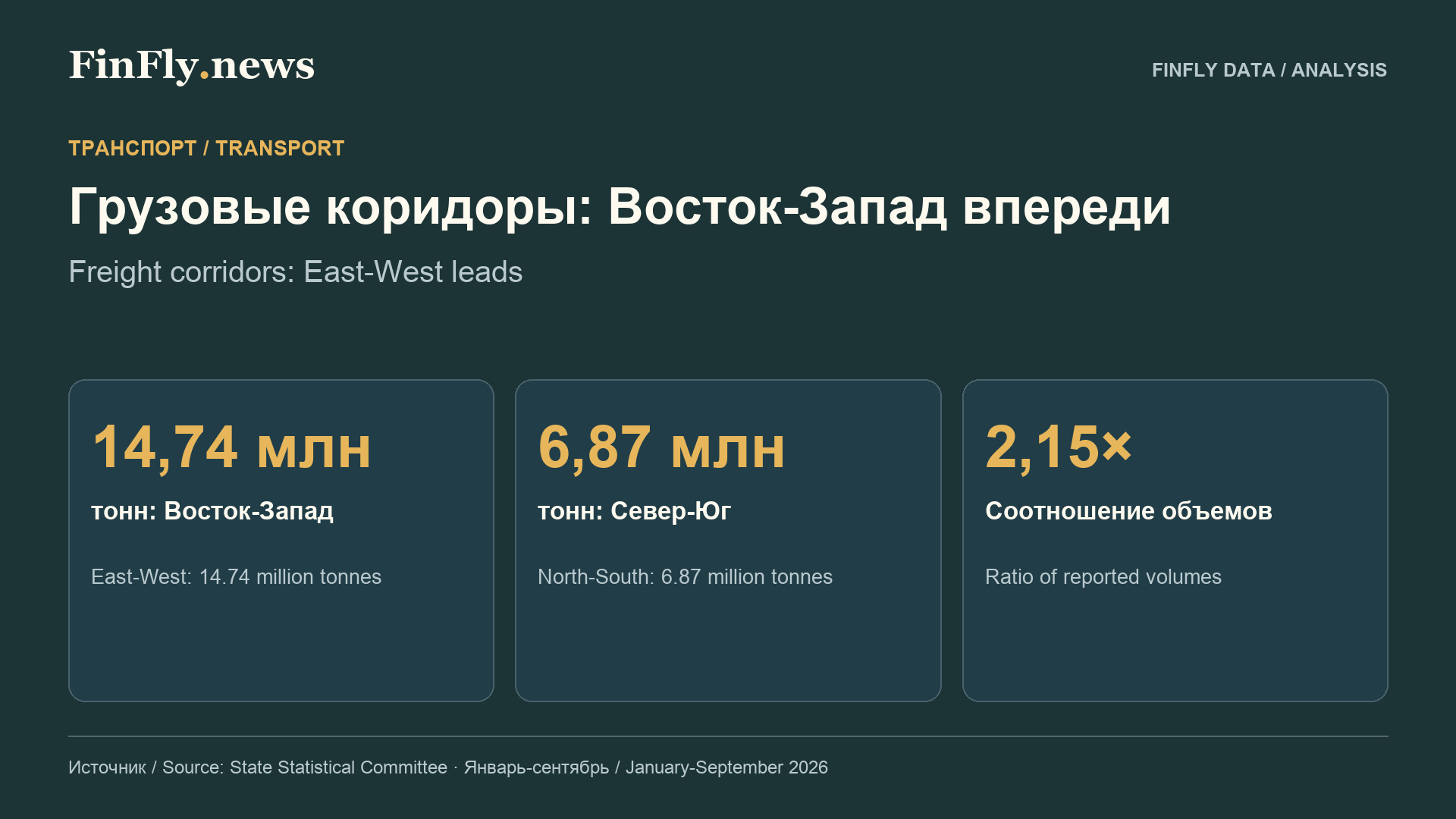
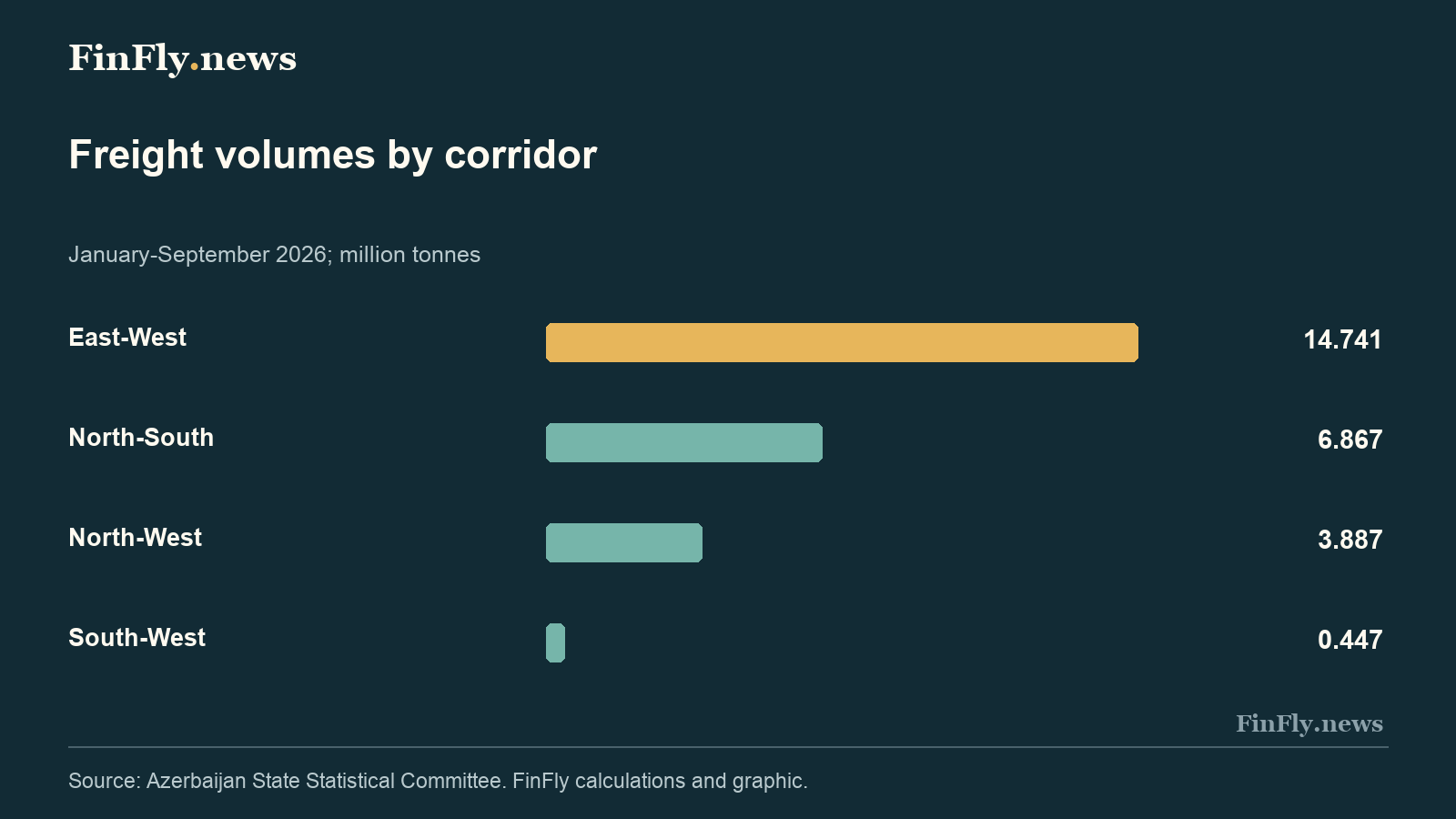
The East-West direction accounted for 14.74 million tonnes of freight on Azerbaijan's transport corridors in January-September 2026. North-South handled 6.87 million tonnes. FinFly calculates a volume ratio of approximately 2.15 to one.
The State Statistical Committee released the figures on November 16. North-West recorded 3.89 million tonnes and South-West 447,000 tonnes. These are actual nine-month transport volumes, not designed capacity.
Tonnage measures scale, not route profitability
A larger freight volume does not automatically make a corridor more profitable. Revenue depends on tariffs, cargo mix, services provided and distance. One flow may generate substantial tonnage with relatively little value added, while another supports demand for storage, handling and other services.
For shippers, variation in delivery times also matters. Average speed is useful, but delays at individual stages determine inventory and working-capital requirements. The release does not provide these indicators, so it cannot establish the full cost of a route to a business.
Avoiding double counting
The Europe-Caucasus-Asia figure of 7.51 million tonnes is included within East-West. Adding it to the 14.74 million-tonne total would double count freight. Similarly, a breakdown by transport mode should not be added to a breakdown by corridor.
Nor should the entire East-West total be relabelled as the Middle Corridor without checking the methodology. Geographic categories and the route names used by the industry do not necessarily cover identical sets of movements.
The next stage of analysis
This snapshot establishes the distribution of actual traffic. Measuring growth requires a comparable prior-year period; measuring efficiency requires cost, transit-time and reliability data. Combining those measures would help determine whether increased freight translates into more competitive logistics rather than simply a larger tonnage total.