
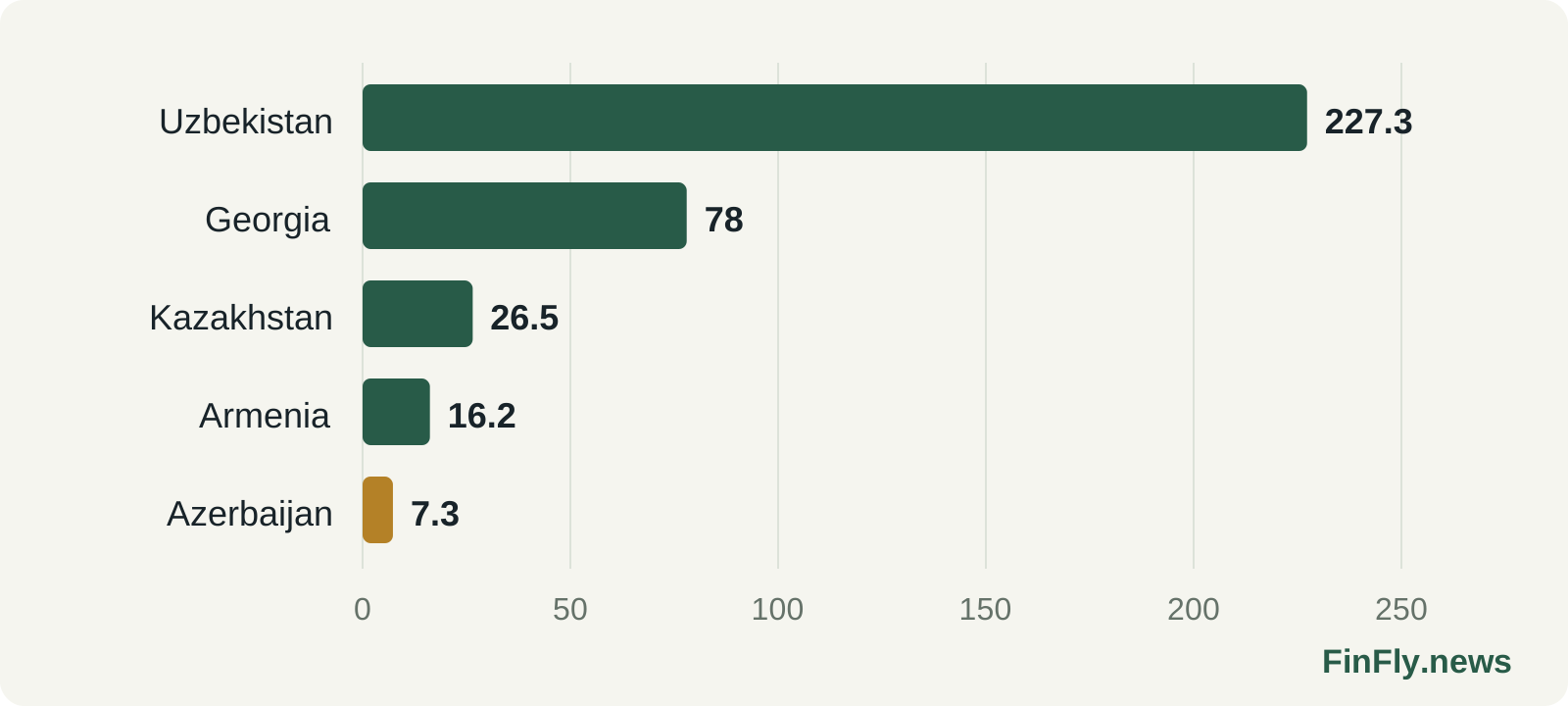
In the StartupBlink report, Uzbekistan is named the fastest-growing country by index dynamics. Its total score reached 1.172 versus Azerbaijan's 1.134. However, rapid growth from a smaller base and the size of today's result are different things: a sharp percentage jump does not mean an equally large advantage over neighbours in the final score.
Score growth is not investment growth
Change in total StartupBlink score, 2026 vs 2025, %
Not a single measure but a sequence of stages
In a statement from the President of Uzbekistan dated 20 January 2026, a four-stage support system is described: idea, development, launch and scaling. It provides for grants, tax incentives, co-financing and reimbursement of export costs. This is a description of policy and intended instruments, not proof that any startup can already receive the full set without selection.
For Azerbaijan, what deserves attention here is the coherence of the transitions themselves. If training ends with a presentation, and the next programme requires a working product and customers, some teams may find themselves between two sets of requirements. A useful question for a support system is whether a clear next step exists and whether it can be taken with the results of the previous stage. This question is not equivalent to concluding that such a transition is currently absent.
Increasing the number of programmes does not necessarily mean closing this gap. A new programme may repeat training that is already available, while what a team needs is an industry customer or product validation. Therefore, it is more reasonable to compare systems by which obstacles they remove sequentially, rather than by the total number of grant competitions, events and participants.
The ecosystem becomes visible beyond the capital
StartupBlink records three Uzbek cities in the top thousand: Tashkent, Samarkand and Fergana. Tashkent ranked 229th, Samarkand 814th, Fergana 863rd. This is an indicator of the geography of representation in the index, not proof that the three cities are equally mature and not a census of all technology companies in the country.
The regional agenda has a separate, verifiable economic snapshot. In an official statement about a visit to Fergana on 28 April 2026, 139 IT Park residents in the region and IT services exports of $22.7 million for 2025 are cited. A park resident is not necessarily a startup, and services exports do not equal venture investment. These figures show the activity of the region's technology sector, but they cannot be substituted for startup index indicators.
The distinction matters for choosing a development model. Services exports can create jobs and competencies, while a scalable product creates a different structure of revenues and risks. Both directions can be useful, but reporting on their results must separate contract revenue, sales of own products and capital raised. Adding these values into a single success metric deprives the comparison of economic meaning.
What is transferable and what requires verification
The transferable principle is to accompany a team to the next confirmed result: a working product, a buyer, a repeat sale, then entry into a new market. The specific size of a subsidy or the design of an investment mechanism cannot simply be copied: they depend on the budget, legislation, the availability of private investors and which companies already exist in the country.
The effectiveness of such a model should be checked by groups of participants, not only by a handful of success stories. It is important to see how many teams passed each stage, how many continued operating and what sales persisted after support ended. If state funding helped attract private capital, it is necessary to distinguish the announced amount, actually closed deals and investors' future commitments.
A record does not explain its own cause
Growth of 227.3% is a change in the StartupBlink composite score, not an increase in investment by the same amount. The index authors warn that dynamics are also influenced by algorithm and database updates. Therefore, the presence of support programmes alongside an improved ranking does not allow calculating each programme's contribution to that growth.
For Azerbaijan, the practical lesson from Uzbekistan is not a promise to repeat the record after launching a similar initiative. It is an invitation to check the coherence of its own support, the results of regional teams and the transparency of the transition to foreign sales. Competing for a place in the table can be quick; a convincing result for business appears when a new position is backed by companies with sustainable demand and clear sources of growth.