
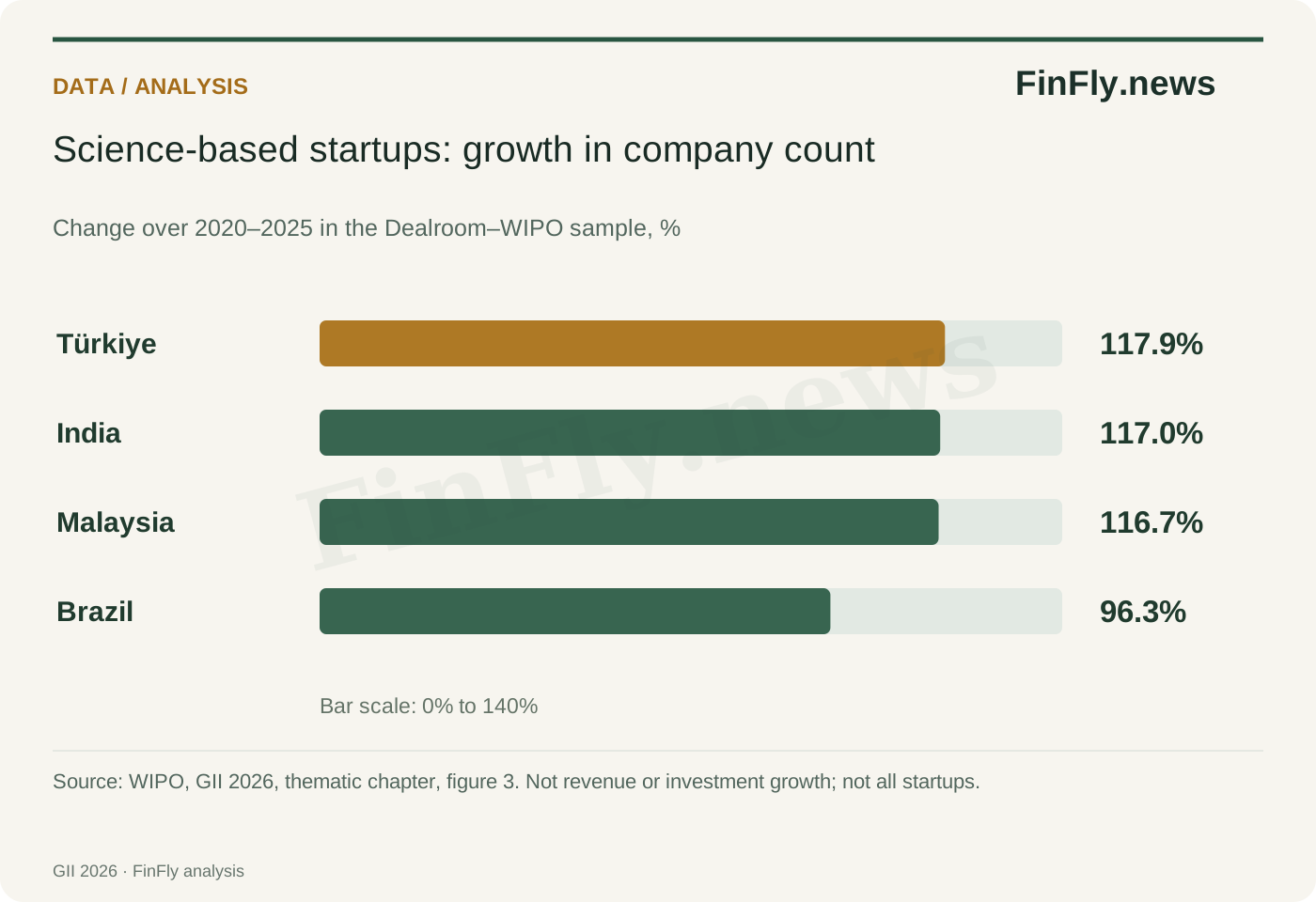
Türkiye’s number of science-based startups in the Dealroom–WIPO sample increased 117.9% between 2020 and 2025. That is more than a doubling, but not a doubling of the country’s entire startup economy. The chart in Global Innovation Index 2026 covers a specifically defined group whose products depend on scientific advances.
For Azerbaijan, the type of business behind the number matters more than the percentage itself. Such a startup may need to do more than find an investor and write software. It might have to verify a material’s physical properties, test a device, establish manufacturing or obtain market approval. Capital and infrastructure are needed at different stages and over different time horizons.
What actually increased?
WIPO uses deep science more narrowly than the widely used label deep tech. Its scope includes research-intensive fields such as advanced materials, biotechnology and energy. Ordinary digital services and fintech should not automatically be included in this group.
The 117.9% figure describes a change in the number of firms covered by the dataset. It is not growth in revenue, investment or an individual project’s probability of success. The starting population and coverage affect interpretation. The percentage alone cannot establish that Türkiye has become the world’s largest science-entrepreneurship market.
A short accelerator cannot replace a long development cycle
The report’s thematic chapter examines mismatches between scientific and financial timelines. Proof of concept, prototype development and industrial validation are distinct tasks. Even a successful experiment may require additional years before a technology becomes reliable and economical for a customer.
Support designed for a rapid digital launch does not always fit that process. A team may need testing equipment, manufacturing expertise and a clear certification pathway more than another investor presentation. This is not an argument against software entrepreneurship: the risks that need to be resolved before sales are different.
A concrete instrument: stage-based investment
The BiGG 2026-2 call in Türkiye provides for a TRY 1.35 million investment in selected ventures in exchange for a 3% stake, with the possibility of requesting up to TRY 1.35 million in follow-on investment. This is an investment arrangement, not an unconditional grant to every applicant.
Applications closed on September 30, 2026, and the published timetable schedules support to begin on January 1, 2027. The call therefore should not be presented as open when this article was prepared. Nor can these terms explain the 2020–2025 increase in company numbers: the periods do not match.
The structure nevertheless illustrates a relevant principle: initial backing and follow-on capital serve different stages. A science-based firm needs to understand not only the first cheque’s size, but also which evidence unlocks the next financing source. A programme’s existence does not prove its effectiveness; that requires evidence about recipients and their subsequent operations.
What Azerbaijan can usefully examine
FinFly’s interpretation is to begin with the local development process rather than copying an investment amount or ownership percentage. A university technology that cannot reach a prototype needs one instrument. A working prototype that has not been tested with a customer needs another. A company with validated demand but no financing for its first production run faces a manufacturing-finance problem.
Shared testing capacity can reduce the need for every team to buy equipment. An industrial partner can provide a validation environment and quality requirements. Clear intellectual-property terms help an investor establish what the company controls. None of these elements replaces a market, but each makes risk more identifiable.
The comparison should end with outcomes: do products work outside a laboratory, do independent customers emerge, and do ventures reach new milestones without indefinite subsidy extensions? Growth in science-based company numbers is a meaningful signal. For Azerbaijan, adopting a disciplined path from research to market is more useful than setting a target to reproduce another country’s percentage increase.