The StartupBlink country profile highlights the ecosystem's concentration in Baku. This conclusion should be read within the ranking's coverage. A city's absence from the top 1,000 does not prove the absence of entrepreneurship, tech teams or commercial projects. To verify real activity, other observations are needed, with clear dates and participant lists.
Regions already have a measurable start
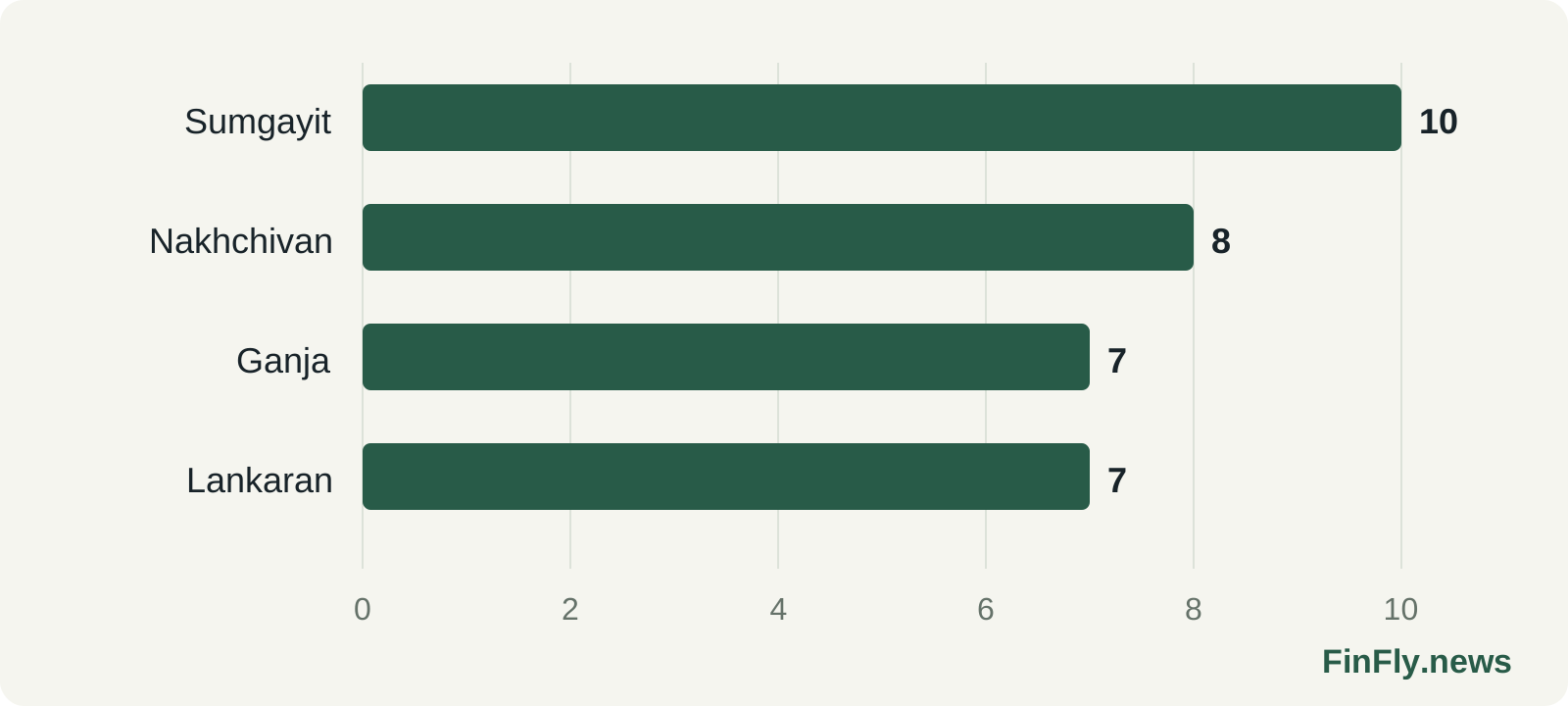
On July 25, 2025, IDDA reported the results of the regional incubation program Innostart: 32 startups, of which 29 were ready to present a minimum viable product, and 14 had already made first sales. Sumgayit had ten projects, Nakhchivan eight, Ganja and Lankaran seven each. This is a snapshot of one program on that date, not the total number of startups in these cities today.
32 projects of the regional Innostart program
Program projects by city, snapshot as of July 25, 2025
These numbers yield a limited but useful calculation: first sales were made by 43.8% of the presented group — 14 out of 32 projects, according to FinFly's calculation. This is not the share of profitable companies or a measure of their survival. Product readiness and having sales may overlap, so 29 and 14 cannot be added as two distinct groups or depicted without additional data as a precise sequence of attrition.
The first sale is the start of validation, not its end
A sale confirms that at least one deal took place, but it does not yet answer the question of demand repeatability. The buyer may have purchased a one-off service, a trial sample or a customised product. To understand the scaling potential, one needs to see whether the solution can be sold to the next client without a complete reinvention and whether resources remain for further work after fulfilling the order.
Therefore, the next evaluation of the regional program should observe the same teams, not replace them with a new set of participants. What happened to sales after graduation, did the team stay together, did repeat customers appear? These are questions for subsequent measurement, not a statement that the projects closed or failed to grow. IDDA's historical announcement does not allow determining their status in autumn 2026.
Support needs a route to the customer
For a regional team, the location of training does not necessarily coincide with the location of product sales. A solution created in Ganja may seek buyers in Baku or abroad; a local entrepreneur, conversely, may become the first customer for a team from another city. Therefore, the result of regional policy should be assessed not only by the availability of a venue but also by the team's access to the market after the program ends.
One possible route is industry validation of the technology. In the September Industry Challenge by IDDA and Plug and Play, the tasks are formulated by Baku Metro and ADY, and selected companies are offered a testing opportunity. This example does not prove the participation of Innostart graduates. It shows the type of next step that can be sought for a regional project: a specific customer task instead of another general presentation.
But testing cannot be considered completed commercialisation either. For an entrepreneur, clear success criteria, terms for further implementation and the possibility of payment if the solution fits are essential. Without these conditions, the number of pilot projects may grow while confirmed recurring revenue remains a separate question. This is a risk of program design, not an established fact about specific participants.
Visibility in the ranking and business development are different tasks
In the StartupBlink 2026 methodology, the minimum threshold for a city is six startups. However, having six projects does not by itself guarantee a place: compliance with the startup definition, the observation base and the overall score are taken into account. Seven teams in a city's program cannot be automatically equated with seven companies included in the international database.
Two separate tasks follow. The first is company development: product, market, team and funds to operate. The second is a reliable description of existing results: up-to-date project pages, confirmed development stages, consistent geography of operations. Improving record-keeping can raise a city's visibility, but it does not by itself create new sales; these effects must not be conflated.
For Azerbaijan, it is more accurate to set the goal not as the appearance of another name in a table, but as the sustainable development of several regional teams with subsequent verification of results. The program has already had an observable start. The next meaningful indicator is how many of these projects continued to sell, to whom and in which markets. Such an answer is more useful to founders and customers than the conclusion that there are no startups outside Baku.