
Singapore has entered the world’s top ten startup ecosystems for the first time in StartupBlink’s ranking. Within Southeast Asia, its lead remains substantial: its total score is 2.46 times Jakarta’s, the regional runner-up. Further down the table, Ho Chi Minh City has entered the global top 100, Hanoi has climbed 30 places and Surabaya has become the fastest-growing city in the regional top ten.
The Global Startup Ecosystem Index 2026 depicts a region with one strong leader and several distinct development paths. For businesses considering expansion, ecosystem scale and growth increasingly point to different locations. The choice of potential partners and operating bases is widening.
Singapore pulls further ahead of Jakarta
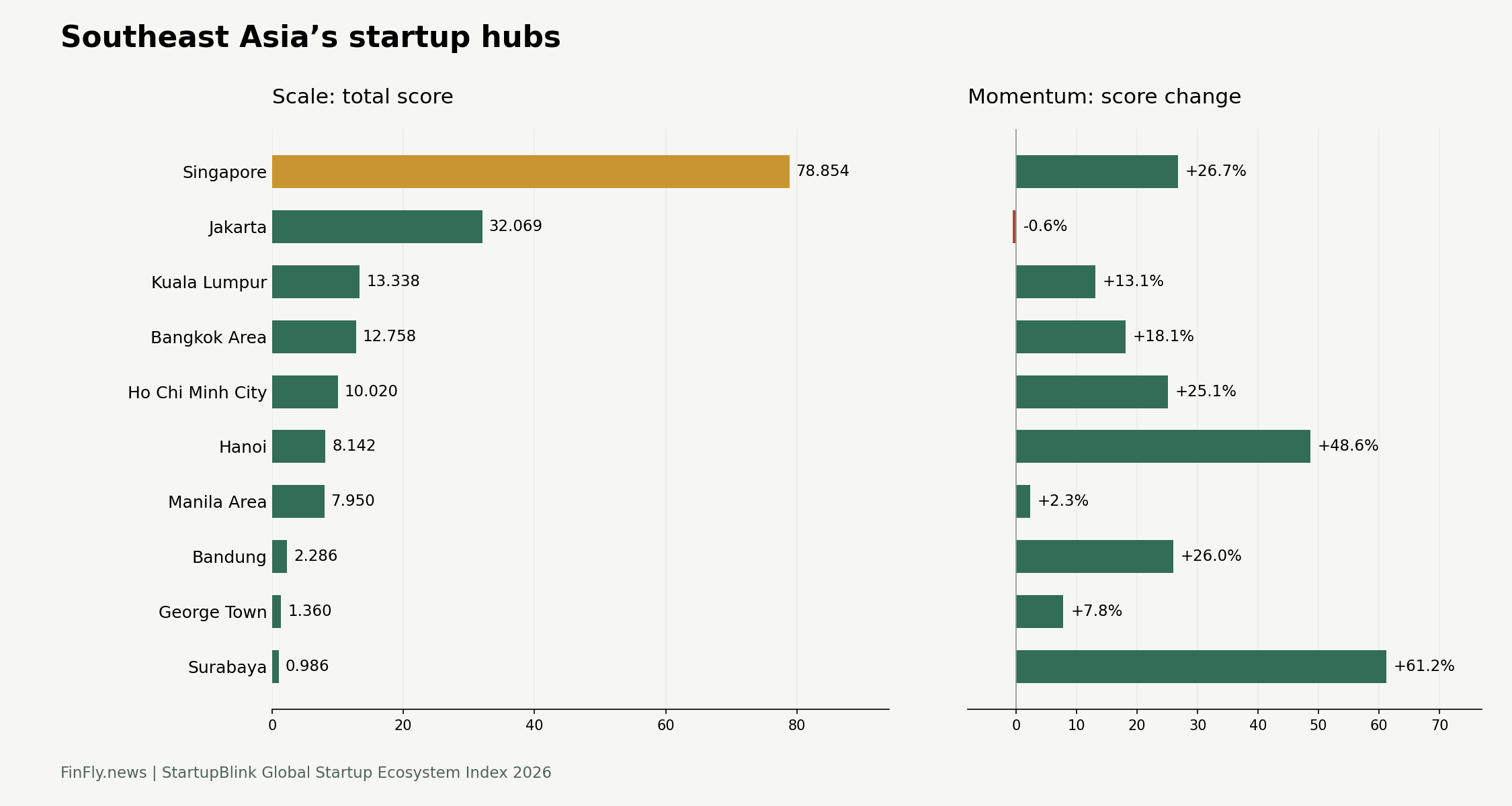
Singapore climbed two places to tenth globally as its score rose 26.7% to 78.854. Jakarta fell three places to 33rd, with its score edging down 0.6% to 32.069. The gap is widening through a combination of Singapore’s growth and Jakarta’s weaker performance.
Jakarta still has a sizeable buffer over the next group. Its score is around 2.4 times Kuala Lumpur’s. Progress further down the table therefore does not yet signal an imminent change in the region’s second-largest ranked hub. For the following cities, the immediate challenge is to narrow that distance.
Southeast Asia’s ten leading startup cities
The table selects Southeast Asian cities from StartupBlink’s 2026 edition. Ranks and scores come from the global city list, while growth figures are drawn from the report’s tables and country profiles. Score growth measures changes in a composite ecosystem assessment; it is not a measure of investment growth or new business formation.
| Regional rank | City | Country | Global rank | Score | Score change, % |
|---|---|---|---|---|---|
| 1 | Singapore | Singapore | 10 | 78.854 | +26.7% |
| 2 | Jakarta | Indonesia | 33 | 32.069 | -0.6% |
| 3 | Kuala Lumpur | Malaysia | 71 | 13.338 | +13.1% |
| 4 | Bangkok Area | Thailand | 76 | 12.758 | +18.1% |
| 5 | Ho Chi Minh City | Vietnam | 98 | 10.020 | +25.1% |
| 6 | Hanoi | Vietnam | 118 | 8.142 | +48.6% |
| 7 | Manila Area | Philippines | 121 | 7.950 | +2.3% |
| 8 | Bandung | Indonesia | 268 | 2.286 | +26.0% |
| 9 | George Town | Malaysia | 361 | 1.360 | +7.8% |
| 10 | Surabaya | Indonesia | 434 | 0.986 | +61.2% |
Vietnam develops two substantial hubs
Ho Chi Minh City rose 12 places to 98th globally. Hanoi reached 118th after climbing 30 places, with score growth of 48.6%. The two cities are relatively close: Ho Chi Minh City’s score is approximately 23% higher than Hanoi’s.
That differs from Indonesia, where Jakarta’s score is about 14 times Bandung’s. Vietnam offers two hubs of comparable scale within the index. This broadens the geographical range for finding teams and partners, although operating conditions still depend on the industry and the individual project.
Surabaya gains momentum from a smaller base
Surabaya’s score rose 61.2%, taking it up 44 places to 434th globally and into the regional top ten. It recorded the fastest growth in this group. Yet Jakarta’s total score remains more than 32 times higher. Rapid growth from a small base has not erased the accumulated difference in scale.
Indonesia now has three cities in the regional top ten, while Malaysia and Vietnam have two each. Bandung’s score grew 26%, but the city still lost seven places globally. Malaysia’s George Town gained 7.8% in score while falling 25 places. Competition beyond Southeast Asia means positive growth alone does not secure a higher global position.
What the changing map means for Azerbaijani businesses
Expansion planning should distinguish between finding a supportive environment for a company and identifying its sales market. Singapore remains the first reference point for ecosystem strength. A commercial shortlist should also include specific cities and potential industry partners in Indonesia, Vietnam, Malaysia and Thailand.
The ranking can help build that shortlist. The next stage is a business calculation: customer acquisition costs, product localisation, distribution access and the cost of a local team. The significant regional shift is a wider choice of locations. Singapore is strengthening its lead, while several other hubs are developing at different speeds and merit separate assessment.