San Francisco Bay remains first in the StartupBlink Global Startup Ecosystem Index 2026 with a score of 935.325, compared with second-placed New York’s 352.159. The gap is approximately 2.66-fold, but New York grew faster in the current edition: 11.6% against 9.7%.
London ranks third. The table shows absolute city scores and their changes, not investment volumes or the value of all local companies.
| Ecosystem | Global rank | Score | Score change, % |
|---|---|---|---|
| San Francisco Bay | 1 | 935.325 | 9.7 |
| New York | 2 | 352.159 | 11.6 |
| London | 3 | 197.557 | 5.4 |
| Los Angeles | 4 | 152.371 | 9.5 |
| Boston | 5 | 127.119 | -1.1 |
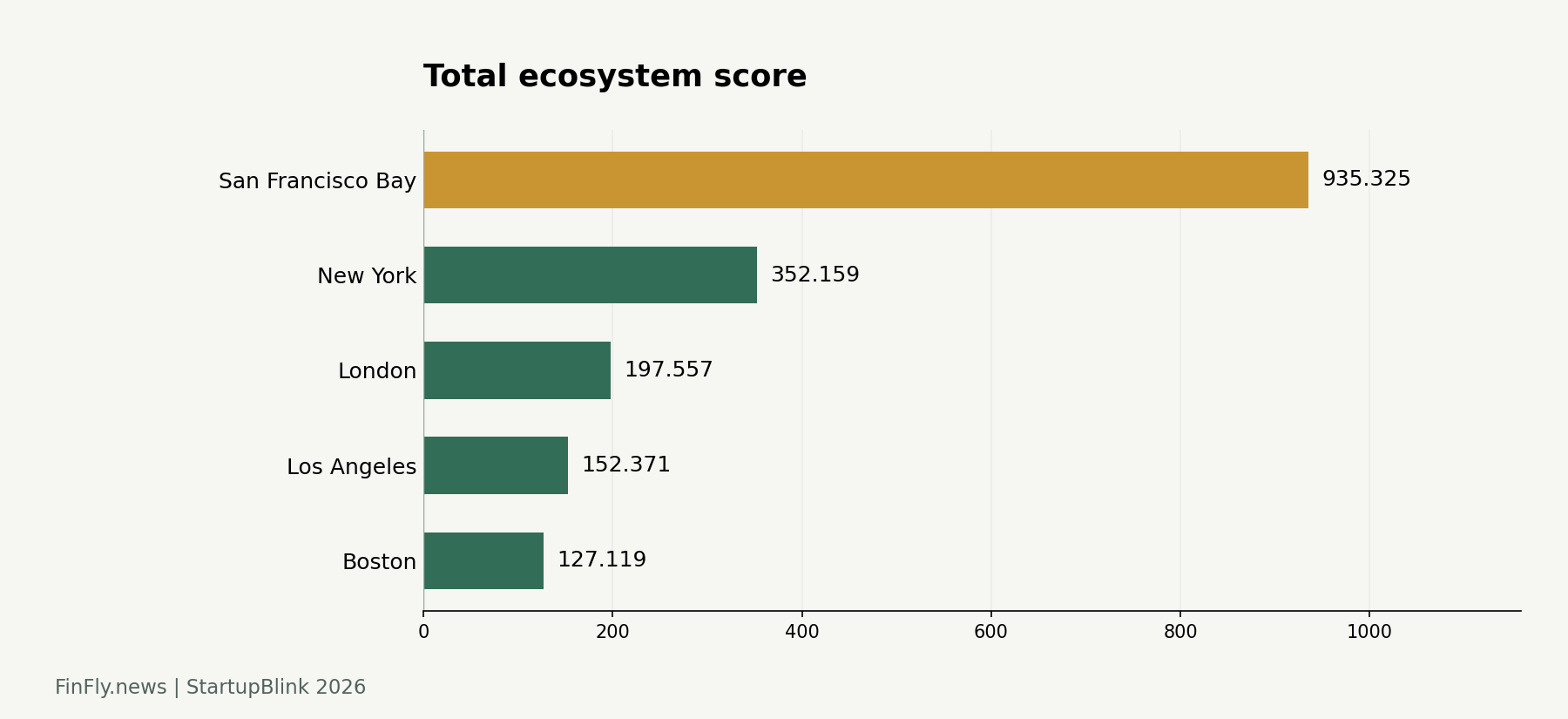
A wide lead is not necessarily a widening lead
The current gap and its direction are different measures. With New York growing faster, the figures do not support claiming that San Francisco widened its relative lead over the latest year. Longer-term comparisons depend on the starting date.
The report’s US profile links San Francisco’s longer-term strength to AI. Aggregate scores do not independently quantify how much of the difference between the cities comes from that industry.
New York occupies a separate tier
New York’s score is around 1.78 times London’s. Significant intervals separate the first three cities, rather than a group of nearly equal-sized ranked ecosystems.
Los Angeles and Boston form the next tier. Boston rose to fifth despite a 1.1% score decline, illustrating how ranking movement also depends on competitors.
What the index does not settle
Founders comparing major hubs need to consider product stage, customer type and relevant contacts. A high overall score guarantees neither investor access nor a particular cost structure.
The central distinction is between accumulated strength and current momentum. San Francisco retains a substantial lead, while New York improved faster over the period measured.