Riyadh has taken first place among Arab League startup cities and ranks 42nd globally, ahead of Dubai in 48th. In the 2026 StartupBlink index, the Saudi capital recorded 117.6% growth in its ecosystem score. For founders, the change is a reason to revisit their market shortlist before deciding where to expand.
Dubai lost a position, not all momentum
Dubai's own score rose 6.9%. The change in leadership therefore reflects different growth rates rather than an outright decline in Dubai. A city can improve its performance while losing places if its competitors advance faster.
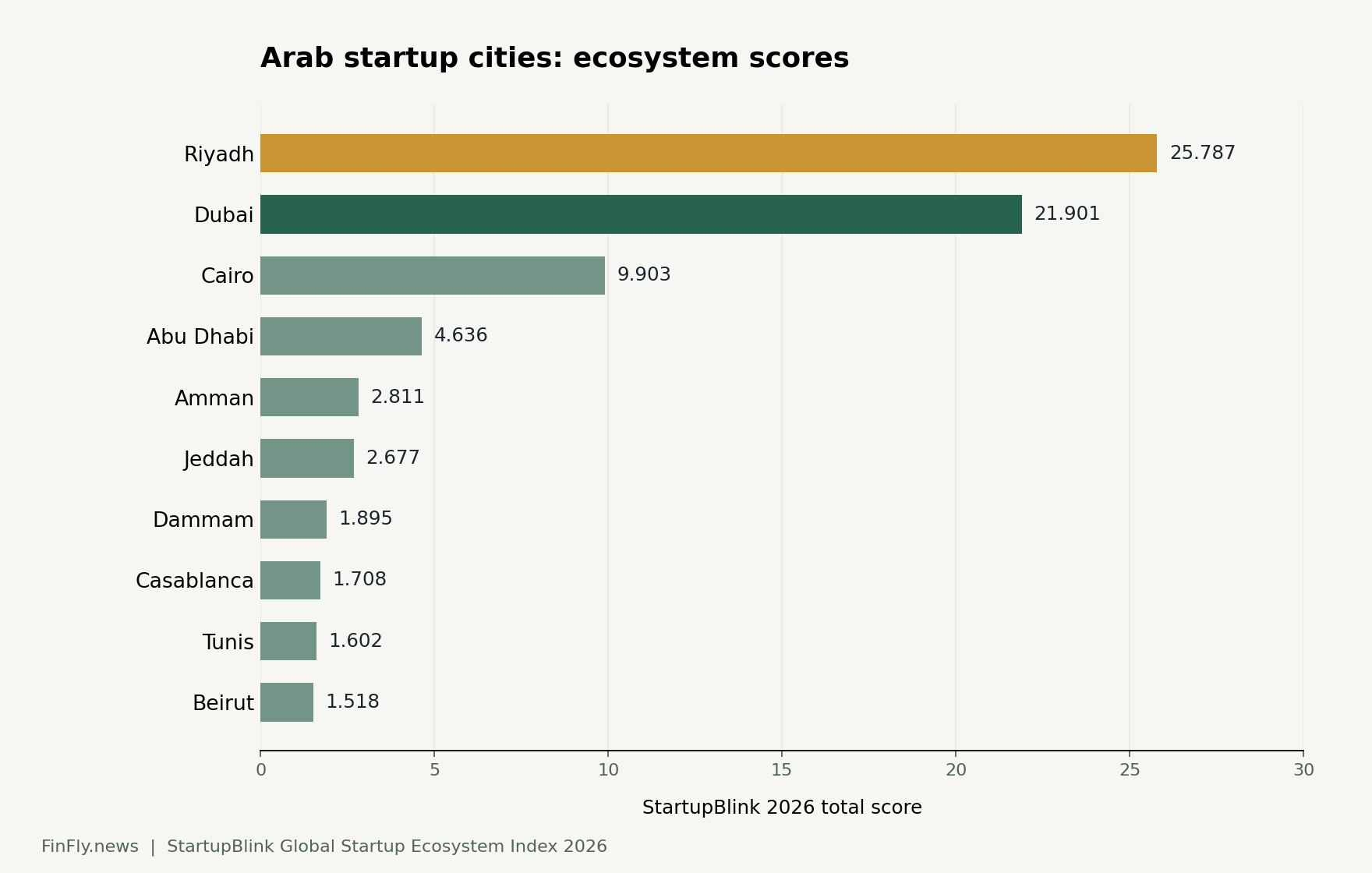
Riyadh's score of 25.787 is approximately 17.7% above Dubai's 21.901, calculated from the published figures. That is a gap within the index. It does not establish a corresponding difference in investment, customer numbers or successful businesses.
The ten leading Arab startup cities
The table brings together StartupBlink's city data for the Middle East and Africa, selecting Arab League countries. This is distinct from the ranking for the entire Middle East, which covers a different group of countries.
| Rank | City | Country | Global rank | Score | Score growth, % |
|---|---|---|---|---|---|
| 1 | Riyadh | Saudi Arabia | 42 | 25.787 | +117.6% |
| 2 | Dubai | UAE | 48 | 21.901 | +6.9% |
| 3 | Cairo | Egypt | 99 | 9.903 | +0.7% |
| 4 | Abu Dhabi | UAE | 173 | 4.636 | +14.2% |
| 5 | Amman | Jordan | 237 | 2.811 | +36.2% |
| 6 | Jeddah | Saudi Arabia | 241 | 2.677 | +41.0% |
| 7 | Dammam | Saudi Arabia | 300 | 1.895 | +49.2% |
| 8 | Casablanca | Morocco | 318 | 1.708 | +23.1% |
| 9 | Tunis | Tunisia | 330 | 1.602 | +22.8% |
| 10 | Beirut | Lebanon | 341 | 1.518 | +46.3% |
Saudi Arabia accounts for three cities and the UAE for two. The arithmetic average of score growth across these ten cities is 35.8%. This describes the selected group, not the entire Arab startup market.
A first-place city is only the starting point
The wider distribution of startup activity matters alongside the leader. More visible hubs can broaden the locations a company considers when looking for partners and testing demand. Yet inclusion in a ranking does not establish product-market fit. Industrial software, consumer applications and payment services will each have different prospective buyers.
A ranking can narrow the search. The next stage is to assess the economics of entry: customer acquisition costs, the time needed to agree a pilot, responsibility for procurement and the ability of a local partner to turn discussions into a contract. These answers turn ecosystem interest into a commercial plan.
What founders from Azerbaijan should compare
Start with the company's immediate objective. A business seeking its first overseas contract should identify relevant buyers and test demand. A company preparing a funding round needs to assess investors' sector focus, stage requirements and willingness to work with an overseas corporate structure. A city's position cannot answer those questions.
Registration, product localisation, staffing and sales support should have their own cost estimates. Licensing, data handling and customer-service requirements need to be checked for the particular activity. They cannot be inferred from a city's overall ranking.
Reading growth correctly
The 117.6% figure measures a change in an ecosystem score. It is not venture funding growth or an increase in startup numbers. These figures belong to the 2026 index edition, rather than a single month's performance.
The practical implication is a broader market shortlist. Riyadh warrants comparison alongside Dubai, while the final decision should depend on access to buyers, operating costs and the potential for recurring revenue. For an expanding startup, contracts and customer retention are more useful commercial tests than a ranking alone.