
Rapid revenue growth at a technology group does not, by itself, tell us whether the underlying business has become stronger. Acquired companies, currency movements and sales expansion at existing operations can all contribute. Founders and investors need to keep those effects separate.
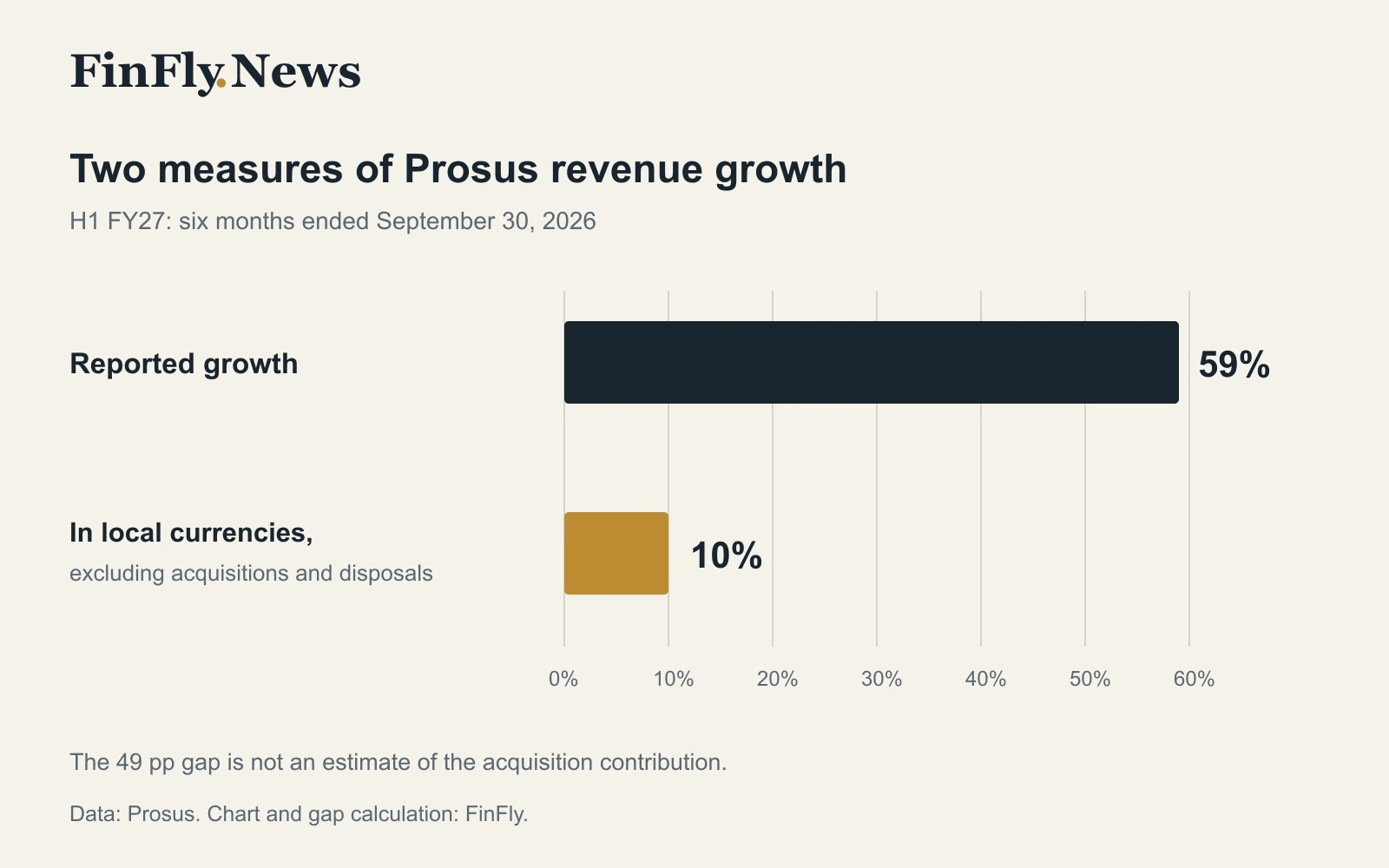
In its results for the six months ended September 30, 2026, Prosus reported ecosystem revenue of $5.7 billion. Growth was 59% as reported and 10% in local currencies excluding acquisitions and disposals. Adjusted EBITDA declined from $530 million to $492 million.
Why acquisitions cannot explain the entire gap
The gap between the growth rates is 49 percentage points. That is our arithmetic, not an estimate of the acquisition contribution. The second measure removes currency changes as well as changes in the business perimeter. Allocating the difference to individual causes requires a proper reconciliation.
For a local platform, this is a straightforward reporting lesson. Buying a competitor can increase total revenue without accelerating the original business. Currency translation can lift reported results without improving the economics of an individual order. Neither effect is inherently bad, but each answers a different question.
More sales do not guarantee more profit
The decline in adjusted EBITDA in these figures is $38 million, or approximately 7.2%. That metric is not net profit or free cash flow. Its decline does not prove every new investment is ineffective, because spending can precede returns. Nevertheless, revenue growth cannot substitute for explaining how and when investment will pay back.
| Observed measure | The next question |
|---|---|
| Total revenue growth | How much came from existing operations, deals and currency? |
| Customer acquisition costs | Will customers return when discounts end? |
| Adjusted EBITDA | How does it reconcile with cash flow and investment? |
| Claimed AI benefits | What remains after all costs and quality checks? |
An order-level test of the model
Consider a hypothetical platform earning AZN 10 in revenue per order. Fulfilment costs AZN 4, payments and support another AZN 1, and a platform-funded discount AZN 3. The contribution before fixed costs is AZN 2. Raising the discount to AZN 5 would reduce that contribution to zero at unchanged revenue.
This is a FinFly illustration, not a calculation from Prosus operating data. If the accounting treatment deducts a discount from revenue itself, it must not be deducted again as an expense. Definitions have to be aligned before the calculation starts; otherwise a tidy spreadsheet can still produce the wrong decision.
Where AI belongs in the calculation
AI should face the same test. The number of processed enquiries does not demonstrate savings if model costs, manual review and mistakes increase. A useful unit is the cost of a successfully completed process at comparable quality, not the cost of one generated response.
A pilot should define a control group or comparable baseline period, the full processing cost and the rate of repeat contacts in advance. A faster first answer is not necessarily progress if the customer has to ask three times. Maintaining quality while lowering total cost creates a stronger case for expansion.
What happens after the subsidy ends?
A particularly useful question for a platform is whether customers remain and contribute positively once a promotion finishes. It should be answered separately for groups acquired in different months, rather than hidden inside an overall average.
Prosus provides a reason to examine technology growth through several lenses. Scale describes how large the system has become. Comparable growth helps isolate existing operations. Order economics and cash flow test whether expansion can sustain itself. For Azerbaijan’s market, that discipline is more useful than importing another company’s growth percentage into a local business plan.