
Kalshi has announced $1 billion in funding at a $40 billion post-money valuation. The scale of the round puts a financial-infrastructure challenge at the center of the story: retaining trading activity and converting it into durable income.
According to the company’s October 29 announcement, Wellington and Sequoia co-led the Series G. Kalshi plans to expand its product range and institutional business. It also reports an annualized trading-volume run rate above $1 trillion.
Funding and valuation answer different questions
A funding round measures the size of an investor transaction. Valuation describes the negotiated value of the business in that transaction. Neither figure automatically represents annual revenue, profit or assets available to back customer positions.
Dividing $1 billion by $40 billion gives 2.5%. Without the transaction structure, however, that ratio cannot unconditionally be described as the new investors’ ownership stake. Secondary sales and instrument terms can matter. It is an arithmetic reference point, not a disclosed capitalization table.
Trading volume is not revenue
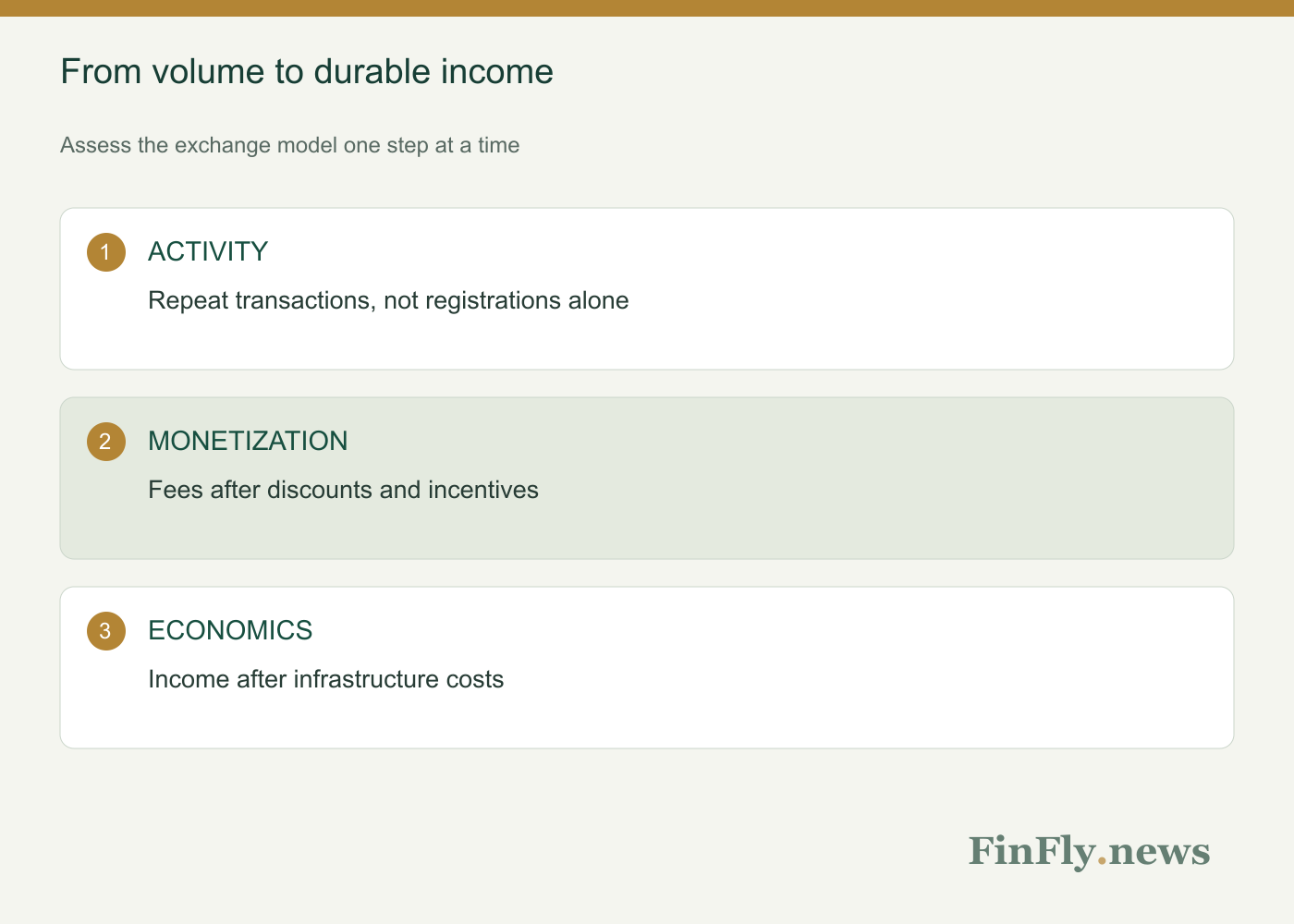
An exchange can process substantial trading volume while charging a relatively small fee. Economics depend on pricing, discounts, liquidity incentives and the cost of supporting transactions. Volume growth becomes meaningful alongside a clear monetization model.
An annualized run rate also differs from a completed year’s result: it extrapolates current activity. An unusually eventful period may not be representative of the months that follow. The measure is informative, but its time basis must remain visible.
| Metric | What it measures | What it does not measure |
|---|---|---|
| Post-money valuation | Negotiated business value | Cash held by the company |
| Trading volume | Value of transactions | Platform revenue |
| Fee revenue | Transaction monetization | Profit after expenses |
| Annualized run rate | An extrapolated current pace | A completed annual result |
These metrics are not interchangeable. Funding-to-valuation ratio calculated by FinFly.
New markets need their own liquidity
A larger product range does not automatically transfer activity into every new contract. Buyers and sellers need opposing orders, acceptable spreads and the ability to execute the required size.
Distribution spending therefore needs to be assessed alongside market quality. Acquiring users without sufficient order-book depth may increase registrations without creating a dependable trading experience.
What would demonstrate scalable economics
A useful assessment would examine repeat trading activity, revenue after incentives, market depth and operational resilience during peaks. Institutional participation adds requirements around permissions, reporting and reliable settlement.
For regional fintech founders, the transferable lesson is about sequence: funding creates room to build infrastructure, while repeatable transactions demonstrate its economics. A high valuation does not remove the need to show how a product earns income after all relevant costs.