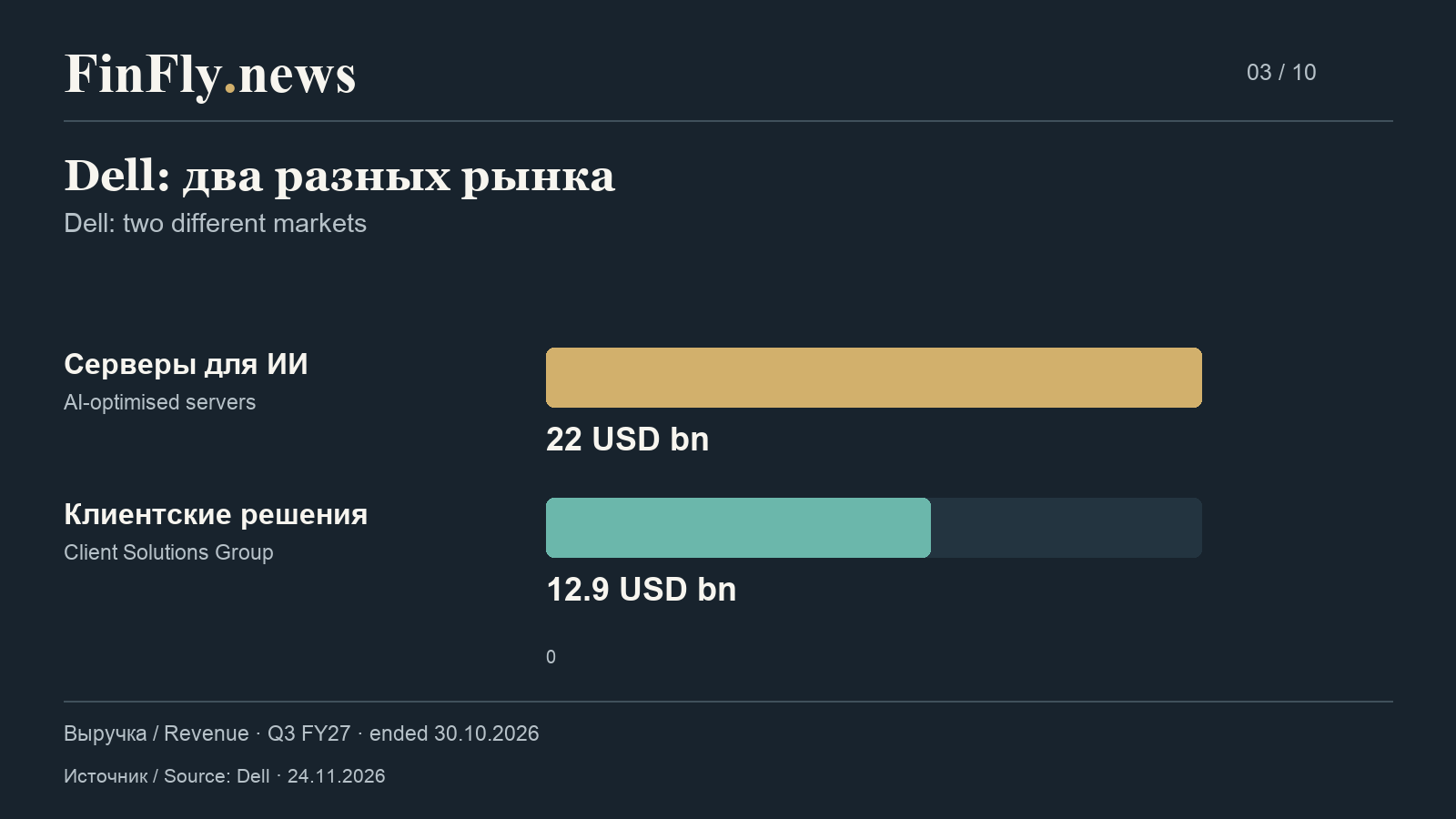
Dell reported $22 billion in AI-optimised server revenue, up 291% year on year, while Client Solutions Group revenue reached $12.9 billion, up 3%. The November 24 release covers fiscal 2027's third quarter, which ended on October 30, 2026. For buyers, the useful signal is the difference between infrastructure and client-device demand.
Supplier sales do not measure buyer returns
FinFly's assessment is that strong demand does not establish the payback of an individual deployment. Ownership can make sense for sustained workloads, data-placement requirements or predictable compute demand. An experimental workload may leave expensive capacity idle.
Compare the complete annual cost: hardware and financing, electricity, cooling, hosting, support, software and redundancy. For cloud services, include data transfer, storage, support and contractual minimums. A GPU purchase price and a rental hourly rate are not sufficient inputs.
Calculate a utilisation threshold
Consider an illustrative FinFly scenario: an owned configuration costs AZN 60,000 annually with all assumed costs included. A comparable cloud configuration with matching performance and service costs AZN 12 per billed hour. The simple break-even point is 5,000 hours: 60,000 divided by 12, or roughly 57% of the year's calendar hours. These are assumed figures, not Dell or cloud-provider quotations.
The comparison changes if some jobs cannot run on the owned system, a cloud commitment reduces the hourly price, or the ownership budget omits backup capacity. Recalculate for the actual workflow and equivalent availability requirements.
Make procurement measurable
Specify useful output, execution time, acceptable downtime and an operating owner. Measure representative workloads before committing to a configuration. Equipment demand is evidence of supplier sales; the buyer's decision needs its own utilisation and cash-benefit case.