Alibaba's November 19 results, covering the quarter ended September 30, show AI Cloud and Compute Services revenue rising 53% to approximately RMB 61 billion. AI Labs and Applications reported a RMB 10.5 billion adjusted EBITA loss, with investment and Qwen inference costs contributing to the increase. These are different segments and should not be combined into one AI profitability measure.
A request is not a completed task
FinFly's implication for business buyers is to measure the cost of a result accepted by an employee or customer. Cheap requests can involve retries, checking and correction. Reducing the provider's invoice does not necessarily reduce the cost of the process.
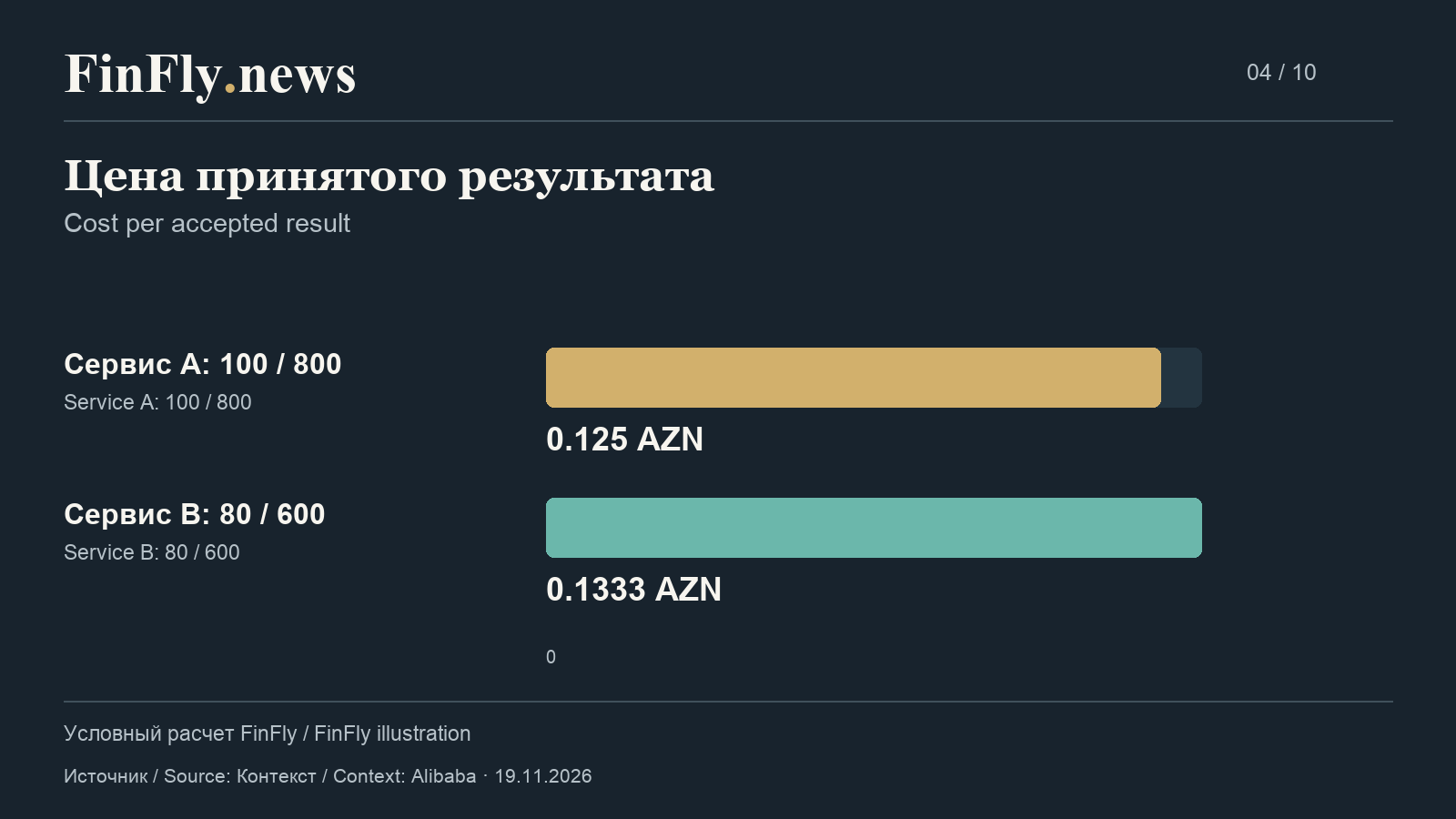
In an illustrative comparison, two services each process 1,000 requests. One costs AZN 100 and produces 800 acceptable results: AZN 0.125 per accepted result. Another costs AZN 80 and produces 600: about AZN 0.133. The smaller invoice comes with the higher unit cost. This is a FinFly model, not an assessment of Alibaba products.
Include the surrounding work
Add reviewer time, storage, integration, monitoring and exception handling to the request charges. Use identical documents and quality standards when comparing systems. Otherwise, task difficulty can be mistaken for a difference in model efficiency.
Check where spending is concentrated. A few long documents or repeated attempts may account for a large share of the bill. Context, retry and transaction limits can make budgets more predictable, provided required quality is preserved.
Set the pilot's acceptance criteria
Before deployment, define the share of accepted outputs, cost per completed task and processing time. Tie expansion to those results. Supplier revenue growth establishes demand for the supplier's services; the customer's savings still need to be measured separately.