Latin America’s startup growth extends beyond its best-known major hubs. Medellin climbed 15 places to 130th in the StartupBlink Global Startup Ecosystem Index 2026, with 31.1% score growth. Several Brazilian cities also advanced globally.
Rio de Janeiro, Curitiba, Belo Horizonte and Porto Alegre are inside the top 200. Florianopolis ranks 247th with 57.1% growth. This is a selection of improving hubs, not a complete regional ranking.
| Ecosystem | Global rank | Score | Score change, % |
|---|---|---|---|
| Medellin | 130 | 7.218 | 31.1 |
| Rio de Janeiro | 138 | 6.586 | 19.9 |
| Curitiba | 146 | 6.043 | 10.5 |
| Belo Horizonte | 157 | 5.539 | 14.7 |
| Porto Alegre | 196 | 3.814 | 27.1 |
| Florianopolis | 247 | 2.63 | 57.1 |
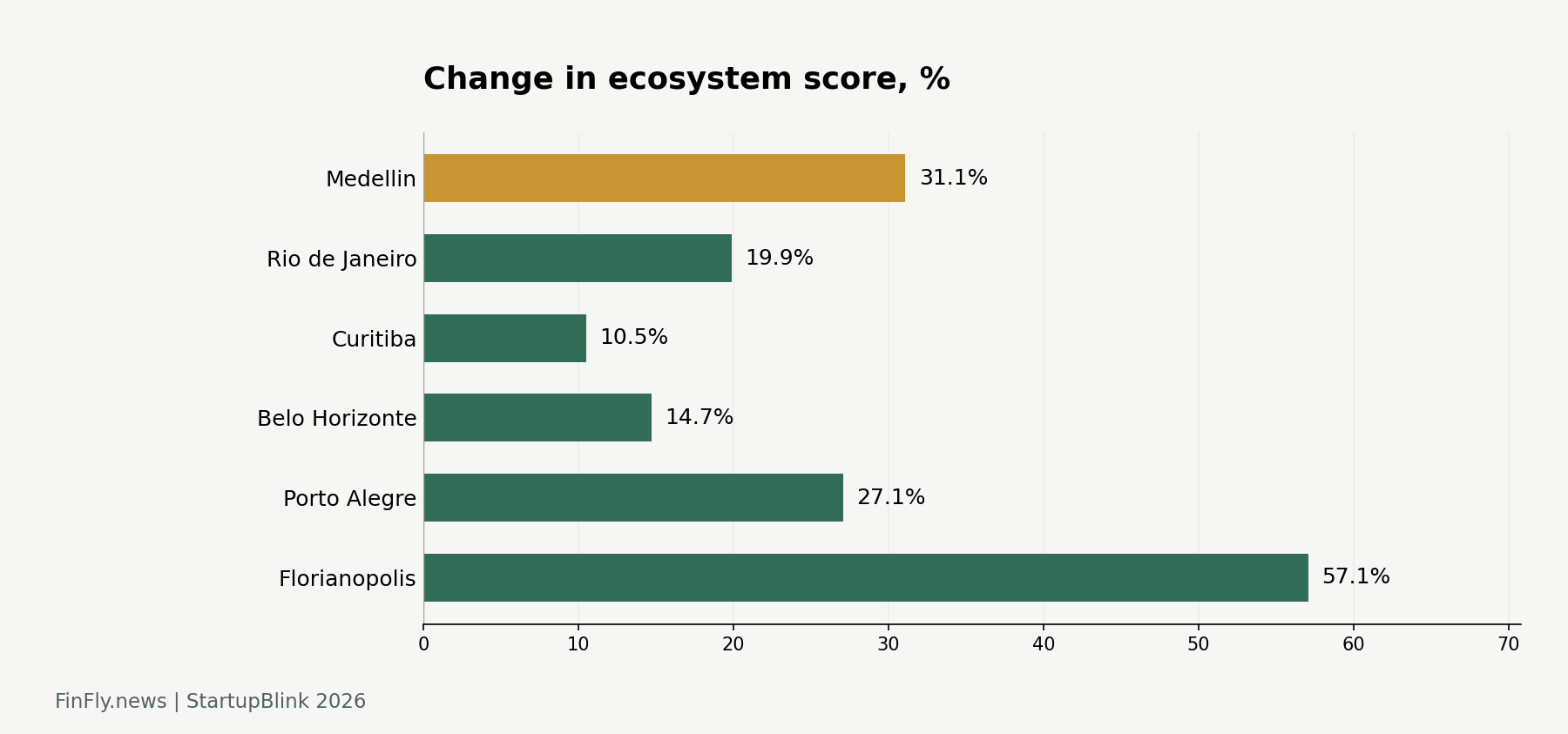
Different measures of progress
Medellin has the highest total score in this selection, while Florianopolis has the fastest growth. The distinction separates accumulated ecosystem scale from current momentum.
Florianopolis climbed 31 places, but its score remains less than half Medellin’s. Both scale and momentum can inform partner searches without establishing the quality of an individual company.
Brazil’s geographical footprint widens
Within the 201-1,000 tier, 14 Brazilian cities rose at least 30 places, according to the report. Progress therefore extends beyond one major business centre.
The ranking alone does not establish the causes. Claims about support programmes, universities or investors require additional city-specific evidence.
Using the map for business research
The selected locations offer further directions for overseas partner searches. Industry fit, working language, international customers and sales organisation should guide the next assessment. Neighbouring ranking positions do not make Brazil and Colombia identical markets.
The broader result is a more varied group of visible ecosystems behind the leading cities, suitable for investigation against specific commercial needs.