

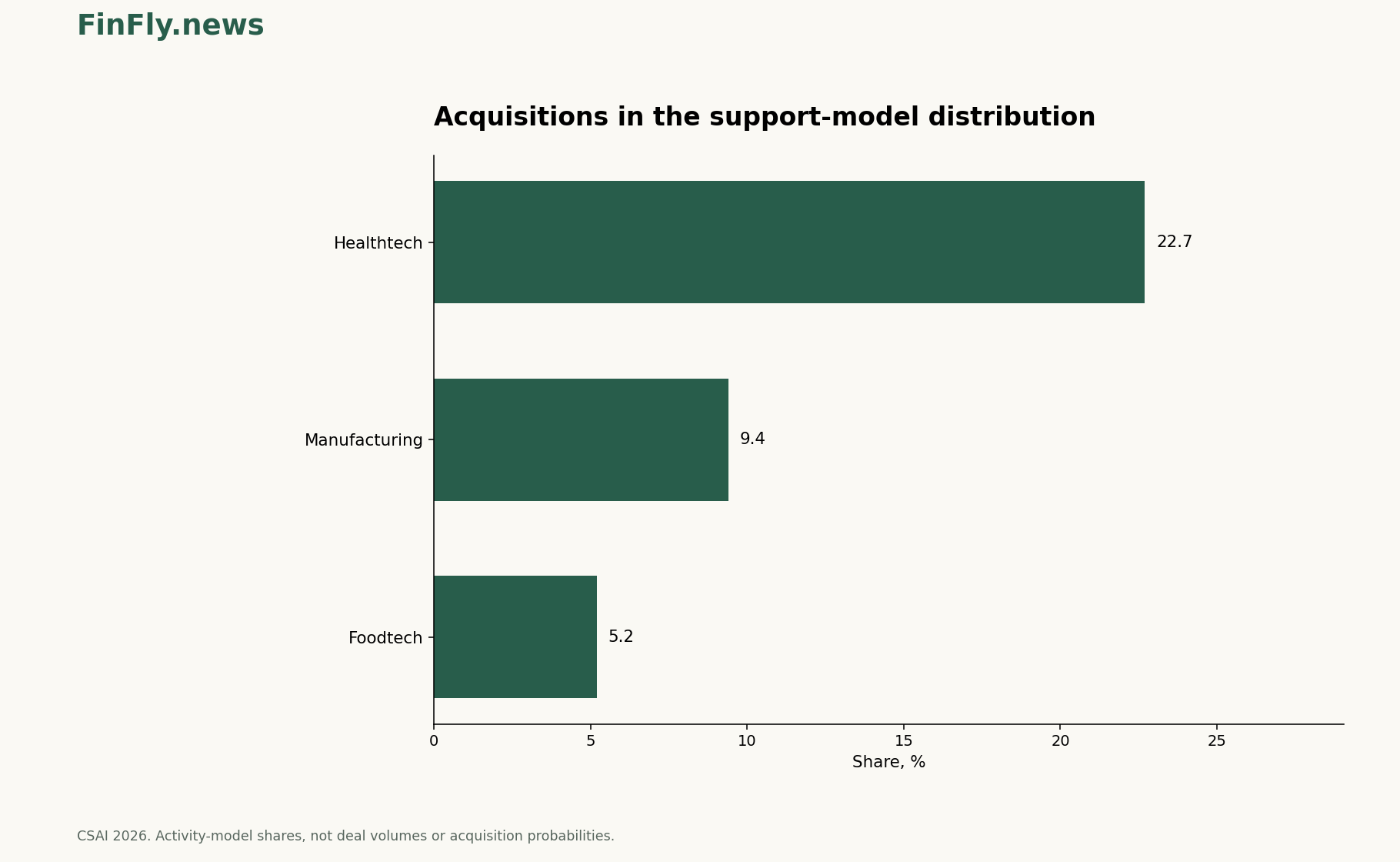
Startup acquisitions account for 22.7% of the support-model distribution shown for Healthtech, compared with 5.2% for Foodtech in the Corporate Startup Activity Index 2026. Such differences help explain why the same startup presentation can meet different responses across industries.
Three models with different implications
An acquisition involves a change of control. Equity investment leaves room for independent development while changing ownership. A cohort programme provides a structured development process and does not itself imply investment or acquisition.
In Healthtech, corporate startup investment programmes represent 47.9% of the displayed distribution and cohort programmes 24.9%. Foodtech shows 35.5% and 45.9% respectively. Manufacturing is more heavily weighted toward investment programmes at 58.5%, with cohort programmes at 14.9%.
| Category | Investment programmes, % | Cohort programmes, % | Acquisitions, % |
|---|---|---|---|
| Healthtech | 47.9 | 24.9 | 22.7 |
| Foodtech | 35.5 | 45.9 | 5.2 |
| Manufacturing | 58.5 | 14.9 | 9.4 |
The numbers describe engagement formats
These shares are not probabilities that a startup will be acquired, nor allocations of invested dollars. The report includes several activity categories; the remainder covers challenges, events, in-kind support and other displayed forms. The three selected columns should not add up to 100%.
The differences can nevertheless guide an approach. An investment conversation needs a credible business-value growth case. A development programme requires alignment with its objectives and a team able to participate. A potential acquisition requires a clear rationale around technology, people or market access. This is an editorial interpretation of the formats, not a forecast of individual transactions.
Define the desired outcome first
Founders should establish whether they want capital, industry expertise or an exit. They can then check which instrument the corporate team actually offers. A logo appearing on both an accelerator website and a ranking does not mean that the relevant unit handles every type of deal.
Industry structure saves time by framing the first question. The final decision still depends on the specific offer, participation terms and owners’ objectives rather than an average sector percentage.