The central bank’s foreign-currency reserves increased 33.4% over nine months. The regulator purchased currency as market supply exceeded demand.
Foreign-currency purchases and reserve accumulation
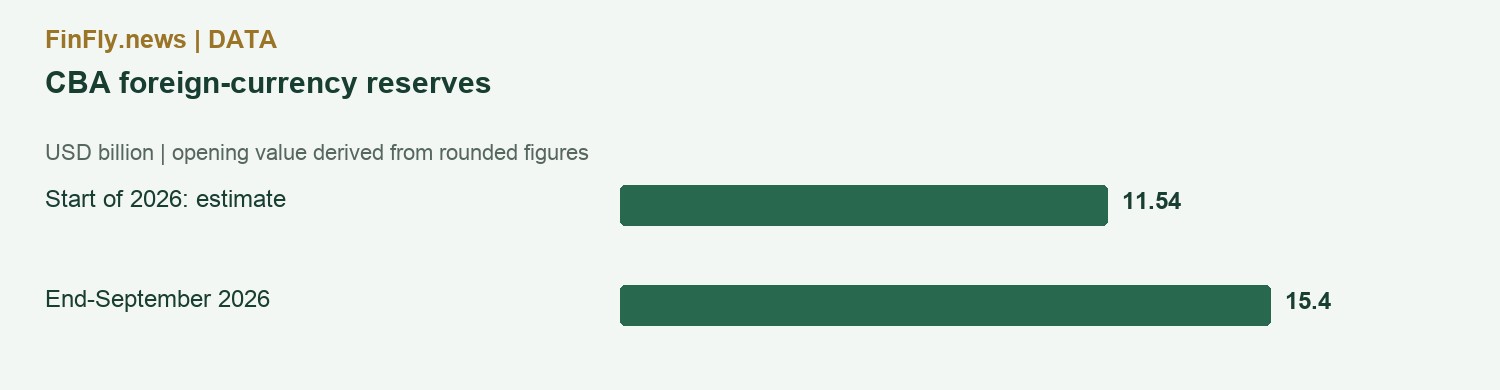
The CBA reported foreign-currency purchases as demand declined and supply increased. Its reserves reached $15.4 billion after nine months, up 33.4%. These are the central bank’s reserves, not the state’s total financial assets.
The rounded figures imply an opening balance of about $11.54 billion and an increase of roughly $3.86 billion. That is an estimate of the change in reserve holdings, not a reported intervention total. The release does not fully break down the sources of the increase.
Net purchases in the cash currency market
In January-September, exchange offices bought $759 million more in cash foreign currency from customers than they sold to them. Customers were therefore net sellers of cash foreign currency to exchange offices.
This covers the cash segment. It is neither the total national foreign-currency surplus nor a complete account of non-cash market transactions. Alongside the CBA’s purchases, however, it helps explain why the regulator describes supply as exceeding demand.
| Measure | Value | Period / meaning |
|---|---|---|
| CBA reserves | $15.4bn | End of nine months |
| Reserve increase | 33.4% | Since year-start |
| Net cash FX purchases by exchange offices | $759m | January-September; purchases from customers less sales |
Reserve adequacy and currency-market stability
Buying foreign currency increases the external reserve buffer and also affects manat liquidity. Currency transactions therefore need to be considered alongside liquidity data and the tools used to absorb it. They are connected parts of monetary policy.
For importers, ready access to currency can simplify settlement planning. Today’s excess supply is not a guarantee of any future exchange rate, however. Export receipts, imports, capital flows and policy choices remain important. A larger reserve buffer helps manage changes in those flows without eliminating them.
Further foreign-currency purchases are possible before year-end
At the 29 October press conference, Taleh Kazimov said the CBA could purchase around another $1 billion in foreign currency over the remaining two months of the year. He said the regulator has no fixed reserve target at which purchases must stop.
Decisions will depend on currency-market conditions and the assessed inflationary effects of issuing manat to purchase foreign currency. The figure is therefore an expected transaction volume, not a guaranteed increase in reserves, whose final value also reflects asset revaluation and other operations.