
Luxembourg ranks 33rd among countries in the Corporate Startup Activity Index 2026, while Malta is 54th. Each has just one company in the corporate table: ArcelorMittal and GO plc respectively. The pairing illustrates how carefully a short national list needs to be interpreted.
A company score is not a country position
ArcelorMittal scores 56.527 and ranks 574th globally among corporations. GO plc scores 67.843 and ranks 483rd. The Maltese company places higher, yet Malta places below Luxembourg in the country ranking.
The explanation lies in the research design. Country scores reflect domestic corporations alongside startups’ foreign corporate connections, research presence, collaboration programmes and the business environment. They are also population-adjusted. Corporate and country positions are therefore not interchangeable.
| Country | Corporation | Score | Corporate rank |
|---|---|---|---|
| Luxembourg | ArcelorMittal | 56.527 | 574 |
| Malta | GO plc | 67.843 | 483 |
| Estonia | Kaamos Group | 13.446 | 1110 |
| Estonia | Bolt | 4.803 | 1151 |
A narrow sample is a signal, not a diagnosis
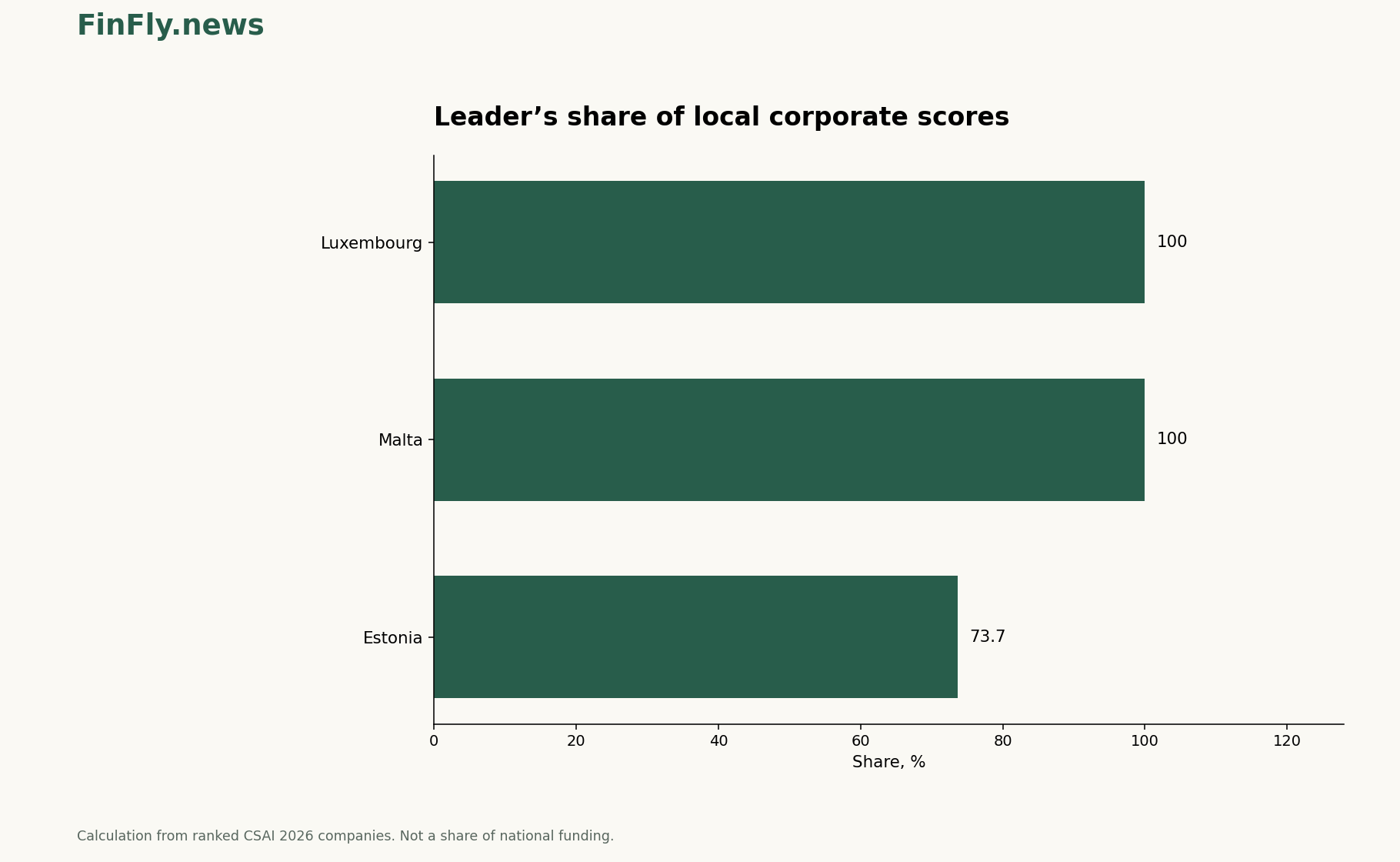
A sole company necessarily represents 100% of the combined scores of locally headquartered ranked corporations. That is sample arithmetic. It does not mean control over every investment in the country or the absence of other organisations supporting startups.
Estonia offers a useful comparison. Its two ranked companies are Kaamos Group with 13.446 points and Bolt with 4.803. Kaamos accounts for approximately 73.7% of their combined score. This describes concentration within a two-entry corporate table, not the economic dependence of the entire Estonian ecosystem.
The practical exposure
A founder relying on a single familiar programme can lose an important development channel when that programme changes priorities. This is a company-level risk regardless of how many corporations appear in a report. Several potential partners, alternative applications and overseas programmes provide more options.
Assessing national resilience requires additional evidence: active corporate customers, repeat transactions, industry coverage and financing distribution. A single ranked participant is a reason to investigate more broadly, rather than declare an entire country a one-corporation market.