Expanding exports support Georgia’s external finances. Assessing the durability of that growth requires separating the value of goods crossing the border from domestic business income and value added within the country.
According to preliminary Geostat figures, January-September exports reached $6.15 billion, up 19.6%, while imports totaled $14.38 billion. The merchandise deficit was $8.23 billion. These figures cover goods, not the entire balance-of-payments current account.
Goods can cross the border without domestic manufacturing
In its rating review, Fitch highlights the role of vehicle exports without a local manufacturing base and refined oil products made from imported crude. This does not make trading activity unproductive, but it changes the test of its resilience.
A re-exporter earns through trading margins, logistics, storage, financing and related services. The full sale value of an exported vehicle does not become a contribution to GDP. Similarly, refined-product revenue includes the cost of purchased crude: processing activity and the margin retained domestically are the relevant components.
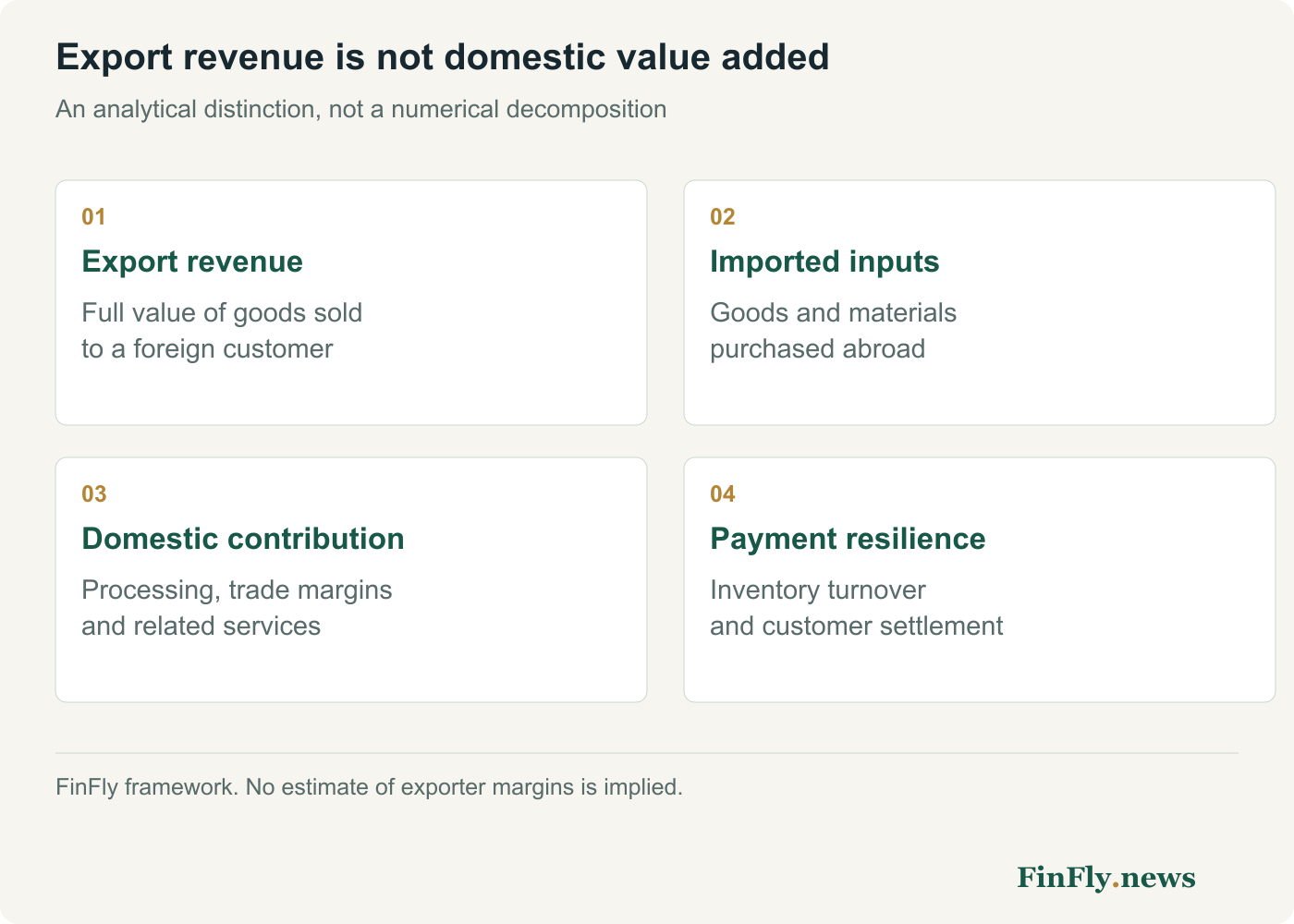
Three measures that are not interchangeable
Export revenue measures sales abroad. Value added measures output after intermediate inputs. The net foreign-currency contribution also depends on import payments, settlements and other external transactions. Large gross receipts can therefore coexist with a much smaller domestic economic contribution.
Rapid export growth may produce only a limited improvement in net external earnings. Conversely, a smaller increase with substantial domestic inputs can provide a more durable contribution than a large low-margin turnover. This is an analytical distinction, not a claim about the actual margins of Georgian firms.
| Model | Domestic contribution | Main dependence |
|---|---|---|
| Re-exporting | Margins and related services | Purchasing goods and market access |
| Processing imported inputs | Processing activity and services | Input prices, energy and utilization |
| Locally based production | Domestic production activity | Productivity and demand |
FinFly framework, not an estimate of model shares or exporter profitability.
A better current account can coexist with a goods deficit
Fitch reports that the current-account deficit narrowed to 2.9% of GDP in 2025 from 5.1% in 2024. On a rolling four-quarter basis it reached 1.5% of GDP in the second quarter of 2026. Comparing that directly with nine-month merchandise trade is inappropriate: both coverage and measurement periods differ.
The current account includes services and primary and secondary income as well as goods. Receipts elsewhere can offset part of a merchandise deficit. Evaluating the reliability of that offset requires examining the individual flows rather than assuming that one industry explains the entire difference.
What regional businesses should examine
Suppliers and lenders need to assess buyer concentration, inventory turnover, funding access and settlement terms. When goods must be purchased abroad before resale, a customer’s late payment can raise working-capital needs even while reported sales increase.
A durable export expansion is supported by domestic value added, repeat orders and manageable payment risks, not turnover alone. For Azerbaijani firms assessing Georgian partners, the practical lesson is to examine trading scale and the capacity to pay on time as two distinct questions.