Fitch has revised Georgia’s sovereign rating outlook to Positive from Stable while affirming the rating at BB. The October 30 decision recognizes stronger external finances, but it is not an upgrade to a higher rating category.
In its rating announcement, Fitch points to reserve accumulation, a narrower current-account deficit and resilient growth. Two separate developments must be distinguished: the outlook improvement has occurred; a future rating upgrade remains a possibility, not a commitment.
Higher reserves, but a remaining external-buffer gap
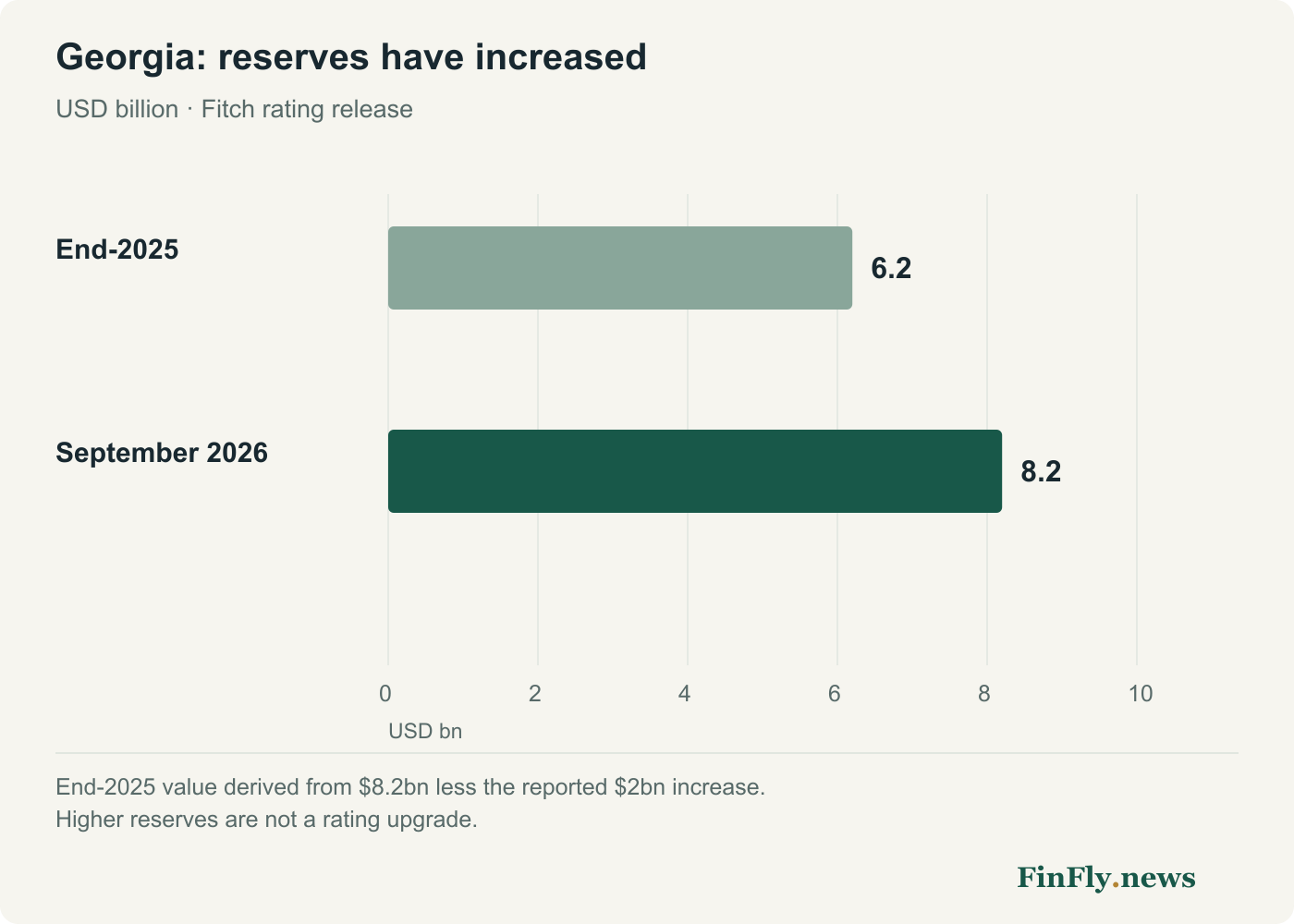
International reserves reached $8.2 billion at the end of September, $2 billion above their end-2025 level. Fitch links the accumulation to an improving external balance, capital inflows and stronger resident demand for lari assets.
Nevertheless, reserves cover less than four months of current external payments, compared with a 4.5-month peer median. A record dollar amount therefore does not mean external vulnerability has disappeared. The size of the buffer must be assessed against the payments it may have to support.
Economic growth supports the public finances
Fitch forecasts GDP growth of 7.5% in 2026. This is a full-year forecast, not a completed annual result. It expects growth subsequently to move toward an estimated medium-term potential of about 5%.
The agency forecasts government debt at 32% of GDP in 2026, against a 52% median for BB peers. A relatively moderate debt burden provides fiscal space, although the currency composition of those liabilities remains an important qualification.
| Indicator | Value | Status |
|---|---|---|
| Sovereign rating | BB | Affirmed |
| Outlook | Positive | Revised October 30 |
| International reserves | $8.2bn | September 2026 |
| GDP growth | 7.5% | Fitch forecast for 2026 |
| Government debt | 32% of GDP | Fitch forecast for 2026 |
Fitch. Forecasts should not be presented as completed annual results.
Foreign-currency exposure still matters
Foreign currency accounts for more than 60% of government debt. Long maturities and concessional terms on much official-sector lending mitigate the risk, but exchange-rate changes can still affect the domestic-currency value of obligations.
Bank deposit dollarization declined to 43% in September from 54% in February 2025. This reduces one vulnerability without removing political risks or the external balance’s reliance on durable export receipts. The direction is favorable; the remaining exposure is still material.
What the decision changes for businesses
A Positive outlook improves the direction of the sovereign risk assessment. It neither sets a new borrowing rate for every company nor guarantees cheaper credit. Currency, maturity, collateral and borrower-specific cash generation remain central to financing terms.
For Azerbaijani businesses working with Georgian partners, the decision updates the country-risk backdrop. Counterparty analysis still requires a review of cash flows and settlement currencies. The next meaningful test is whether stronger external finances persist beyond the current phase of rapid economic growth.