
Azerbaijan’s hotel industry maintained nominal revenue despite a decline in guest nights. That combination changes the central business question: visitor traffic matters, but so do revenue generated during each stay, additional services and property operating costs.
The State Statistical Committee’s January-September 2026 report records the following results:
| Indicator | Result | Versus January-September 2025 |
|---|---|---|
| Guest nights | 3.239 million | -6.6% |
| Revenue | AZN 497.3 million | +0.6% |
| Bed-capacity utilisation | 23.0% | Previously 25.0% |
Revenue per guest night is not a room rate
These totals imply approximately AZN 153.5 in overall revenue per guest night, 7.7% above the comparable calculated figure a year earlier. This must not be described as the average room rate: total hotel revenue includes other services, while nights are counted by guest.
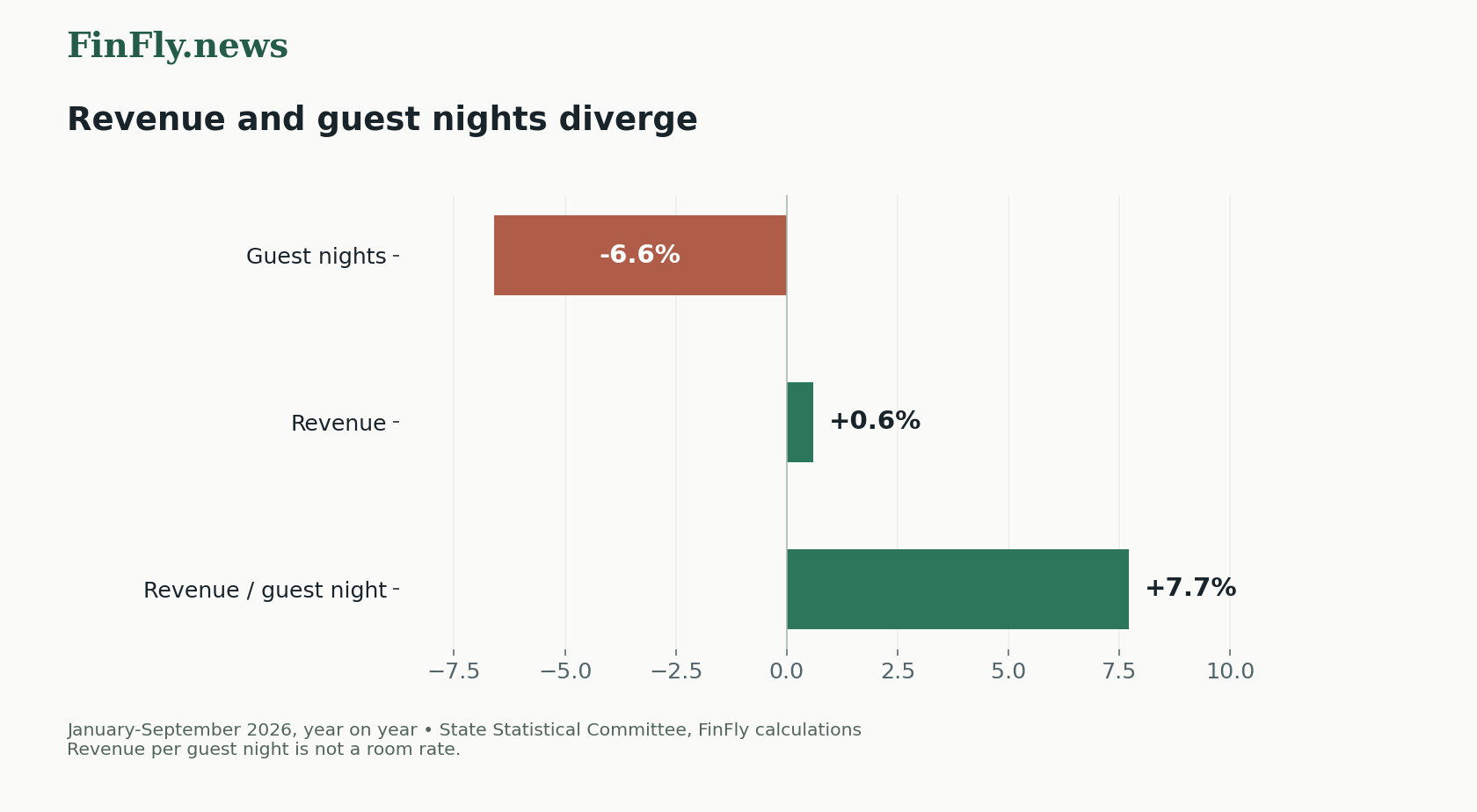
The divergence could reflect higher accommodation prices, a different guest mix, food sales or additional services. Demand could also have shifted between properties in different price brackets. Aggregate results do not isolate these explanations. They cannot support a claim that every hotel increased prices by the same percentage.
Stable sales leave the profit question unanswered
Hotels carry costs that continue regardless of guest numbers: building upkeep, part of the payroll, equipment servicing and financing. Lower utilisation spreads those costs across fewer sold guest nights. A modest increase in turnover can therefore coexist with pressure on operating margins.
The reverse is also possible. A property may reduce variable costs or sell more high-margin services. Determining which effect dominates requires operating expenditure and profit data. The published revenue total does not by itself establish improved profitability.
Where visitor spending goes
Travel spending is divided among accommodation, dining, transport, excursions and shopping. Visitors buy some of these services outside their hotel. A hotel report consequently describes one market segment, rather than tourism’s entire economic contribution. It cannot rank the earnings of restaurants, transport providers or regions.
An independent restaurant near a hotel depends on guests spending beyond the property. A hotel with its own restaurant benefits when a larger share stays within the complex. The same number of guest nights can produce different revenue outcomes for neighbouring businesses under these models.
What to assess before expanding
A new property requires a comparison of seasonal utilisation, realised room rates, ancillary income and full operating costs. An annual average can conceal both capacity shortages on peak dates and lengthy periods of weak demand. National results cannot replace a location-specific business case.
The main statistical signal is the gap between physical activity and the financial result. The industry preserved turnover, but business resilience depends on the amount remaining after expenses. The next useful question concerns the economics of existing properties as much as the number of new hotels.