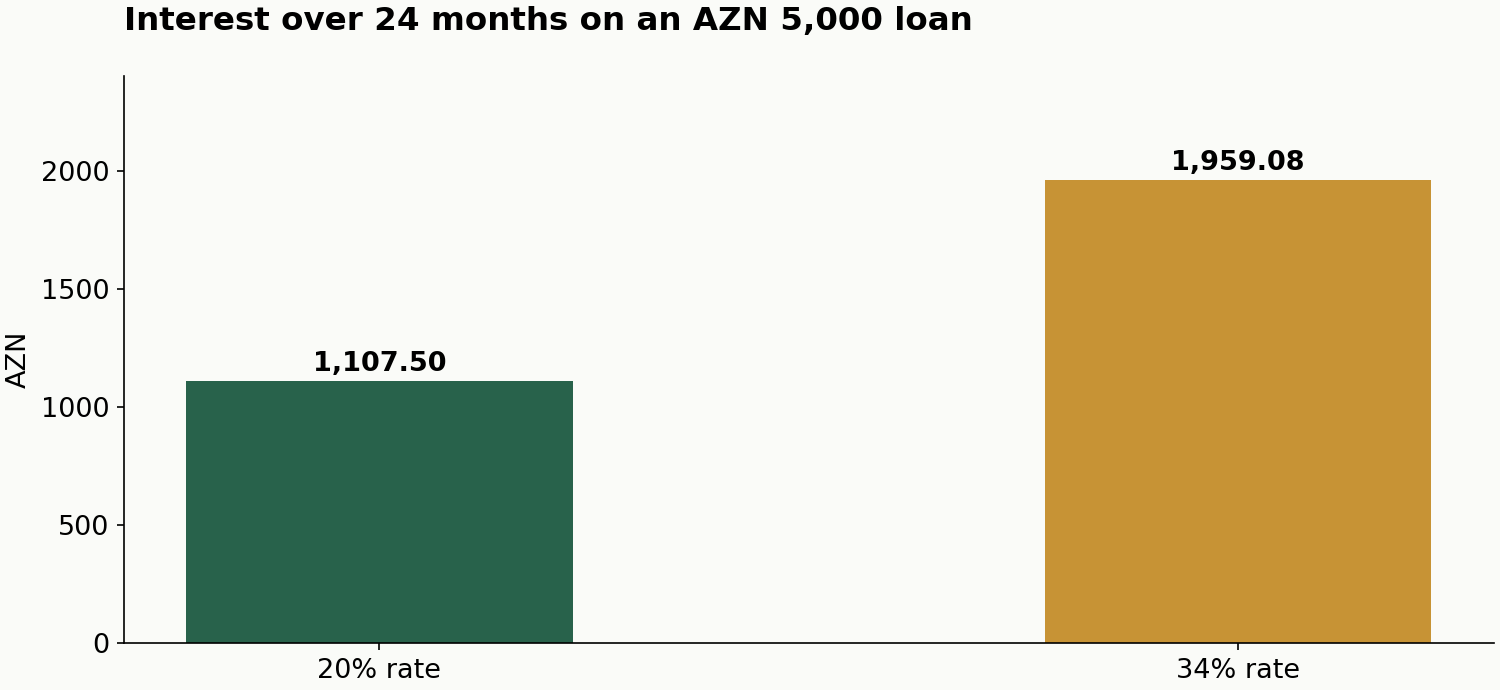
For a two-year AZN 5,000 loan, increasing the annual rate from 20% to 34% adds about AZN 852 to total interest costs when all other assumptions are held constant. The monthly payment rises from AZN 254.48 to AZN 289.96. FinFly's calculation assumes equal monthly payments and excludes fees and insurance.
Both rates appear in the CBA's September 30, 2026 statistics. Banks report an average of 20% for “other consumer loans”, while non-bank credit institutions report 34% for manat-denominated consumer loans.
The cost of a 14-percentage-point difference
The model assumes the borrower receives the full principal at the outset and repays it over 24 months. The rate is fixed, with the monthly rate equal to the annual rate divided by 12. Each payment includes interest on the outstanding balance and principal repayment.
| AZN 5,000 over 24 months | 20% annual rate | 34% annual rate |
|---|---|---|
| Monthly payment | 254.48 | 289.96 |
| Total payments | 6,107.50 | 6,959.08 |
| Interest included | 1,107.50 | 1,959.08 |
The monthly difference is about AZN 35.48. Over the full term, it adds AZN 851.59 to the cost, equivalent to roughly 17% of the original principal. Total interest in the 34% scenario is 76.9% higher.
A scenario, rather than a lender ranking
The two sector averages cover different loan populations. The banking category does not include all consumer products. The non-bank measure excludes daily short-term loans and loans for purchasing or building housing. The gap therefore cannot be attributed entirely to a non-bank lender's pricing premium.
The model isolates the effect of interest rates with other terms held equal. It does not establish that the same borrower can choose between these two offers, nor does it calculate the actual cost of a specific contract.
Total repayments matter for the household budget
A relatively modest increase in a monthly payment becomes substantial over two years. Comparing offers requires more than the headline rate: the amount actually received, fees and mandatory additional services also affect the cost.
Totals in the table use unrounded monthly payments. A lender's repayment schedule may adjust the last payment by a few gapiks. With principal and maturity unchanged, the central result remains: the rate difference materially increases the total financing cost.