
Baku dominates foreign hotel demand
Baku accounted for 81.4% of hotel nights spent by foreign nationals and stateless persons in Azerbaijan in January-September. Naftalan represented 5.4%, Gusar 5.1%, Gabala 2.8%, Guba 1.3% and all other locations together 4%, according to the State Statistical Committee’s October 28 release. These are shares of overnight stays, not unique tourists or border crossings.
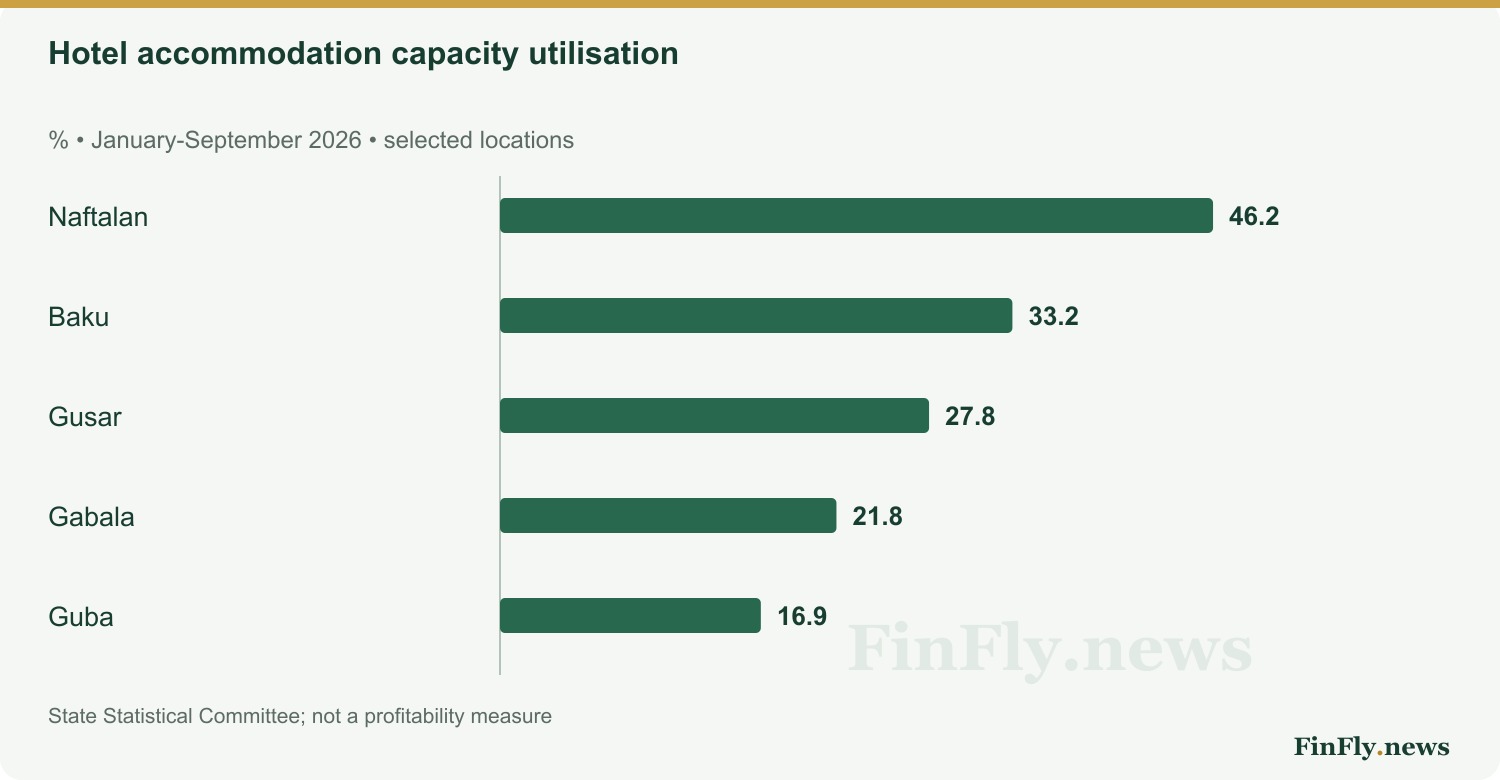
The capital remains the main hotel destination for foreign guests. But the scale of international demand is not the same as capacity utilisation. On the latter measure, Baku’s 33.2% was below Naftalan’s 46.2%.
Market share and utilisation have different denominators
The foreign-night share shows where overseas guests stayed. The utilisation of one-time accommodation capacity compares occupied places with available capacity over the period and includes more than foreign guests. It is not an average room rate or a measure of rooms sold at a particular tariff.
National capacity utilisation was 23%, down from 25% a year earlier. Gusar recorded 27.8%, Gabala 21.8% and Guba 16.9%. A smaller share of foreign demand can coexist with higher utilisation when the scale of supply or the mix of demand differs.
Domestic guests cannot be omitted. Azerbaijani citizens generated 1.394 million nights, or 43% of hotel nights nationwide. Foreign nationals and stateless persons accounted for 1.846 million, or 57%. Baku’s share of all hotel nights was 55.9%, substantially below its share in the foreign segment.
| Location | Share of foreign nights | Capacity utilisation |
|---|---|---|
| Baku | 81.4% | 33.2% |
| Naftalan | 5.4% | 46.2% |
| Gusar | 5.1% | 27.8% |
| Gabala | 2.8% | 21.8% |
| Guba | 1.3% | 16.9% |
Regional projects require a separate demand model
An investor cannot infer a shortage of hotels from a region’s foreign-demand share alone. Available bed capacity, seasonality, travel purpose, length of stay, room rates and operating costs all need examination. The published summary does not establish profitability for an individual property.
Naftalan’s figures illustrate that a specialised regional destination can combine high utilisation with a relatively small share of foreign nights. The table does not, however, establish which factor produced that outcome. Guest composition and the structure of accommodation supply would be needed to test the explanation.
The practical conclusion is to distinguish demand models. Baku benefits from the scale of international traffic; regional assessments must separately examine domestic travel and existing capacity use. Applying the capital’s model to every destination without that analysis would be risky.
Cover: an AI-generated editorial illustration by FinFly.news.