
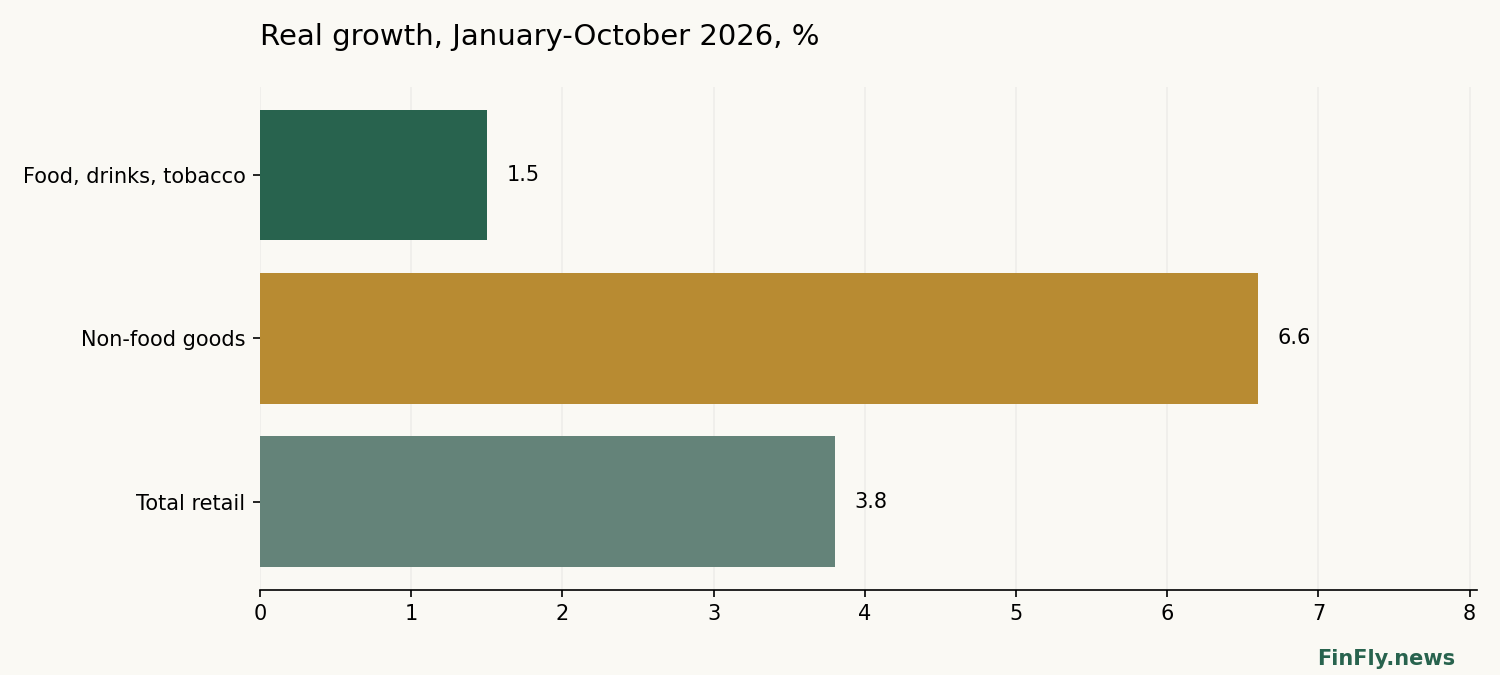
Azerbaijan's non-food retail sales rose 6.6% in real terms over ten months. Food, beverages and tobacco gained 1.5%, while total retail grew 3.8%, according to new official statistics.
| Indicator | Value |
|---|---|
| Food, drinks, tobacco | 1.5 |
| Non-food goods | 6.6 |
| Total retail | 3.8 |
An average covers different markets
For a retailer, where households spend matters as much as the size of their budgets. Grocery shopping and purchases of durable goods follow different cycles. Replacing a phone or furniture can change a household's monthly bill sharply; food purchases recur regularly.
Faster non-food growth therefore does not establish that every consumer is better off. The aggregate combines different products, locations and income groups. It shows the direction of demand, not how purchases are distributed among households.
Turnover is not the profit calculation
These are real growth rates, so inflation alone cannot explain the increase. Yet greater sales volume does not translate directly into higher profit either. Discounts, rent, delivery costs and inventory financing can change a store's financial result.
The practical implication is to base procurement on the retailer's own category rather than the headline figure. Larger inventories make sense where stock turnover and margins support them. Even a growing market can be difficult for an individual seller if goods move only after heavy discounts.