Rising remittances support recipients in Azerbaijan, but an increasing share of the gain depends on one corridor. FinFly calculates that Russia accounted for roughly two-thirds of the increase in incoming transfers in the first half of 2026. This strengthens the importance of foreign earnings and payment conditions for recipient households.
The CBA table on personal remittances records January-June inflows of $748.5 million, up from $534.0 million a year earlier, an increase of 40.2%. The series excludes capital transactions and covers six months, not the whole of 2026.
Where the inflows are concentrated
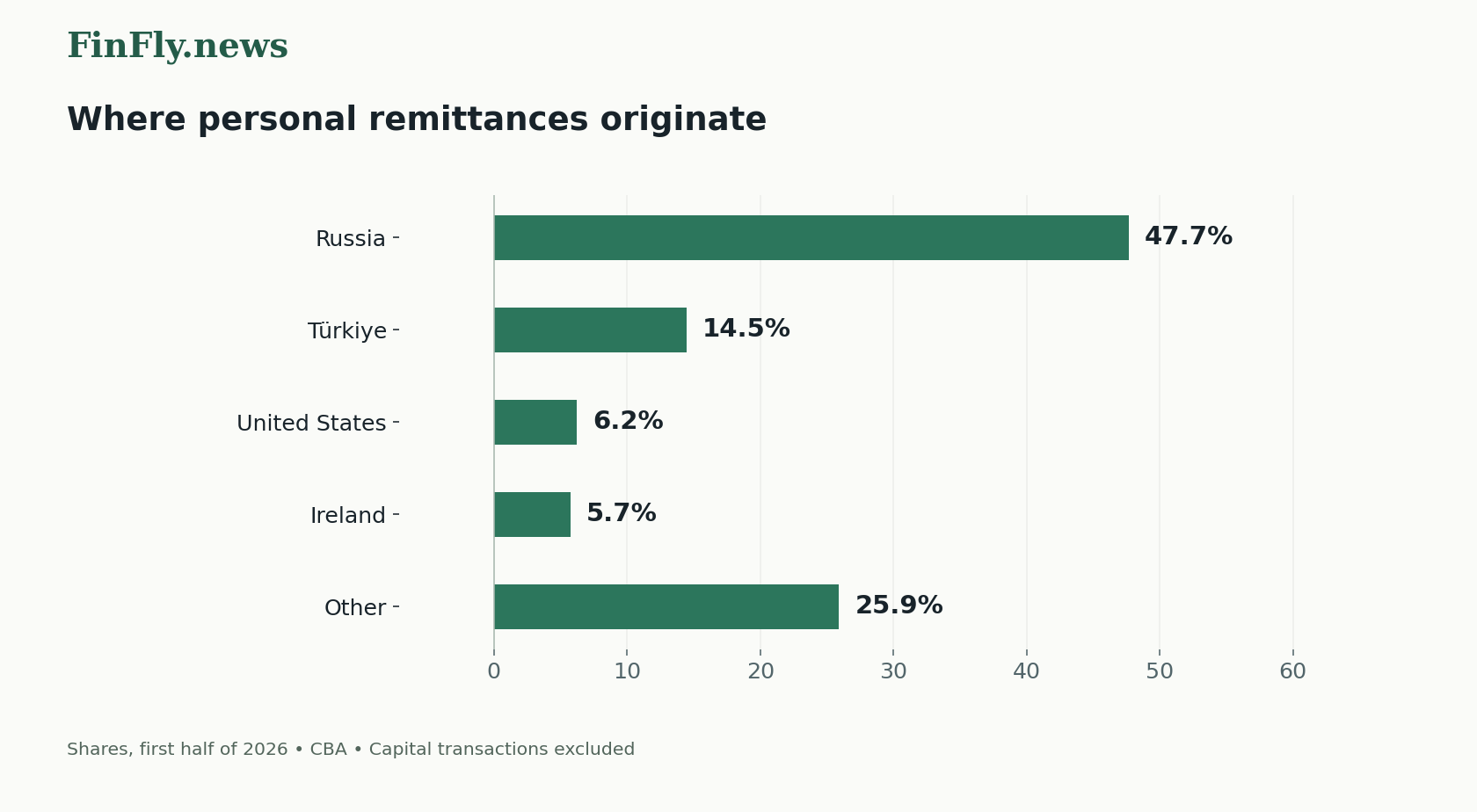
| Origin | First half 2026, USD million | Share |
|---|---|---|
| Russia | 356.7 | 47.7% |
| Türkiye | 108.3 | 14.5% |
| United States | 46.5 | 6.2% |
| Ireland | 43.0 | 5.7% |
| Other | 194.0 | 25.9% |
Growth alongside greater concentration
Russia’s share increased from 39.9% to 47.7%. The aggregate result has consequently become more dependent on one corridor. Additional funds can support recipients’ spending and savings, but the sources of the increase are unevenly distributed.
A country’s share of transfers does not establish senders’ nationality. Nor does the table identify their occupations, the purpose of each payment or its regularity. It cannot show that migrant wages explain the entire increase, or establish the income of an average recipient household.
How external exposure reaches a household
An individual sender’s employment and earnings, exchange rates, payment-channel availability and transaction costs can all affect transfers. Unchanged earnings in local currency can still produce a different amount after conversion. A service provider’s fee and exchange rate further affect the sum received.
These are potential transmission mechanisms, rather than demonstrated explanations for the current figures. Separating their contributions would require transfer currencies, sender counts and payment characteristics. The geographical table identifies concentration but cannot reconstruct every cause of the change.
Sensitivity to a single corridor
An illustrative calculation shows the scale of this exposure. If inflows from Russia fell 10% and all other origins remained unchanged, total incoming transfers would decline by about $35.7 million, or 4.8% of the half-year baseline. This is a constant-other-factors scenario, not a forecast.
Aggregate sensitivity does not describe every household. A recipient depending entirely on one overseas sender has much greater exposure. A household receiving no foreign transfers has no direct exposure, although changes in other households’ spending can affect local demand.
What businesses should watch
Retailers and service businesses need to understand the regularity of their customers’ income. A one-off increase in transfers may support major purchases, but incorporating it into a permanent sales plan requires evidence of persistence. Banks can assess the stability of receipts, while payment providers can improve cost transparency and access to alternative channels.
Higher remittances provide additional funds to recipients. Assessing resilience, however, requires more than a total and a growth rate: the diversity of payment origins matters too. The first-half figures show concentration increasing at the same time as overall inflows expanded.