
Two developments increased the non-oil share
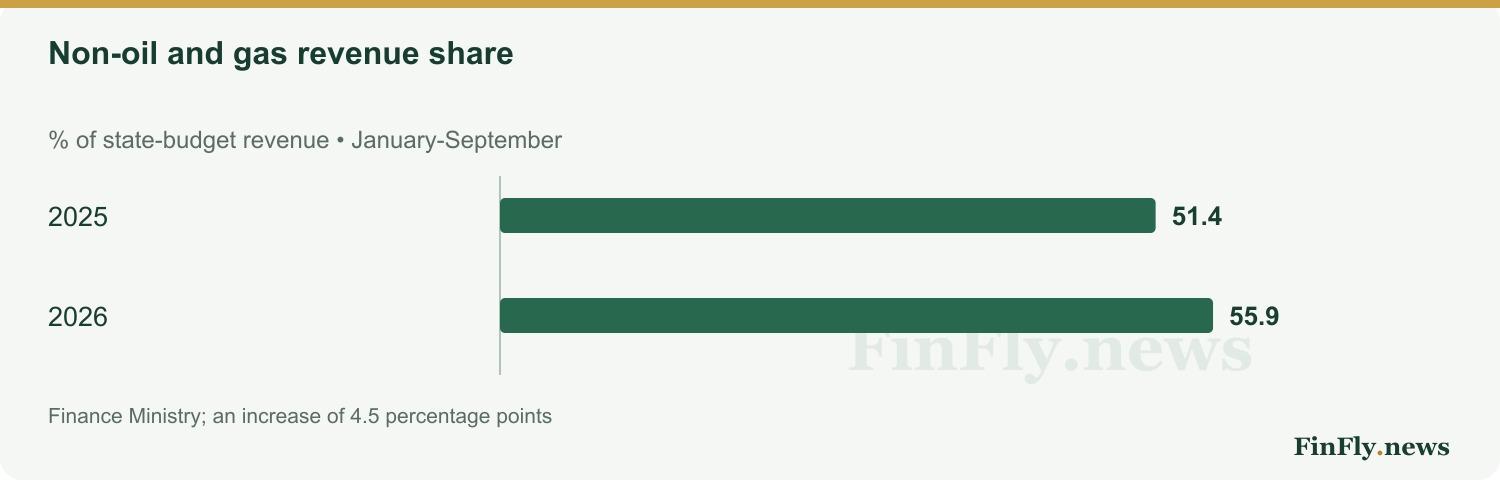
Azerbaijan’s non-oil and gas state-budget revenue reached AZN 16.381 billion in January-September. Its share rose to 55.9%, up 4.5 percentage points from a year earlier, according to the Finance Ministry’s detailed execution report. Receipts increased by AZN 1.388 billion, or 9.3%, in absolute terms.
At the same time, the State Oil Fund transfer fell by AZN 1.233 billion to AZN 9.628 billion, a decline of 11.4%. The higher non-oil share therefore reflects both stronger non-oil receipts and a smaller contribution from one of the budget’s largest oil-related funding sources.
Tax and customs receipts dominate the category
Tax authorities supplied AZN 10.328 billion of non-oil receipts and customs another AZN 4.973 billion. Their published shares add up to 93.4% of the category. Paid services of budget-funded organisations, state-property rent and other receipts make up the remainder.
Total receipts through tax authorities, AZN 13.630 billion, must not all be classified as non-oil: they include AZN 3.303 billion of oil and gas taxes. In this report, customs receipts are assigned entirely to the non-oil category.
This is a fiscal classification. Customs revenue can reflect the value and composition of imports, while non-oil taxes can be influenced by turnover, profits, tax rules and administration. Revenue growth alone cannot establish how much came from higher real production.
| Source | AZN million | Category share |
|---|---|---|
| Tax authorities | 10,327.9 | 63.0% |
| Customs authorities | 4,973.3 | 30.4% |
| Paid services | 543.2 | 3.3% |
| Other receipts | 493.7 | 3.0% |
| State-property rent | 43.2 | 0.3% |
Broader receipts do not remove indirect oil dependence
Oil and gas revenue remains substantial at AZN 12.931 billion, or approximately 44.1% of total receipts. The SOFAZ transfer accounts for 74.5% of that category, with oil and gas taxes providing the remainder. A smaller transfer does not mean oil-related financing has ceased to matter.
Non-oil activity can also have indirect links to the spending of oil wealth through public procurement, investment and household income. The report contains no model separating those effects. The defensible conclusion is that the direct non-oil revenue base has expanded, not that the entire economy has become independent of hydrocarbons.
Assessing durability requires full-year execution, individual tax performance and the composition of transfers. Non-oil receipts currently exceed the nine-month forecast by 1%, a useful additional benchmark beyond their share of total revenue.
Cover: an AI-generated editorial illustration by FinFly.news.