Azerbaijan’s insurance sector’s aggregate regulatory capital fell by AZN 69 million in the first half of 2026, reaching AZN 312 million. That is a decline of approximately 18.1% from end-2025. The Central Bank’s financial stability report attributes the reduction mainly to dividend payments.
The distinction matters: lower capital does not necessarily mean an operating loss. A company can earn a profit and then distribute more to shareholders than it retains within the business.
Capital still exceeds requirements
The Central Bank states that sector capital remains above prudential requirements. A smaller absolute buffer nevertheless means fewer own resources to absorb an unexpected deterioration, other things being equal.
The report contains a discrepancy in rounded required-capital figures: its chart shows AZN 204 million and its text AZN 205 million. No exact surplus is calculated here using one of those competing figures. Both presentations agree on aggregate capital of AZN 312 million.
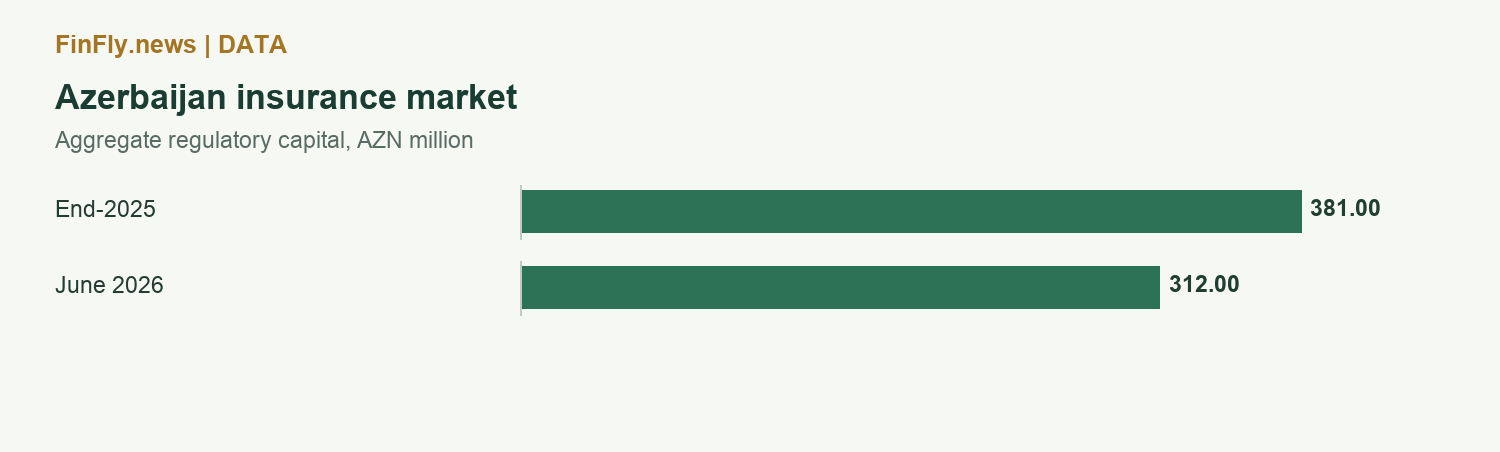
| Measure | End-2025 | June 2026 |
|---|---|---|
| Aggregate capital, AZN m | 381 | 312 |
| Insurance liquidity ratio, % | 325 | 237 |
Capital and liquidity serve different purposes
Capital absorbs losses; liquidity enables timely payments. The same report shows the insurance liquidity ratio declining from 325% at end-2025 to 237% by mid-2026. The regulator still describes liquidity as being in a comfortable range.
The two declines cannot be added together or treated as an identical problem. They do demonstrate why resilience cannot be assessed through profit alone. Positive earnings do not reveal how many resources remain within the system.
Dividend policy belongs in risk analysis
The balance between shareholder distributions and retained buffers matters. Insurers expanding their portfolios or accepting larger exposures may need more capital even with stable current earnings.
Aggregate statistics do not establish that every insurer has the same headroom. Assessing an individual company requires its own capital, regulatory requirements and risk profile. The sector remains above requirements overall, but its absolute capacity to absorb additional losses has become smaller.