
Headline spending growth conceals diverging priorities
Azerbaijan’s state budget allocated AZN 12.643 billion to socially oriented expenditure in January-September, up 14.9% year on year. Capital expenditure fell 10.1% to AZN 7.285 billion, according to the Finance Ministry’s preliminary execution report published on October 29. Total spending increased only 2.8% to AZN 25.348 billion.
The contrast matters for public-sector demand. Funding is expanding for salaries and social payments, while the aggregate trend is less favourable for businesses dependent on government capital orders. One headline spending-growth rate cannot describe conditions across individual sectors.
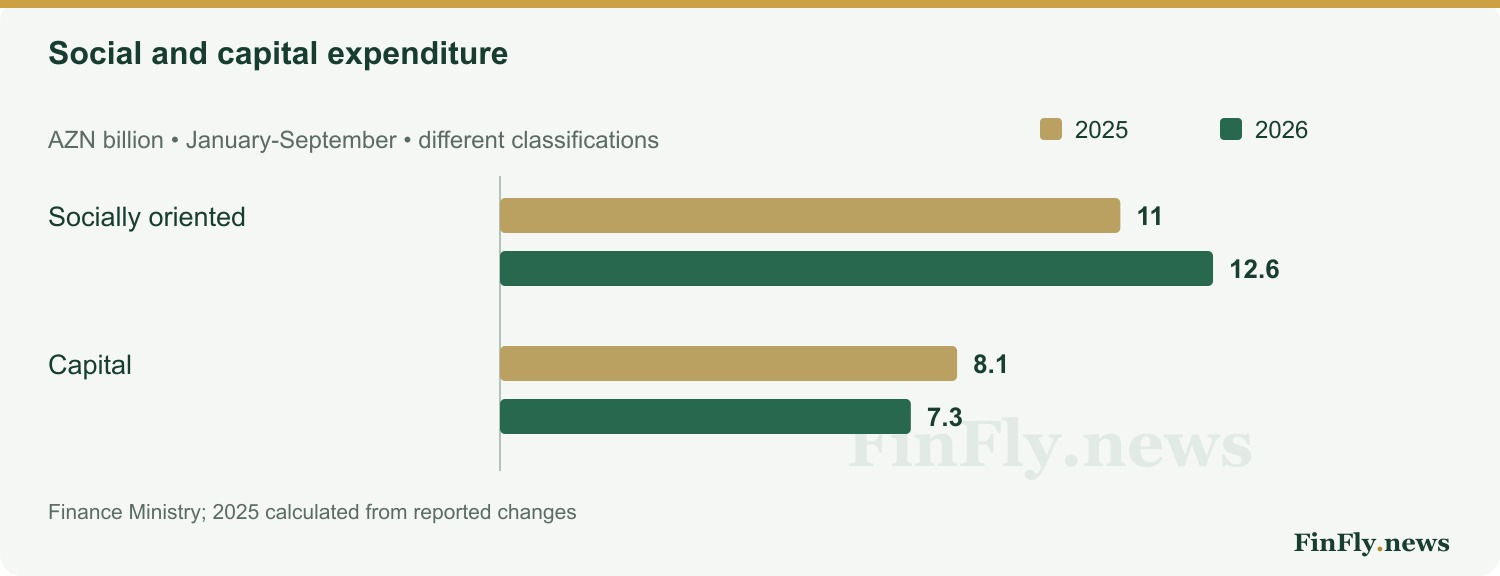
The classifications must not be added together
The ministry’s socially oriented category is broader than welfare benefits. It includes payroll, food purchases, scholarships and social benefits, medicines, dressings and compulsory health insurance. Together, these represented 49.9% of total expenditure.
A separate breakdown by the nature of spending reports AZN 16.614 billion of current expenditure, AZN 7.285 billion of capital expenditure and AZN 1.450 billion of debt service. Current spending increased 10.4%. Social spending overlaps with these classifications; it cannot be added to current expenditure or presented as an independent fourth component.
Compared with the previous year, socially oriented spending increased AZN 1.644 billion and capital expenditure fell AZN 820.3 million. Those changes do not prove that one category directly financed the other. Establishing a transfer would require evidence of appropriation decisions.
| Measure | AZN billion | Year-on-year |
|---|---|---|
| Total expenditure | 25.348 | +2.8% |
| Current expenditure | 16.614 | +10.4% |
| Capital expenditure | 7.285 | -10.1% |
| Socially oriented spending | 12.643 | +14.9% |
Execution and payment schedules matter for contractors
Lower executed capital expenditure does not necessarily mean cancelled projects. Construction stages, acceptance of completed work and payment schedules can all affect a nine-month result. The report does not separate those causes, so extrapolating the decline to the full year or to every contractor would be premature.
A government supplier should compare its order book with the relevant programme, execution stage and payment timetable rather than rely on aggregate budget growth. Similarly, the social-spending increase measures nominal financing, not an automatic 14.9% gain in recipients’ real incomes. Purchasing-power analysis also requires prices and the composition of beneficiaries.
Cover: an AI-generated editorial illustration by FinFly.news.