Portugal's real estate market is experiencing an unprecedented boom. By the end of 2025, the housing price index soared by 17.6%, recording the strongest annual growth in history. The trend continued into the first half of 2026: supply shortages, stable demand, and protracted bureaucratic procedures for obtaining construction permits continue to push the cost per square meter upward.
According to the National Institute of Statistics (INE), in April 2026 the average bank valuation of housing in the country reached €2,174 per sq m (+16.5% year-on-year). Meanwhile, prices quoted by sellers on the market are significantly higher: in May 2026, the analytical platform Idealista recorded an absolute historical maximum of €3,142 per sq m on average across the country.
Apartments vs. Villas
Market analysis shows that buyers are literally sweeping up multi-apartment stock. The secondary market is under tremendous pressure, causing apartments to appreciate almost twice as fast as detached houses.
- Apartments: median cost reached €2,546 per sq m, showing rapid annual growth of 21.0%.
- Villas and houses: increased more modestly by 12.7%, reaching €1,561 per sq m.
Regional Snapshot
The geography of prices remains unchanged: the epicenter of investment demand is Greater Lisbon, the resort Algarve, and dynamic Porto. In the capital, the cost per square meter has already crossed psychological thresholds. According to Idealista, the average asking price in Lisbon reached a staggering €6,124 per sq m, and in Porto €4,064 per sq m.
Official bank valuations (INE data for April 2026) also confirm the price gap in key regions:
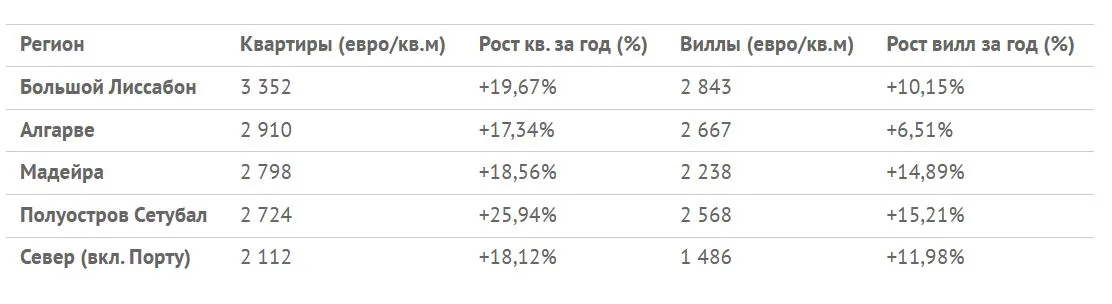
Anomaly of the month: The sharpest jump in apartment prices was recorded in the Western region and the Tagus Valley – a 26.22% increase year-on-year, indicating an active shift in demand to the suburbs due to the high cost of the capital.
A Cold Shower from the Bank of Portugal and OECD
Despite the rosy statistics for sellers and investors, regulators are beginning to sound the alarm. The Organization for Economic Co-operation and Development (OECD) directly states that the current price surge is a consequence of artificial regulatory barriers, the weak response of the construction sector to market needs, and excessively long approval times for new projects.
In turn, the Bank of Portugal, in its May report on financial stability, issued an official warning:
"A chronic supply shortage keeps prices at their peak, but housing affordability for the population is critically declining. Any further deterioration in macroeconomic indicators or financial conditions could trigger a sharp negative market correction."
What Lies Ahead for the Market?
Analysts at BPI Research believe that Portugal has found its price ceiling. The forecast for price growth for the remainder of 2026 has been revised down to 11.7%. Developers are expected to become more cautious in launching new projects, and purchasing power, constrained by tight limits, will force the market to gradually slow its rally after the historic record of recent months.