
Demand growth can produce contrasting financial outcomes within the same technology group. Samsung’s results illustrate why semiconductor success should not automatically be projected onto all consumer electronics.
For the third quarter of 2026, Samsung reported Device Solutions operating profit of KRW 106.5 trillion and a Device eXperience operating loss of KRW 0.8 trillion. Group operating profit was KRW 107.4 trillion. The company links memory performance to AI demand, product mix and capacity constraints.
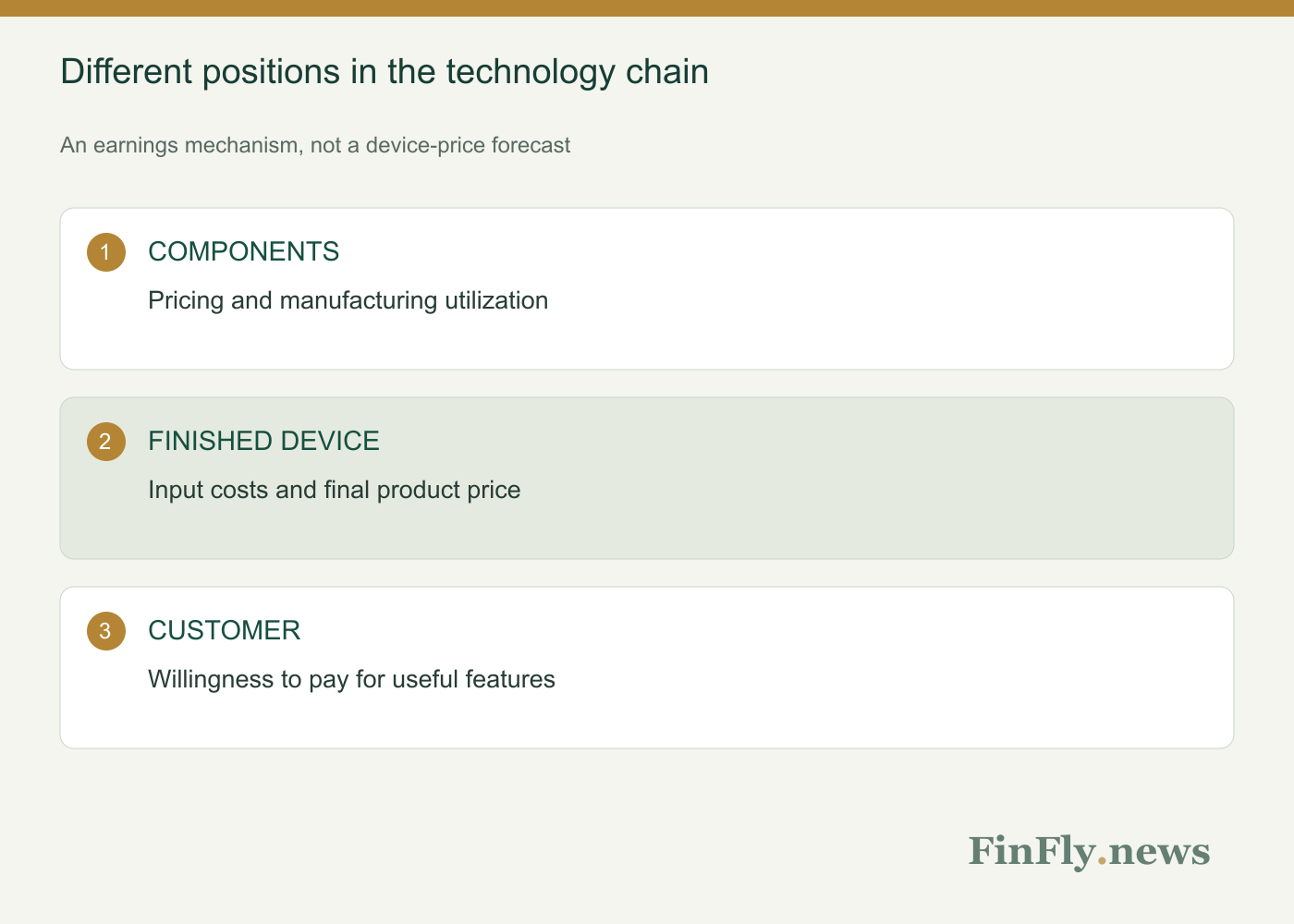
Components and finished devices have different economics
For the supplier of a sought-after component, constrained supply can create pricing power. For a finished-device manufacturer, that same component is an input cost. If customers will not accept a corresponding increase in the final price, device margins narrow.
This explains a value-chain mechanism, rather than establishing the precise cause of Samsung DX’s entire loss. Product mix, promotion, logistics and development spending may also contribute. Their individual effects require separate evidence.
Why selected segments are not a full reconciliation
DS and DX do not exhaust the group’s reporting perimeter. Consolidation can also involve intragroup eliminations. A difference between the sum of these two divisions and the group result is therefore not, by itself, an accounting error.
A more useful comparison keeps the measurement consistent: operating profit against operating profit, over the same quarter and in the same currency. A dollar conversion without a specified exchange rate would introduce another uncertainty, so the figures remain in won.
| Perimeter | KRW trillion | Result |
|---|---|---|
| Device Solutions | 106.5 | Profit |
| Device eXperience | −0.8 | Loss |
| Consolidated group | 107.4 | Profit |
Samsung. The two divisions shown are not a complete reconciliation of consolidated profit.
AI demand does not produce identical returns
Infrastructure suppliers, device manufacturers and application developers earn revenue at different points in the chain. More spending on compute can support the first group before end users are willing to pay more for the second or third.
Saying that a company benefits from AI is therefore incomplete without specifying the product, period and financial measure. One activity may record higher sales, another higher costs, and a third investment whose return is not yet established.
What procurement teams and distributors should watch
Businesses buying equipment need to examine delivery dates, configurations and price-lock terms. A manufacturer’s earnings release cannot establish the future retail price of a particular model in Azerbaijan: inventories, logistics and seller terms also affect that price.
The next substantive test is whether device profitability improves alongside the component business. Until then, Samsung’s results are better read as evidence of uneven earnings distribution within a technology group, rather than a uniform expansion across all of its markets.
