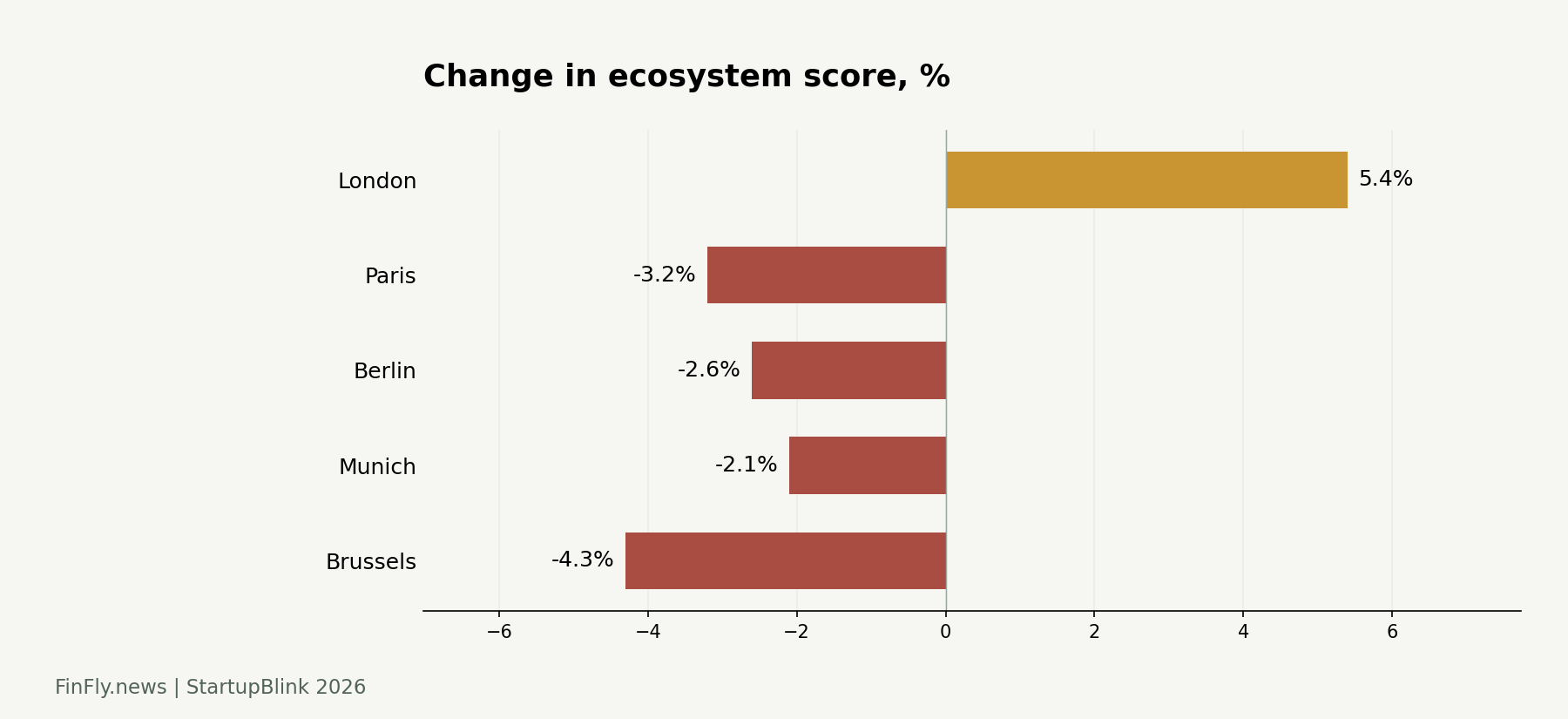
Paris and Berlin recorded score declines of 3.2% and 2.6% in the StartupBlink Global Startup Ecosystem Index 2026. They rank ninth and fifteenth globally. Weakness in major established hubs coexists with positive performance elsewhere in Europe.
London remained third and increased its score 5.4%, while Munich declined 2.1%. The selection illustrates different city trajectories rather than Europe’s average performance.
| Ecosystem | Global rank | Score | Score change, % |
|---|---|---|---|
| London | 3 | 197.557 | 5.4 |
| Paris | 9 | 79.215 | -3.2 |
| Berlin | 15 | 58.694 | -2.6 |
| Munich | 40 | 27.606 | -2.1 |
| Brussels | 75 | 12.76 | -4.3 |
Scale can sustain a high position
Paris remains in the global top ten despite its decline. Accumulated scale allows leading cities to retain high positions during weaker periods. Repeated declines in later editions could gradually alter the balance.
The aggregate score does not identify the specific companies or transactions responsible. Attributing the changes solely to financing costs, regulation or relocation requires additional evidence.
Europe is not one trajectory
Other European hubs improved in the same edition. That limits any claim of a uniform regional ecosystem crisis. City and industry comparisons are more informative.
London’s score remains roughly 2.5 times Paris’s, but this does not measure a corresponding difference in revenue or available financing.
Implications for market screening
Foreign teams can treat negative momentum as a reason to investigate current conditions, not an automatic reason to exclude a location. Customer demand, relevant investors, hiring and operating costs require direct evidence.
Several established hubs have weaker scores while retaining substantial scale. Persistence and sector differences matter more than a conclusion about all of Europe drawn from two capitals.