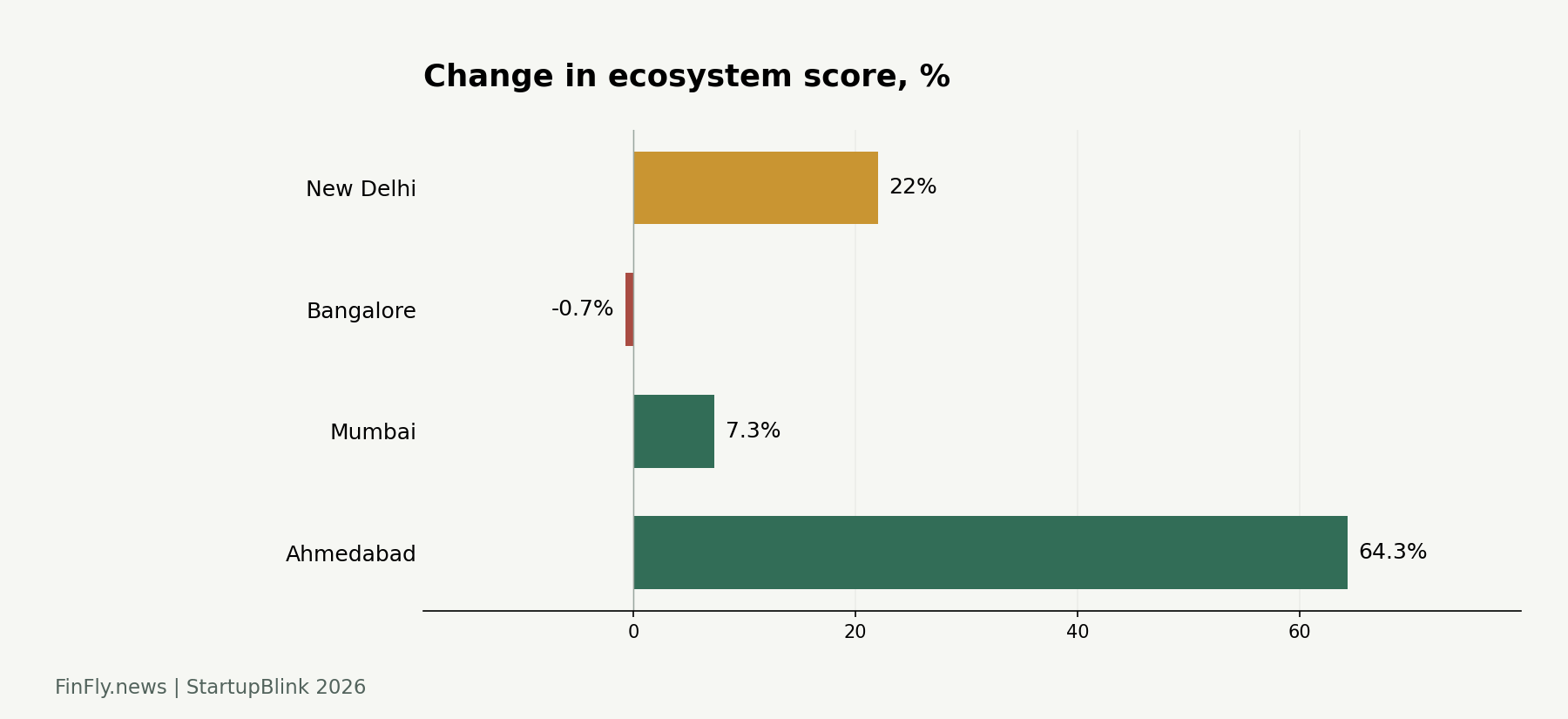
New Delhi ranks 11th in the StartupBlink Global Startup Ecosystem Index 2026, ahead of Bangalore, which slipped to 12th. Their scores remain close, but momentum differs: Delhi gained 22% while Bangalore declined 0.7%.
Mumbai ranks 19th with 7.3% growth. Ahmedabad climbed 43 places to 89th as its score increased 64.3%. India’s changing geography therefore extends beyond its two leading hubs.
| Ecosystem | Global rank | Score | Score change, % |
|---|---|---|---|
| New Delhi | 11 | 78.491 | 22 |
| Bangalore | 12 | 77.022 | -0.7 |
| Mumbai | 19 | 51.99 | 7.3 |
| Ahmedabad | 89 | 10.806 | 64.3 |
A narrow gap at the top
Delhi’s score of 78.491 is around 1.9% above Bangalore’s 77.022. Relevant sector expertise can matter more to a company than this narrow overall gap.
Bangalore’s negative growth does not erase its technology base: it remains twelfth globally. The index describes changes in relative ecosystem performance rather than the quality of every team operating in a city.
Growth in the next tier
The report places 11 Indian cities in the global top 200, with eight improving their positions. Kolkata, Jaipur, Chandigarh and Surat are among the locations showing notable progress.
High growth in smaller centres requires attention to the starting base. Ahmedabad’s score is still more than seven times smaller than Delhi’s. Momentum broadens the shortlist without removing differences in scale.
Match the location to the task
Development work, technology partnerships and sales expansion require separate city comparisons. India’s national rank does not establish staffing costs, specialist availability or demand for an individual product.
The main result is a wider map for initial screening. Delhi and Bangalore remain closely matched leaders, while the expanding group behind them supports looking beyond the best-known locations.