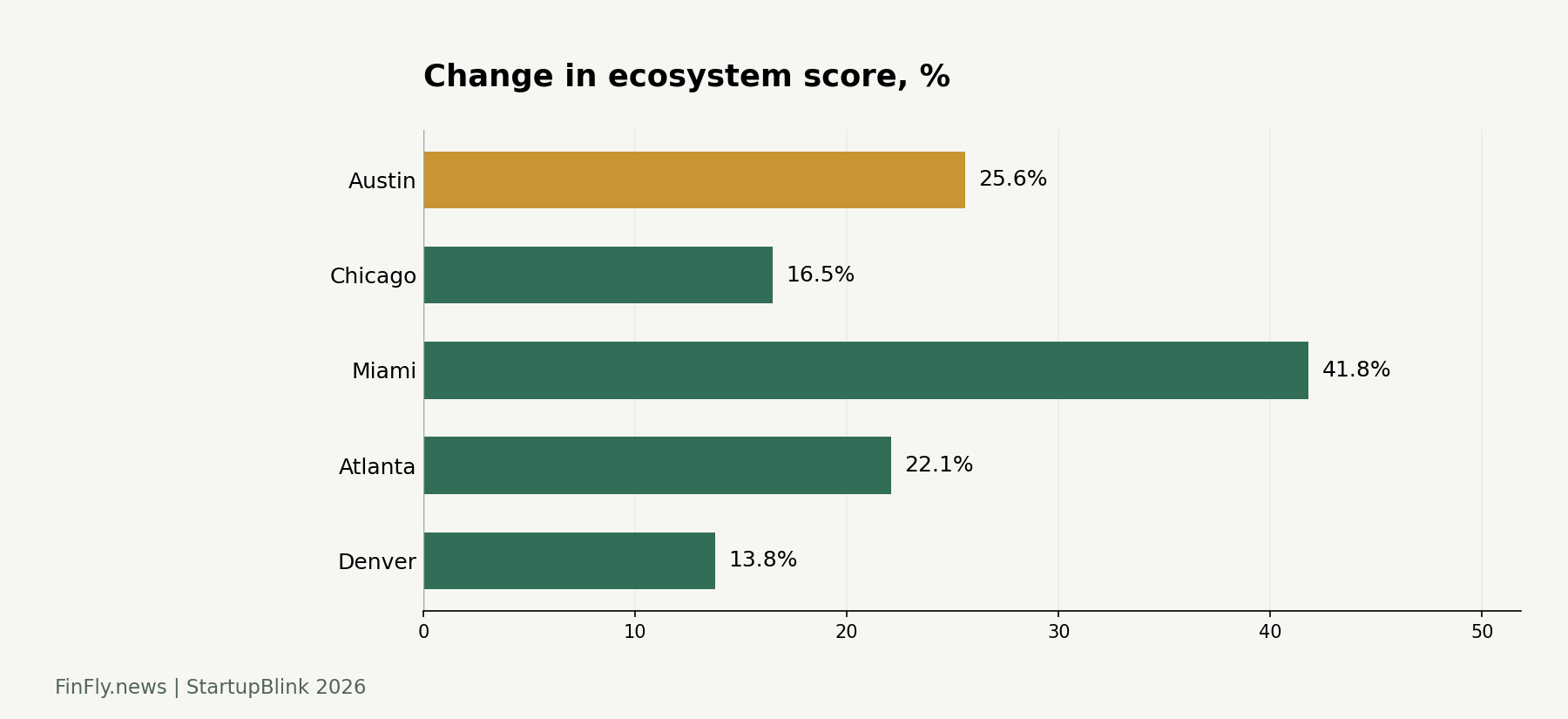
Austin climbed to 14th globally and entered the US top five for the first time in the StartupBlink Global Startup Ecosystem Index 2026, with 25.6% score growth. Miami gained six places to 22nd, increasing its score 41.8%.
Chicago, Atlanta and Denver also improved their scores in this selection. The table compares growing hubs outside the largest technology centre rather than presenting the full US ranking.
| Ecosystem | Global rank | Score | Score change, % |
|---|---|---|---|
| Austin | 14 | 64.342 | 25.6 |
| Chicago | 17 | 55.975 | 16.5 |
| Miami | 22 | 49.473 | 41.8 |
| Atlanta | 29 | 38.454 | 22.1 |
| Denver | 31 | 33.062 | 13.8 |
A broader pattern of progress
All 11 US cities in the global 21-50 tier recorded positive growth, averaging 19.2% according to the report. That describes the selected tier, not the growth rate of the entire US startup economy.
The United States has 33 cities in the global top 100. Its geographical breadth differs from markets where ranked activity is concentrated in one capital.
Scale and specialisation
Austin’s total score exceeds Miami’s despite slower growth. This separates the size of an ecosystem from its rate of change.
Neither measure automatically identifies the best location for a product. Sector customers, suitable investors and specialist talent are unevenly distributed and need separate verification.
A wider shortlist
Foreign teams can use the broader map to build several US expansion options. Actual costs, customer relationships and sales organisation should guide the comparison, alongside ecosystem strength.
Austin’s and Miami’s momentum does not overturn the leading hubs. It supports searching for partners and opportunities beyond Silicon Valley and New York.