
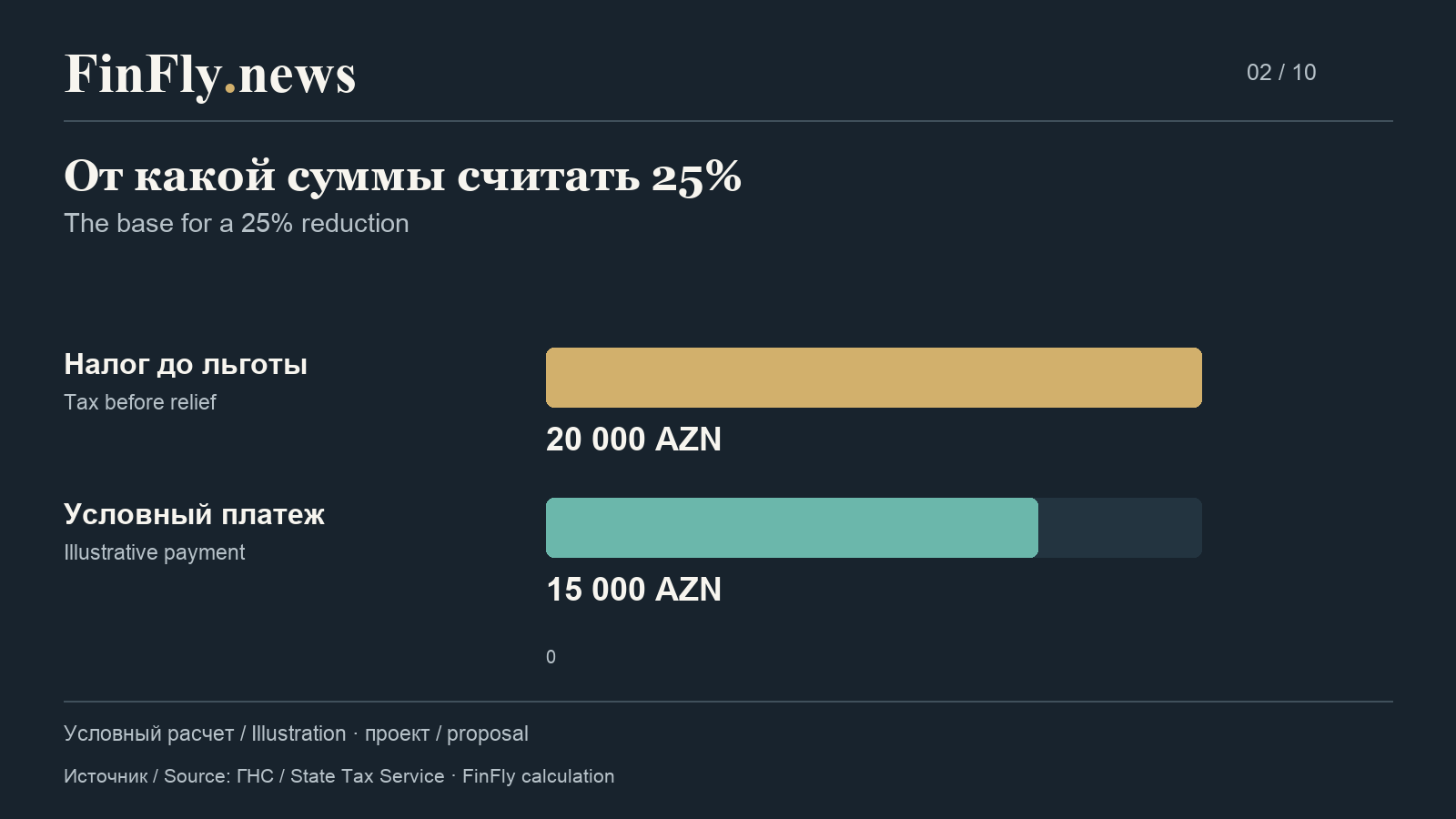
Azerbaijan's proposed small-business relief would reduce income or profit tax, not take 25% off a company's sales. The State Tax Service outlined the proposal on November 24: a five-year reduction equal to 25% of the relevant tax. Conditions include at least two years in the small-business category, no tax debt, a turnover decline no greater than 30% year on year and no labour-relations violations during the tax year. This remains a proposal.
Calculate the correct amount
In an illustrative FinFly calculation, assessed tax is AZN 20,000. If the proposal becomes law and all conditions are met, the reduction would be AZN 5,000, leaving AZN 15,000 payable. If assessed tax is AZN 4,000, the same percentage produces a saving of AZN 1,000. Sales alone do not determine the benefit.
Maintain the current legal obligation in the base budget and show possible relief as a separate scenario. Committing to equipment purchases using an unapproved tax saving creates a cash risk, particularly if the adopted conditions differ from the proposal.
Monitor the turnover test
For a business with previous annual turnover of AZN 500,000, a 30% decline takes turnover to AZN 350,000. That is the arithmetic threshold in the published condition, not an assurance of eligibility. Other criteria still matter, and the enacted text will determine the final rules.
The finance team can already reconcile business classification, tax balances, employment documentation and comparable turnover figures. Higher sales do not offset failure to meet another condition. Differences between management accounts, tax returns and staff records should be identified before relying on the relief.
Keep the benefit in perspective
FinFly's assessment is that a tax reduction can leave more cash inside a qualifying business, but cannot repair weak gross margins or late customer payments. Compare the potential saving with investment needs and liquidity reserves. As checked on November 26, the cited explanation describes draft changes; adjust actual payments only after adoption and a company-specific eligibility review.