
A pension can rise while remaining substantially below earnings from work. There is no contradiction: the increase in a payment and its size relative to wages answer different questions.
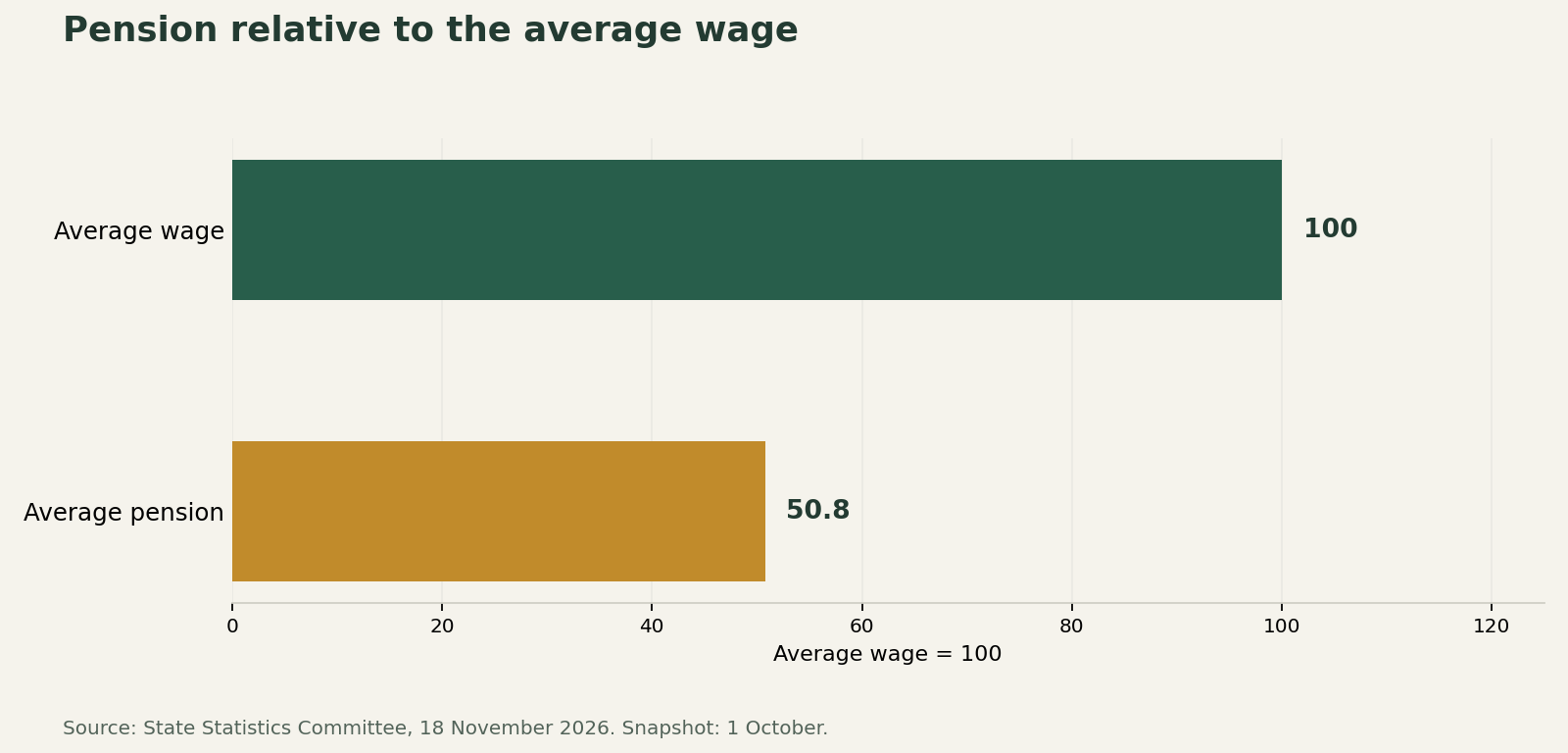
The State Statistics Committee's 18 November release puts Azerbaijan's average assigned pension at AZN 595.8 as of 1 October, up 10.3% year on year. It equals 50.8% of the average wage.
What half a wage actually means
This compares two averages for different groups. It does not establish that an individual will retain exactly half of their previous earnings after retirement. Their outcome depends on their contribution history, accumulated pension capital and the rules applicable to their entitlement.
Three questions behind the headline
| Question | What to examine |
|---|---|
| How much did the payment increase? | Its nominal amount and growth |
| What can it buy? | Prices of the goods and services the household uses |
| What happens to personal income? | An individual pension estimate and regular expenses |
A larger bank payment does not mean an equal improvement in purchasing power. A household's own spending basket matters: food, medicines and utility bills. If those items become more expensive, headline inflation may not fully reflect the household's experience.
Turning the comparison into a household budget
Start with essential expenses and compare them with expected recurring income. For example, if housing and treatment absorb most of that income, even a small unexpected bill can be difficult to cover. This is an illustrative situation, not a claim about every pensioner.
Irregular spending also belongs in the calculation. Repairs, support for relatives and replacement appliances may not occur every month. Leaving them out can nevertheless produce an unrealistically comfortable budget.
The release provides a benchmark for public discussion rather than an individual retirement forecast. Assessing adequacy requires the distribution of pensions, household composition and spending patterns as well as average amounts.