
A stable exchange rate makes planning easier, but does not itself create factories or jobs. For businesses, the distinction matters: a predictable currency removes one uncertainty while demand, costs and productivity remain separate challenges.
The ING report dated 17 November places support for the manat from sovereign assets alongside constraints on growth from oil production and limited diversification.
A financial buffer is not a new income stream
Accumulated assets can help absorb a temporary revenue shortfall. Having that buffer does not automatically mean the economy produces more goods. Total sovereign assets should not be equated entirely with the central bank's liquid foreign-exchange reserves: different funds have different owners, investments and availability.
| Objective | What helps | What it cannot guarantee |
|---|---|---|
| Absorb a currency shock | Accessible foreign-currency funds | Continuously rising income |
| Increase production | Equipment, skills and demand | Rapid payback |
| Expand exports | Competitive products and market access | Sales from currency stability alone |
Why price does not replace volume
Consider a hypothetical exporter. If its selling price rises by 10% while the volume sold falls by 10%, revenue becomes 1.10 × 0.90 = 0.99 of its original level. The two changes do not cancel out completely.
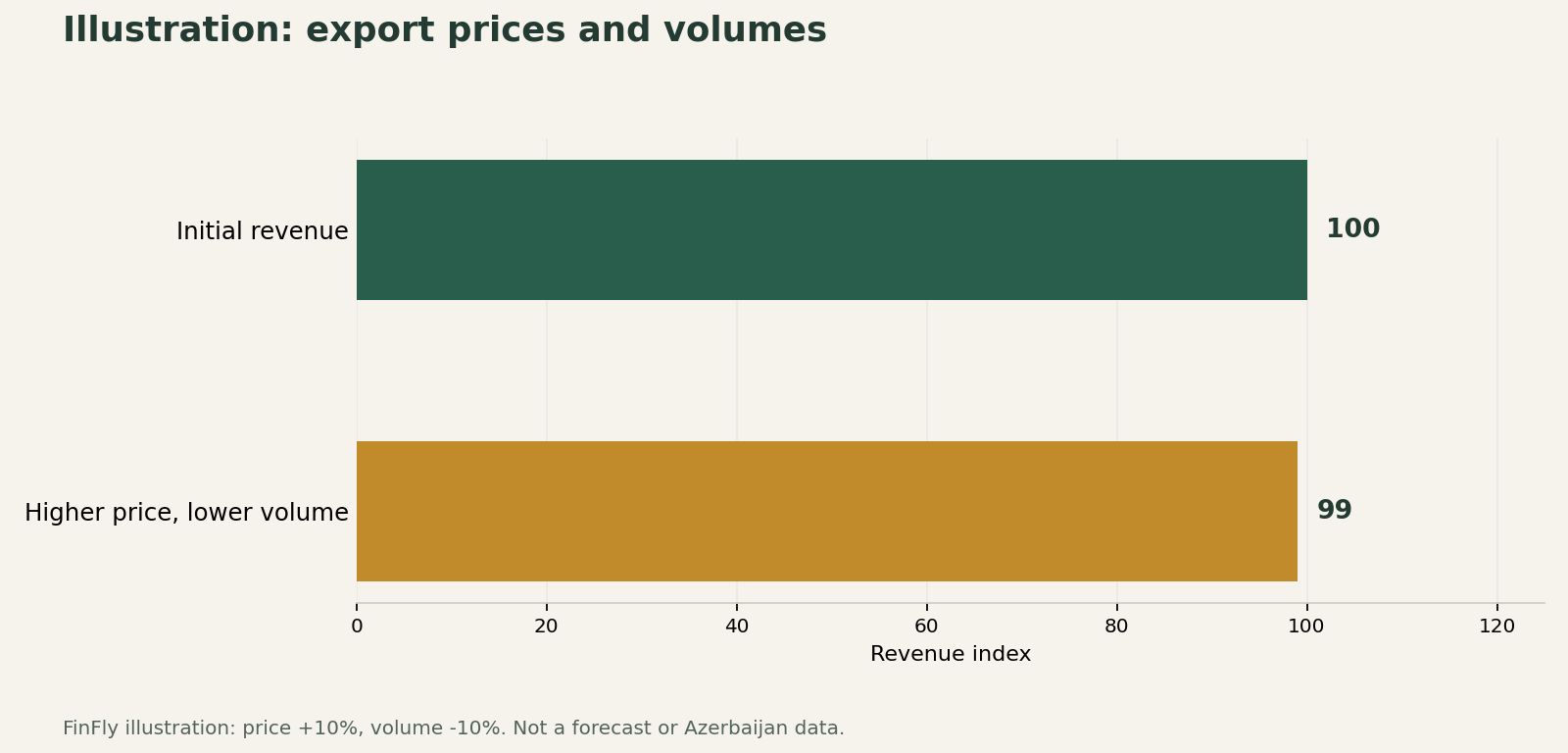
This is an arithmetic illustration, not an estimate of Azerbaijan's oil receipts. It shows why an export assessment needs both prices and physical volumes.
What businesses should examine
An importer needs to consider supplier prices, freight, financing costs and the speed at which inventory sells, alongside exchange rates. A fixed currency does not freeze those other expenses.
A producer faces a different question: can it make a competitive product and sell beyond its home market? Quality, unit costs, logistics and access to buyers determine the answer. Currency resilience and non-oil business development therefore require separate assessments. The former helps planning; the latter creates additional sources of earnings.