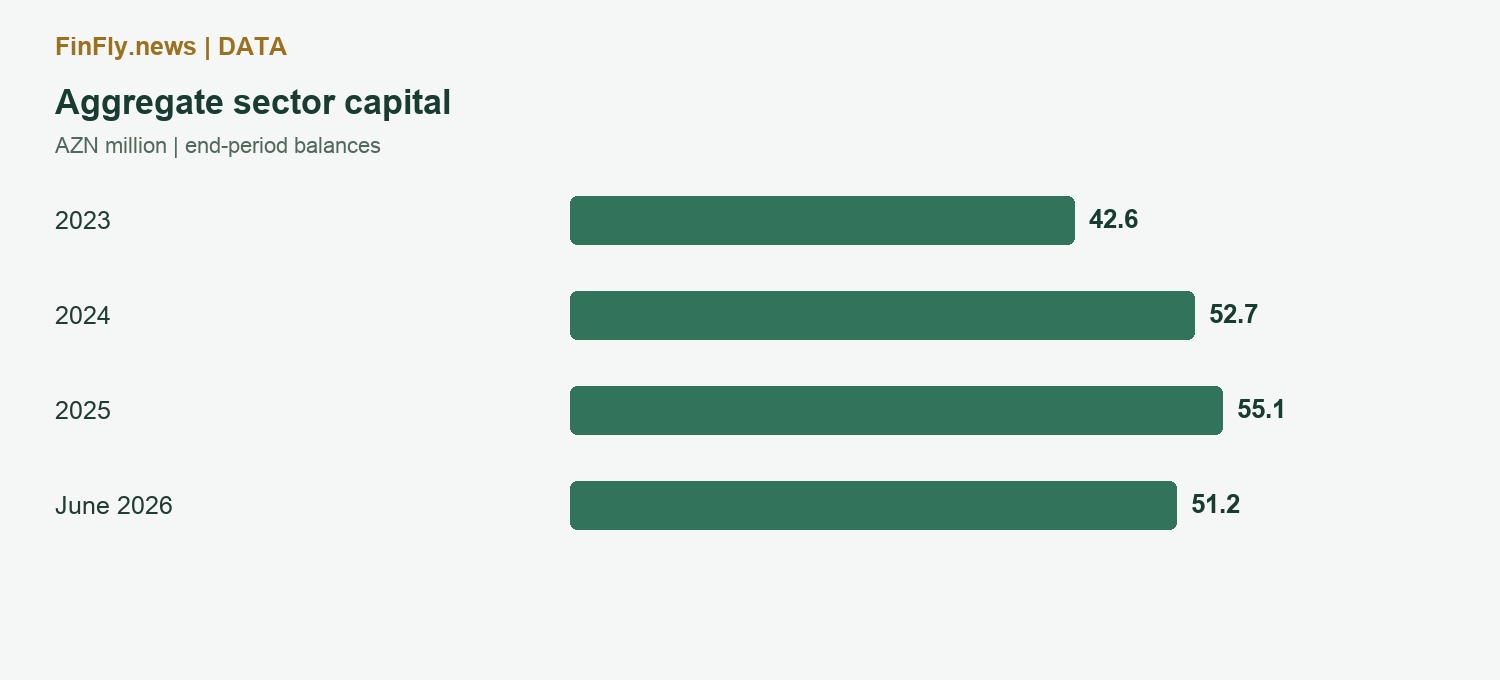
At mid-2026, investment firms held AZN 51.2 million in aggregate capital against an AZN 8.7 million requirement. Coverage remained high but was lower than at end-2025.
Capital above the requirement
The CBA report for the first half of 2026 puts aggregate sector capital at AZN 51.2 million against a requirement of AZN 8.7 million. Dividing the two gives coverage of approximately 5.9 times, with AZN 42.5 million above the requirement.
This is a sector-wide calculation. It does not reveal how capital is distributed among firms or establish that every company has the same cushion. The regulator describes the aggregate capital position as comfortable.
The buffer narrowed from both directions
At end-2025, aggregate capital was AZN 55.1 million and the requirement AZN 7.4 million. Capital fell by AZN 3.9 million over the first half while the requirement rose by AZN 1.3 million. Coverage declined from roughly 7.4 to 5.9 times.
Capital above the requirement decreased from AZN 47.7 million to AZN 42.5 million, around 10.9%. That is a reduction in a substantial surplus, not evidence of a regulatory breach. This section does not explain individual firms’ capital movements.
| Measure, AZN m | End-2025 | June 2026 |
|---|---|---|
| Aggregate capital | 55.1 | 51.2 |
| Requirement | 7.4 | 8.7 |
| Surplus | 47.7 | 42.5 |
| Coverage, times | 7.4 | 5.9 |
Capital is not a liquidity test
Capital absorbs losses but does not by itself show how quickly a company can meet its obligations. Asset composition, liability maturities and available cash also matter.
A high aggregate ratio is therefore not a reliability ranking for individual brokers. Such a comparison would require company accounts on consistent reporting dates. The CBA data support a narrower conclusion: the sector retains substantial capital above requirements, but the cushion has become smaller.