Assessing Binance after the breach requires more than checking customer-asset backing. It also requires understanding how replacement assets were financed and what resources remain available for other risks.
In its October 31 statement, Binance listed SAFU, its own resources and part of the Futures Insurance Fund as funding sources. It says the remaining futures fund exceeds its required protection level and will be replenished when necessary.
Reserves can serve different purposes
The size of a reserve matters, but so does its purpose. Money allocated against one class of loss cannot automatically be counted as additional protection against another. In a simultaneous stress event, demands can arise in several places.
Reallocation does not, by itself, demonstrate inadequate protection. Establishing that would require the remaining fund balance, open-position exposure, collateral composition and comparable stress-test results. The amount transferred alone cannot settle the question.
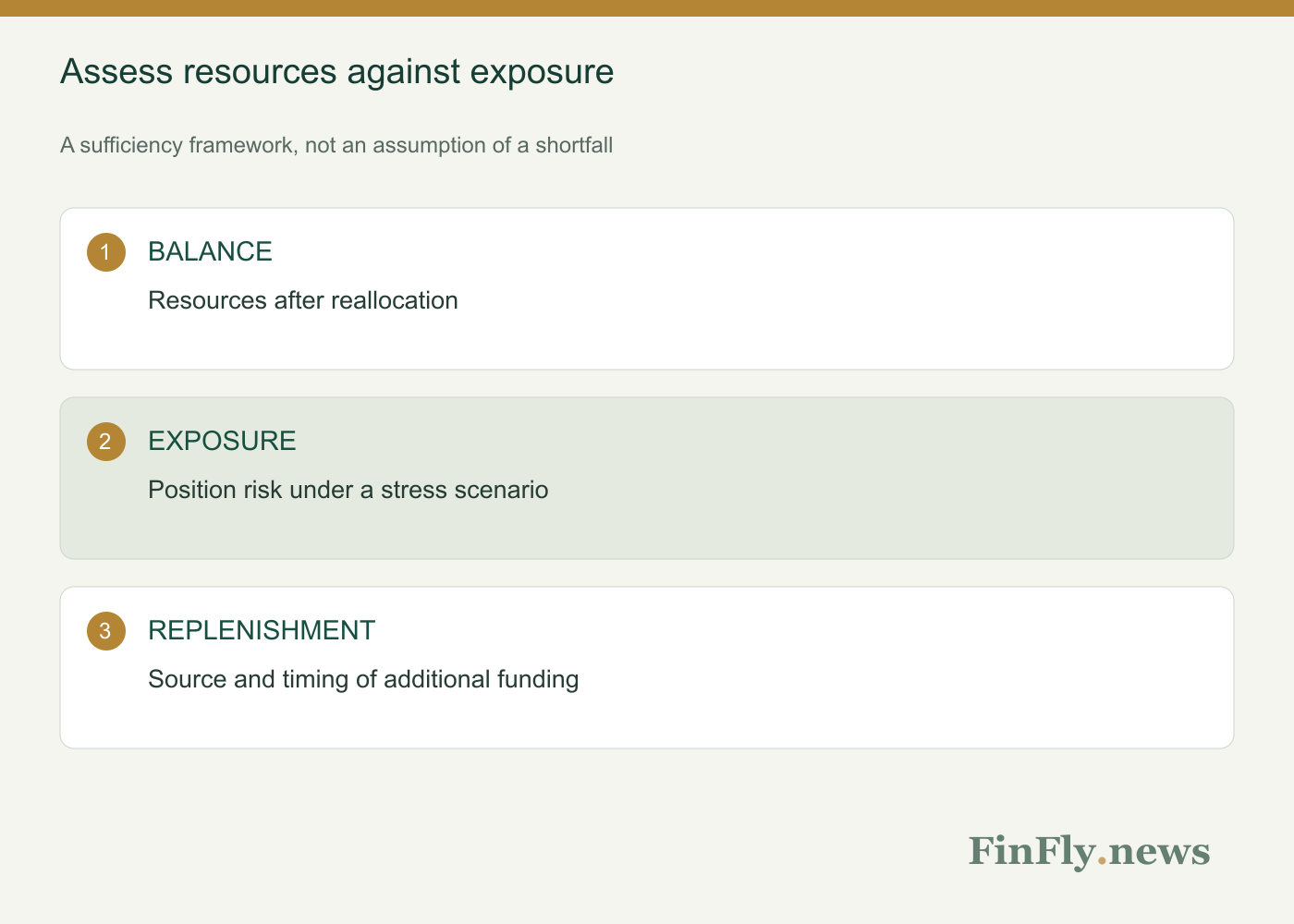
Why proof of reserves is not the whole assessment
Binance states that the Futures Insurance Fund is outside Proof of Reserves. Confirmation of backing for customer balances therefore cannot substitute for an assessment of the resources supporting futures risks.
The analytical trap is double counting: treating the same resource as both already deployed to cover a loss and still available as future protection. A sound reconciliation must identify the date and purpose of each amount.
| Object | Question to assess |
|---|---|
| Customer balances | Do available assets match the relevant liabilities? |
| Loss-replacement resources | Where did funding come from, and has transfer completed? |
| Futures risk fund | Is the residual balance sufficient for current exposures? |
FinFly assessment framework. This table does not establish a Binance shortfall.
The loss scenario matters more than the fund’s label
In a derivatives market, losses can grow while a position is being closed. Required protection therefore depends not only on contract value, but also on price moves, available liquidity and concentration of exposures.
Consider a hypothetical portfolio whose potential uncovered loss doubles. An unchanged fund would provide less protection relative to that risk. The reverse can also hold: a reduction in risky positions can lower the reserve requirement. This is why the balance cannot be assessed in isolation.
What meaningful disclosure would add
Useful disclosures would include balances before and after reallocation, the amount moved, replenishment rules and an explanation of the stress scenario used. Together they would allow comparison of both financial resources and the risks those resources are intended to absorb.
The conclusion remains limited: Binance has disclosed using a separate protective resource and says the remaining balance is adequate. We do not have an independent stress test confirming or rejecting that assessment. Neither inevitable trading losses nor a guarantee of zero risk follows from the statement.